 By
Reaching investors on LinkedIn means using the platform to land in front of the one partner who funds companies like yours, then earning a short reply. It’s a targeting job, not a broadcast. Most founders treat it as a numbers game and fire the same note at 200 VCs. That’s why the direct message to a partner gets under a 1% reply (EasyVC, 2026). The founders who get meetings do the opposite. They pick fewer names, qualify each one, and write like a human who did the homework.
Can you find investors on LinkedIn?
Yes, you can find investors on LinkedIn, and most active angels and VC partners keep a profile there. They post deal memos, share what they’re looking for, and scout founders between meetings. A lot of relationships start here, and they’re warmer for it.
The catch is that everyone else knows this too. A partner who leads your stage can see dozens of cold pitches a week, so their inbox is a wall of founders all saying roughly the same thing. We watch founders treat LinkedIn like a slot machine, and it pays out like one.
So the question isn’t whether investors are there. It’s whether you can get the right one to stop scrolling.
Why do cold LinkedIn messages to VCs get ignored?
Cold LinkedIn messages to VCs get ignored because partners receive far more pitches than they can read, and a generic note signals you never targeted them. Direct messages to VC partners convert under 1% of the time (EasyVC, 2026). The partners with the biggest followings give the worst odds of all.
The reply rate isn’t low because LinkedIn is broken. It’s low because the message looks like the other forty. In the outreach we help founders set up, the notes that die share one tell: they could have been sent to anyone.
A message that could go to any investor gets deleted by every investor.
Fix the signal and the channel starts working. That means fewer names, better chosen, with a reason attached to each one.
Find the right investors before you message anyone
Finding the right investors on LinkedIn starts with a short qualified list, not a hunt for everyone with “VC” in their title. The same targeting discipline that makes a cold email list work makes LinkedIn work, because the channel changes but the homework doesn’t. We walk through that list-building in detail in how to find investors for a startup.
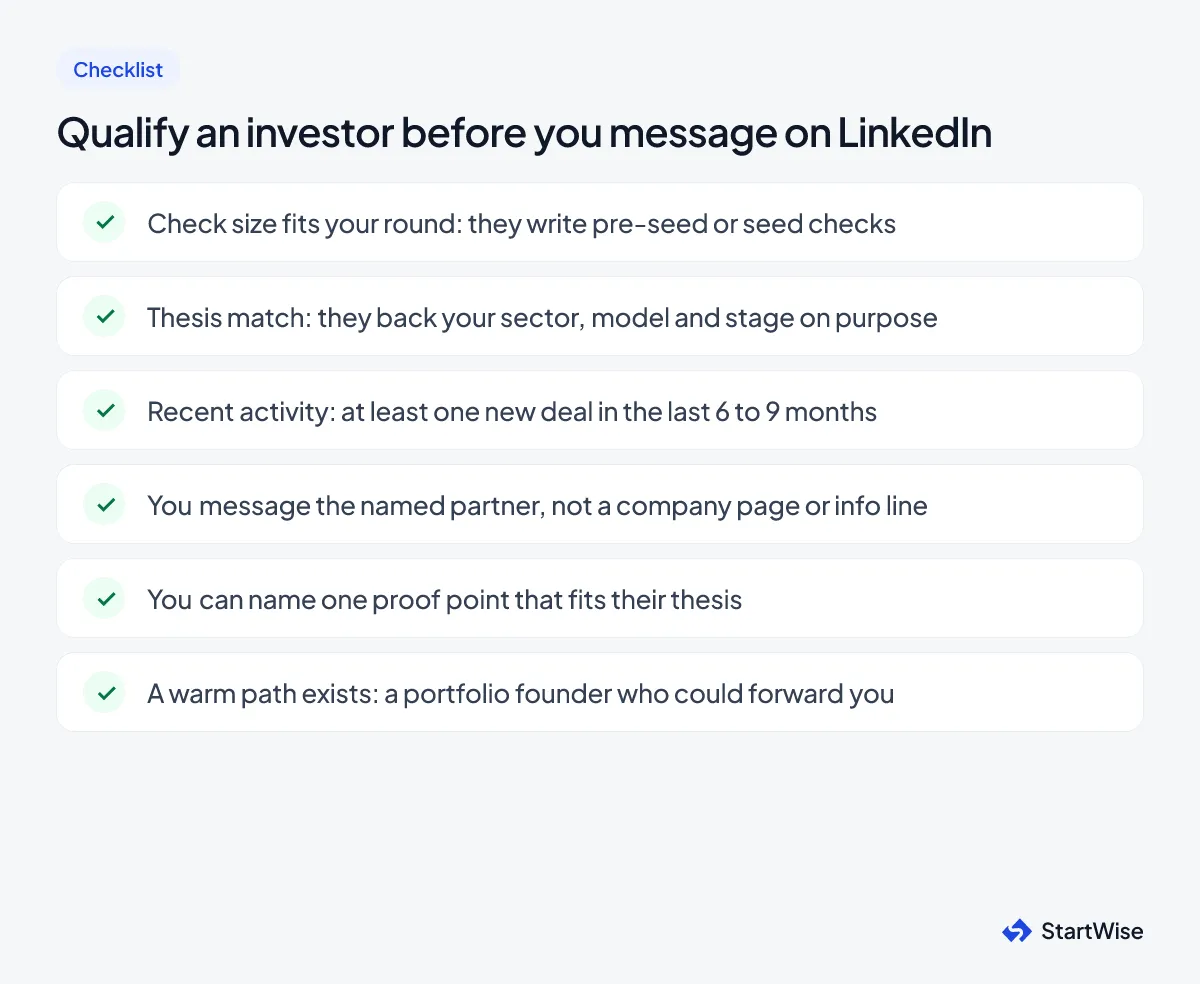
Search by role and keyword, then filter. Sales Navigator narrows by title, company, geography and recent activity, so you can build a list of partners who actually write checks at your stage. Follow the funds you want, read the partner’s recent posts, and note what they say they back.
Then qualify before you type a word.
Angels are often easier to reach than fund partners, because they manage their own inbox and answer for themselves. Search “angel investor” plus your sector, look at who has backed companies near your stage, and prioritize the ones posting this month. If you need a lead for a priced round, that’s a different search again, covered in how to find a lead investor.
What should your first LinkedIn message to an investor say?
Your first LinkedIn message to an investor should be short, personal, and built around one proof point with a low-friction ask. The data backs the instinct: personalized connection requests hit about 45% acceptance versus 15% for generic ones, a 3x gap (Expandi, 2026). Notes under 100 characters do best, and if you’re not sure what to write, a plain request with no note now beats a long one.
Here’s the anatomy I’d use on every target:
- Open with the specific reason you picked them: a recent deal, a post, a line from their thesis.
- Add one line of traction that fits what they back, a slope rather than a vanity total.
- Make a small, clear ask: 20 minutes, or permission to send a one-pager.
- Keep the connection note under 100 characters, or send none and lead in the first message after they accept.
Say it the way you’d say it out loud to a friend who happens to run a fund. If you wouldn’t send the line to a person you respect, don’t send it to a partner.
A personalized note only works if it reaches the partner who funds your stage. StartWise finds that named partner for each fund and verifies the email before you send.
The portfolio-founder path that converts better than cold DMs
The portfolio-founder path means messaging a founder the investor already backed, instead of the investor, and earning an introduction from them. Those connections convert at 7 to 13% into a warm intro (EasyVC, 2026), because a founder who likes your product will forward it, and a forward from a portfolio company reads nothing like a cold note.
The math is blunt, and it isn’t in your favor at volume. EasyVC, citing DocSend, notes the average founder contacts 58 investors and takes 40 meetings to close a seed round, so the channel that turns one accept into a real intro is worth more than ten that end in silence. Message two or three portfolio founders per target fund, be genuinely useful, and they’ll open the door.
StartWise's position
After setting up investor outreach with founders every week, our take is simple: pitch the partner, not the fund. The unit of LinkedIn outreach is the one person who leads deals like yours, never a company page or an info line. The same fund says yes or no depending on who reads your message.
That’s also why a list of 300 fund names does less than a list of 40 named partners you can actually reach.
How do you follow up without being annoying?
You follow up on LinkedIn by timing it to the acceptance curve and adding something new each touch, not by repeating the same ask. Most accepts come fast. 88% of accepted requests land within a week, and 63% within the first day (botdog, 2025), so if a partner hasn’t accepted in seven days, move on instead of nagging.
Once they’ve accepted, the follow-up is where the replies live. Post-connection messages average a 10.4% reply rate (Overloop, 2026), and the ones that work carry a new proof point, not a reminder that you exist. Think of each touch as a reason to reply, not a chase.
One more honest note: connection notes are losing their edge. Their reply rate slipped from 3.5% to 2.2% over twelve months (Expandi, 2026). The relationship does the work now, so plan the second and third message before you send the first. We’ve gone deeper on cadence in how to follow up with investors.
LinkedIn vs cold email vs warm intro: which to use when?
LinkedIn, cold email, and a warm intro each win a different situation, and the strongest raises use all three in order. LinkedIn is where you start a relationship with no email on file. Cold email is where you go when you have a verified address and a tight ask. A warm intro beats both when someone can vouch for you.
| Channel | Typical reply rate | Best when |
|---|---|---|
| LinkedIn message | ~10.4% after connecting (Overloop, 2026) | You have no email and a real reason to connect |
| Cold email | 3.4 to 5.1% (Overloop, 2026) | You have a verified address and a sharp one-pager |
| Warm intro | Highest of the three | A portfolio founder or mutual can vouch for you |
You’ll usually run LinkedIn first to open a door or find a path, a warm intro where you can engineer one, and a cold email as the backup when neither exists. Lead with the warm intro whenever you can build one. It’s slower to set up and far better once it lands.
What to do this week
Pick ten partners who fund your stage and sector. Not fifty. Ten you can research properly.
- Build a list of 10 to 20 partners who write checks at your stage, qualified on thesis, check size and recent activity.
- Rewrite your profile headline to state what you’re building and your traction, not just “Founder”.
- For each target, find one or two portfolio founders you can connect with first.
- Write one personalized connection note under 100 characters per target, naming why them.
- When a partner accepts, follow up within the week with one new proof point.
Ten partners, each messaged like you did the homework, beats two hundred who can tell you didn’t.
