 By
Finding investors for a startup means building a short list of funds and angels who fit your stage, then getting a real person to open the door to each one. It’s a targeting and access problem, not a volume one.
Most first-time founders we work with start by scraping a 300-name database and emailing all of them. That’s the slow way. The median deck that actually gets circulated reaches only 11 investors (Papermark, 2026), which tells you the game is reach, not reach-outs.
Where do startups actually find investors?
Startups find investors through five channels: investor databases, matching platforms, accelerators, startup communities, and warm introductions. Each one feeds the same target list. The difference is how warm the lead arrives and how much work it takes to get there, which is why two founders working the very same list can end up with completely different results.
Free databases like OpenVC and Crunchbase let you filter funds by stage, sector, and geography, while matching platforms and investor portals go a step further to surface funds that fit your profile. Accelerators trade equity for a network and a demo day, and the US alone has more than 700 of them (Mercury).
Communities and events put you in the same room as angels. Your own network, and the networks one hop out from it, produce the warm intros that actually move. The channels also sort loosely by stage, from angels and accelerators early to venture funds at seed (Crunchbase).
Here is how the channels compare for a pre-seed or seed founder.
| Channel | Best for | Warm-path potential | Cost |
|---|---|---|---|
| Databases (OpenVC, Crunchbase) | Building the raw target list | Low on their own | Free tiers |
| Matching platforms / portals | Finding funds that fit your profile | Medium | Free to low |
| Accelerators | Network plus a demo day | High | 5-10% equity |
| Communities and events | Meeting angels directly | Medium to high | Time |
| Your network, one hop out | Warm intros that convert | Highest | Time |
Databases get you names. Only the last two rows get you meetings.
I’ve watched founders over-invest in the first row and skip the last. That’s backwards.
Which investors should you actually target?
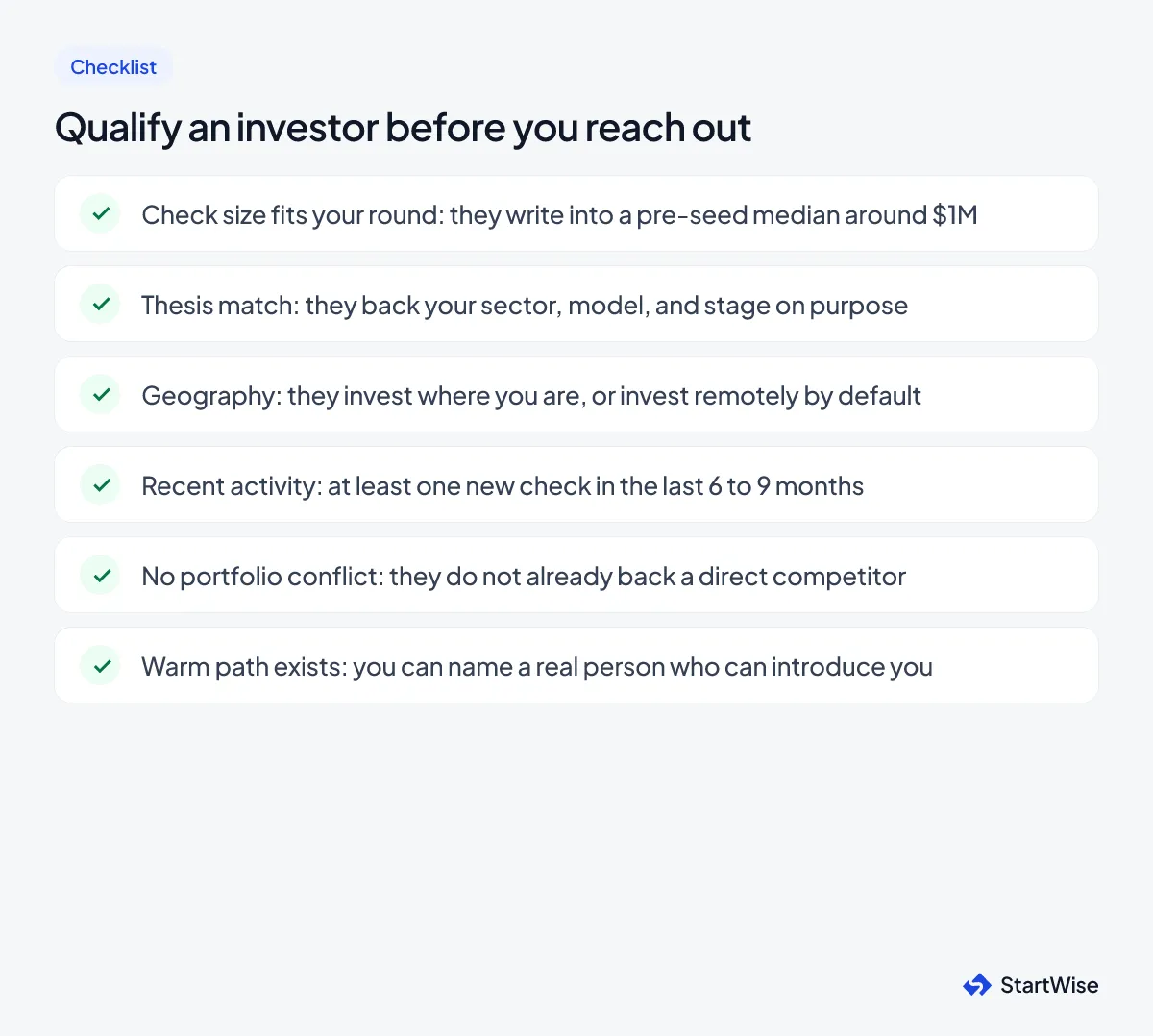
Target investors whose check size, thesis, stage, and recent activity match your raise, before you write a single email. This is the step most guides skip, and it’s where a long list quietly becomes a short, good one. A fund that writes $2M Series A leads won’t do your $400K pre-seed, no matter how clean your deck is.
Check size is the fastest filter. If the pre-seed median round is around $1M and seed sits near $4.1M (Carta State of Private Markets, Q1 2026), find the funds that write checks inside your round and skip the rest.
Then layer on thesis (do they back your sector and model on purpose?), geography, and whether they’ve made a new investment in the last six to nine months. A fund that hasn’t written a check all year may be between funds and out of dry powder, the money a fund still hasn’t deployed.
StartWise's position
Finding investors is a targeting problem, not a volume one. After reviewing founders' outreach every week, our read is simple: a list of 40 investors you can qualify and reach beats 300 cold names every time. The median raised deck gets in front of just 11 investors (Papermark, 2026), so the win is picking the right ones and getting through the door, not blasting the field.
One more filter saves everyone pain: portfolio conflicts. If a fund already backs a direct competitor, they usually can’t touch you. Catch that now, not in the second meeting.
Do warm introductions still matter?
Warm introductions still decide most of your outreach, and the gap over cold email isn’t small. Warm intros convert somewhere around 40-60% to a meeting, against 1-5% for a cold email (Mercury).
Same deck, same founder. The only variable is whether a trusted person vouched for you first.
So the real question is not “who do I email?” It’s “who can open this door?” For each name on your list, look one hop out.
Does a portfolio founder of that fund know you, or know someone you know? Did you work with an operator the partner trusts? A double opt-in intro, where your connector checks with the investor before forwarding, protects the relationship and lands you in a warmer inbox.
Map those paths before you send anything. We cover the mechanics in how to get warm intros to investors, and the short version is this: the person making the intro matters more than the words in it. When no warm path exists, a sharp cold email can still work, but treat it as the exception, not the plan.
Know who you want to reach but not how to get there? StartWise matches you to investors for your stage and industry and helps you run the outreach.
How many investors do you actually need to reach?
You need a qualified list of roughly 40 to 80 investors, not 300, and you’re working it as a funnel.
Start from the end. To close a pre-seed or seed round you usually need one lead and a few followers, so you can back the whole thing out from there.
If warm intros convert near half and a database list of cold names converts in low single digits, the math tells you to spend your energy on fit and access, not on sheer count.
Think of it as a pipeline that narrows at every stage. A realistic shape looks like this:
- Qualified targets: 40 to 80 investors who fit your stage, thesis, and geography.
- Warm paths found: an intro route for as many as you can, cold outreach for the rest.
- Meetings: a healthy chunk of your warm list, far fewer of your cold list.
- Second meetings and diligence: the handful who actually lean in.
- Term sheet: one lead, then followers fill the round.
The number that reframes the whole thing: the median successfully-circulated deck reaches just 11 unique investors (Papermark, 2026). Eleven. Not two hundred.
That doesn’t mean you only contact 11, it means the ones who matter are few, so a short list you can reach beats a long list you can’t. I’d rather a founder nail 40 qualified names than spray 300 and burn the field.
A short list you can reach beats a long list you can’t.
Run it in parallel waves, not one investor at a time. Open a first wave of 15 to 20, learn from the objections, tighten the deck, then open the next wave. And give it room.
The median time from a founder’s first investor view to a round announcement is about six months (Papermark, 2026), so treat the raise as a full-time project with a start date, not a background task. If you want the full sequence, how to raise a pre-seed round walks the whole timeline, and how to find a lead investor covers the one name that sets your price.
What to have ready before your first outreach
Have four things ready before you reach out: a target list, a pitch deck, a short one-pager, and a basic data room (the folder of documents investors ask to see before they commit). Reaching out before these exist wastes your warmest intros, and you’ll only get each one once.
The deck does the heavy lifting, and investors read it fast. Across 24,541 decks and 358,672 investor views in 2024 to 2026, Papermark found the average view lasts 4.0 minutes and 16% of investors quit in the first 10 seconds (Papermark Fundraising Report, 2026). Your opening slides carry the whole thing.
Keep the one-pager to a single screen a connector can forward without opening a file. Build the target list in a real tracker so you can run waves and see what is happening, which is exactly what a pipeline tracker is for.
One honest note from the review room, where we read founder decks every week: a polished deck sent cold to an unqualified fund still goes nowhere. Fit and access come first, then the materials make them count. For the full pre-raise list, the pre-seed fundraising checklist maps every item to a module.
What to do this week
The founders we watch close rounds fastest start with a target list and a map of who can reach each name, so block real time and build both this week before you send a single email.
- Pull 40 to 80 qualified names from OpenVC, Crunchbase, and your investor target list, filtered by stage, check size, and thesis.
- For each name, find the shortest warm path and note the connector. No path? Flag it for cold, and keep that pile small.
- Drop the whole list into a tracker with columns for status, warm path, and last touch.
- Tighten your first three deck slides, since that’s where 16% of investors leave in 10 seconds.
- Open a first wave of 15 to 20 double opt-in intros, then wait and learn before the next wave.
Finding investors was never a database problem. It’s a short list of people you can actually reach, plus a specific reason for each of them to take your call instead of sending it to the pile they never answer.
