 By
StartWise and Metal are both fundraising platforms: each finds investors for a startup, ranks them by fit and helps the founder reach them. They differ in who they’re built for, how you get in, and what else comes with the list. We make StartWise, so read this with that in mind. Every fact about Metal below links to the page on Metal’s own site where we read it on November 12, 2026.
StartWise vs Metal: which one fits your raise?
StartWise vs Metal comes down to stage and setup. Pick Metal if you’re running a venture round and want a platform built around that process, with a higher tier that Metal itself recommends for late seed and Series A+. Pick StartWise if you want to start free, see 20 researched investors for your round first, and keep the deck, the model and the outreach in one place.
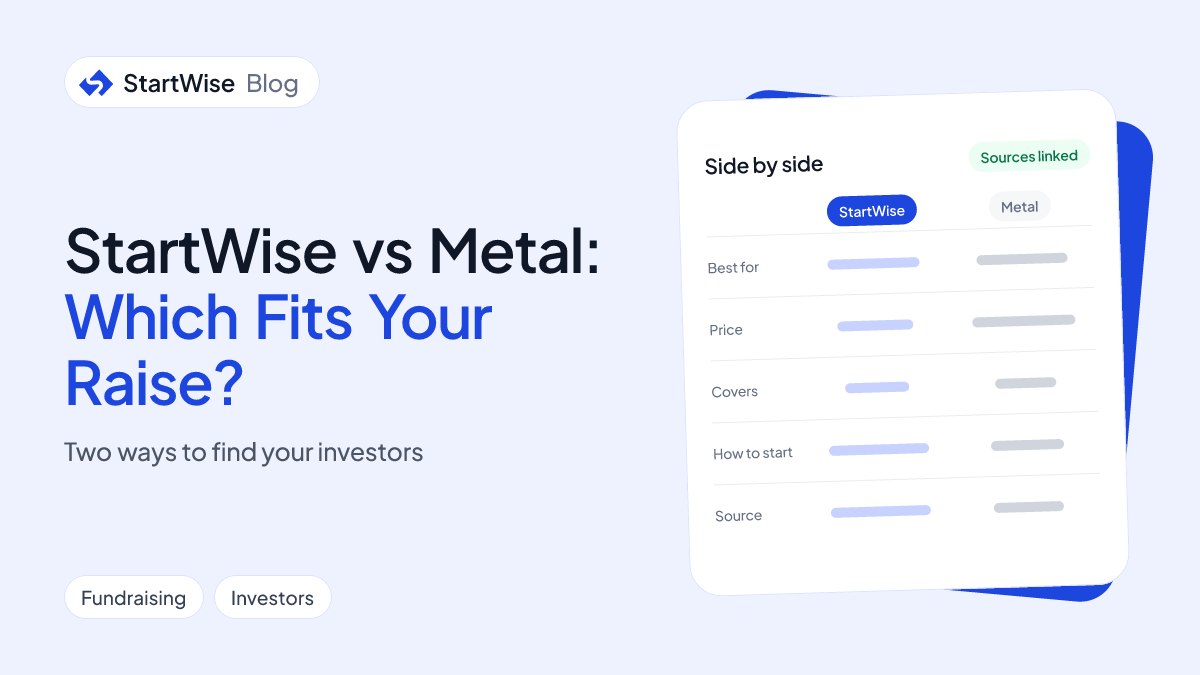
Both cover the core jobs. The table above shows what each company lists on its own site, with the source for each price.
Neither one publishes a price list.
That matters less than it sounds, because the two get you in the door differently. Metal’s own guide says founders book a demo and complete a trial to get access. On our side you sign up, get your first 20 investors researched free, and talk to someone only when you want a paid plan.
What does Metal do well?
Metal does the investor side of a venture round in depth. Its home page describes an agent that identifies, qualifies and ranks investors, then surfaces warm-intro paths from Metal’s relationship graphs and your own connections data. A fundraising CRM sits on top of that.
It also covers the steps after the list. Metal says you can send investor emails and intro requests from inside the product, host your round in data rooms with sharing and tracking, and run a deck through its AI pitch deck review for slide-specific feedback.
So who should pick Metal? In our read, three kinds of founder:
- You’re raising a priced venture round and the round is your full-time job for the next few months.
- Your raise will run on warm introductions, and you want software to map the paths through people you already know.
- You’re at late seed or Series A, the stage Metal names for its Autopilot plan.
We’d test the warm-intro mapping hardest. The investor lists founders bring us usually fail on fit long before they fail on tooling, and a tool that shows you a real path to the right partner fixes the part that hurts most.
What does StartWise do differently?
StartWise starts earlier and reaches wider. It’s free to start, and your first 20 investors are researched before you pay anything or book a call. Each one comes ranked by thesis, stage, check size and recent activity, with the named partner who leads deals like yours and an email verified before you send.
Outreach is where the two read most differently. StartWise runs one sequence across email, LinkedIn, WhatsApp, Instagram and Telegram, sent from your own accounts, and nothing goes out until you launch it. The same sequences work for customers, which is useful if you’re selling while you raise.
It also builds the materials. The deck builder, Deck Doctor review, business plan, financial model and cap table live next to the investor list. On Metal’s site we found a deck review and a data room that takes a model you upload. We did not find a plan or model builder listed there.
Who should pick StartWise:
- You’re a first-time founder at pre-seed or seed and the deck and model aren’t finished yet.
- You want to see matched investors for your own round before a sales call.
- You’re reaching investors and customers in the same quarter.
Paid plans are set up on a short demo call, and the first payment has a 14-day money-back guarantee. There’s no free trial. The free start is how you try it.
How do the two compare job by job?
The two compare closely on finding and tracking investors, and differ most on outreach channels and materials. Here is what each site says for the five jobs a raise is made of.
- Finding investors. Metal’s agent identifies, qualifies and ranks them. StartWise ranks by thesis, stage, check size and recent activity, and names the partner.
- Warm intros. Metal uses its relationship graphs plus your connections data. StartWise uses Atlas, which maps your network from your LinkedIn and ranks people by warmth.
- Reaching them. Metal sends investor emails and intro requests from inside the product. StartWise sequences five channels from your own accounts.
- Tracking. Both list a pipeline CRM built for a raise.
- Materials. Metal lists data rooms and a deck review. StartWise lists a deck builder and review, plan, model, cap table and data room.
Read that list against one number. Investors spend an average of 3.2 minutes on a deck and 23 seconds on its first page (Papermark, 2024). Whichever tool you use, the deck gets a few minutes from each person, so sending it to the right 40 people does more for a round than any feature on either list.
We see founders spend three weeks choosing software and one afternoon choosing who to email. It should be the other way around.
Comparing tools is easier with your own round in front of you. See 20 investors matched to it, each with a named partner.
What does each one cost?
Neither StartWise nor Metal lists prices on its site, so the honest cost comparison is about how you start and what you risk.
| At the start | StartWise | Metal |
|---|---|---|
| Free to start | Yes: first 20 investors researched free | Not stated on its site |
| Price list | Not published; plans set up on a demo call | Not published; custom pricing |
| How you get in | Sign up, then a demo call for paid plans | Book a demo and complete a trial |
| If it doesn’t work out | 14-day money-back guarantee on the first payment | Not stated; Metal says it charges no success fee |
Metal’s pricing page shows two plans, Platform Access + MCP and Autopilot, with buttons to get pricing or request access. Its guide adds that there are no success fees and no revenue share. StartWise’s plans are Basic, Premium, Platinum and Enterprise, with the details on the home page.
Other vendors’ comparison pages quote monthly figures for Metal. Metal’s own site doesn’t confirm them, so we left them out. Ask each company for the price in writing before a second call.
Why are most “best fundraising tool” lists hard to trust?
Most “best fundraising tool” lists are written by a company that sells one of the tools. When we searched for tools to find investors, the first page was mostly vendor guides. Metal’s own guide to the nine tools puts Metal first, and its sitemap held 81 guides when we counted on November 12, 2026.
We’re a vendor too. This page has the same conflict, which is why the facts above link out and why the table says “not published” where a company doesn’t publish something.
StartWise's position
Buy the tool for the job that is stuck. Finding names, judging fit, reaching people, tracking replies and preparing materials are five different jobs, and most founders pay for a database when the stuck job is outreach.
So skip the rankings and run three checks on any tool, ours included:
- Ask for ten investors for your real round. Check three by hand: is the named partner still at the fund, and do they invest at your stage?
- Ask what happens after the list. Who writes the first message, and whose account sends it?
- Ask what you pay if you stop after a month.
If a tool passes all three on your round, use it.
What to do this week
- Write down the stuck job in one line. If it’s “I don’t know who to contact”, start with how to find investors for a startup.
- Run the same round through both tools. Book Metal’s demo, and start StartWise free the same day.
- Put the first ten names from each side by side and do the three checks.
- Decide on what you saw. Then write the first message with our cold email template for investors, and line up warm intros for the top five.
- Still comparing? The wider field is in fundraising tools for startups, the CRM question is in fundraising CRM for startups, and every sourced comparison sits on the compare page.
Send the first five emails by Friday. You’ll learn more from five replies than from another week of comparing.
