
 By
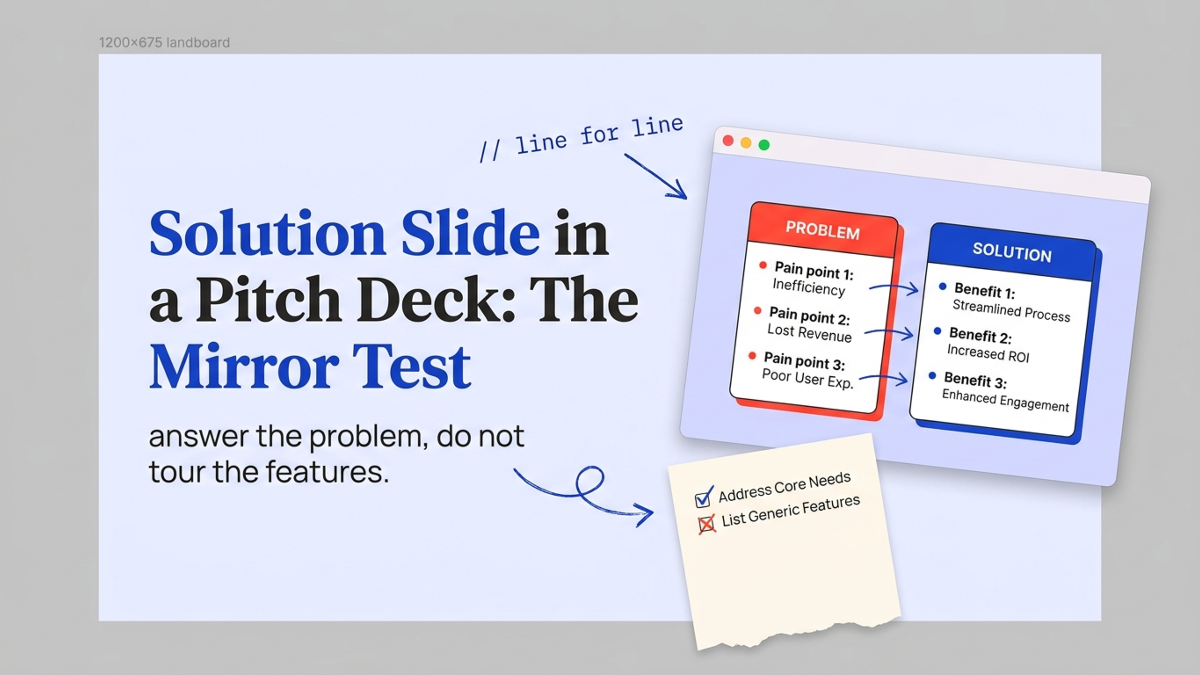
The solution slide is the pitch deck slide that shows how you remove the problem you just raised. It sits right after the problem slide, and reviewers read the two together. That pairing is the whole game. In the decks we review, the strongest solution slides read as one sentence that answers the problem line for line. The weakest list six features and never name what they beat. Papermark’s 2024 analysis of 3,000 decks found investors give each slide about 15 seconds after the first, so a feature tour is a slide they skip.
What is the solution slide in a pitch deck?
The solution slide states, in one benefit-led line, the new approach that removes the problem from the slide before it. It’s your thesis, not your product spec. Slidebean, which has published pitch-deck structure guidance for years, calls it “the mirror to the problem slide” and the point where you “break the status quo.”
That framing matters, because we watch founders treat the slide as a demo. It’s not the product slide. It answers one question: what changes for your customer now that you exist?
Keep it conceptual. “A fast, on-demand car service that tells you who is picking you up, when, and what it costs” is Uber’s solution in a sentence, per Slidebean. No app architecture. No feature grid. The what, not the how.
Mirror the problem slide, line for line
The mirror test is simple: put your problem slide and solution slide side by side and read them back to back. Every pain on the left needs a matching line on the right. Nothing on the solution slide should resolve a problem you never stated.
This is where most solution slides fall apart. The problem slide names three pains. The solution slide lists five features, two of which answer nothing on the left, and skips one pain entirely. A reviewer notices the gap in seconds.
If a line on your solution slide doesn’t answer a line on your problem slide, one of the two slides is lying.
So run the check before you polish the design. Draw an arrow from each problem line to the solution line that kills it. Orphan arrows on either side are the edit. A pain with no solution means you’re building the wrong thing, or forgot to say you fix it. A feature with no pain means you’re in love with something investors were never asked to care about.
We keep seeing this in review, and it’s almost always the fastest fix in the deck. You’re not adding content. You’re deleting the lines that answer nothing.
What goes on a strong solution slide?
A strong solution slide carries four things and cuts the rest. Lead with the outcome, then earn it briefly. Here is the order that survives a 15-second read:
- The headline benefit, in one sentence a reader grasps at a glance. State the result, not the mechanism.
- How it works, in three steps at most. Enough to show it’s real, not a walkthrough. If it takes five steps to explain, the slide is the wrong altitude.
- The status quo you beat, named plainly. “Today teams do this in spreadsheets” tells a reviewer what you replace and why it’s better.
- One proof point, if you have it: a pilot result, a metric, an early number. Dropbox famously reduced its solution to a handful of plain lines after nailing the problem, and let a demo carry the rest.
Notice what is missing. No feature matrix. No architecture diagram. Technology belongs here only as a credibility footnote: mention the model or the hardware if it makes the claim believable, never as the headline. A reviewer stops on a benefit and skims past a spec.
StartWise's position
A solution slide should be readable as one sentence, and that sentence has to answer the problem slide. After reviewing decks daily, our take is blunt: if your solution needs a feature list to make sense, you haven't found the one-line thesis yet, and neither will the investor in 15 seconds.
5 mistakes that make investors skip your solution slide
In review, we see weak solution slides fail the same five ways. Each one shows up fast on a skim, and each has a clean fix. They’re a subset of the broader pitch deck mistakes that cost founders meetings.
- The feature tour. Six bullets of what the product does, zero on the outcome. Cut to the single benefit and move features to the product slide.
- Answering an unstated problem. The slide solves something the problem slide never raised. This is the mismatch that kills raises: 43% of startups fail from poor product-market fit (CB Insights, 2026), and a deck is where that gap first becomes visible.
- No status quo. You never say what people do today, so “better” has nothing to measure against. Name the current workaround.
- The tech flex. Leading with the architecture instead of the result. Investors buy the outcome and check the tech later, if at all.
- Vision creep. The slide describes a five-year platform instead of the wedge that solves the first pain. Save the vision for its own line.
43%
of startups fail from poor product-market fit (CB Insights, 2026, analysis of 431 shut-down companies)
The mismatch mistake is the expensive one. A feature tour costs you attention. A solution that answers the wrong problem costs you the meeting, because it signals you haven’t found the pain that pays.
Not sure your solution slide answers your problem slide? Get a slide-by-slide read.
How does the solution slide change by funding stage?
The solution slide sells a different thing at each stage, because the evidence you can honestly show changes. At pre-seed you sell the insight and the wedge. By seed you have to prove the thing works. The bar moves, so the slide moves with it.
| Stage | What the solution slide sells | Proof it carries |
|---|---|---|
| Pre-seed | The insight and the first wedge | Why now, and why this approach beats the status quo |
| Seed | A working product against the problem | Early usage, a pilot, or a metric that moves |
| Series A | A repeatable solution at scale | Retention and outcomes across real customers |
At pre-seed, nobody expects a finished platform, and we never flag one as missing. They expect a sharp reason this approach wins now that it couldn’t two years ago. That’s your why-now line, and it belongs on the solution slide as much as the competition one.
By seed, an insight alone reads as thin. You’ll need a working product and a number, even a small one, that shows the solution does what the slide claims. Investors spend about 3.2 minutes on a whole deck (Papermark, 2024), and the seed reader spends more of it here, checking whether the thesis survived contact with real users.
What to do this week
Open your deck to two slides: problem and solution. Read them back to back, out loud, the way we do in a review.
- Draw an arrow from each problem line to the solution line that answers it. Delete every orphan on both sides.
- Rewrite the solution headline as one benefit sentence, the outcome, not the mechanism.
- Add the status quo you beat in a short line, so “better” has something to measure.
- Move every feature to the product slide and cut the tech to a footnote.
- If you’re at seed, add one honest proof point; if you’re at pre-seed, sharpen the why-now instead.
Then hand the two slides to someone who has never seen your deck and ask what problem you solve. If they read it back to you in a sentence, you’re done. If they hesitate, you’ve got another orphan arrow to cut.