
 By
By 
The problem slide is the first content slide in a pitch deck, the page where you name the pain your startup exists to fix. It usually sits right after the title. Here’s what most guides skip: investors give it about 38 seconds on a first read, per DocSend’s 2024 data compiled by PitchGrade. We review founder decks before they raise, and this is the slide people rewrite last and hardest. It decides whether the rest of the deck gets read at all.
What is the problem slide in a pitch deck?
The problem slide names the specific pain your customer lives with today, before you show a single thing about your solution. Its job is narrow. Convince an investor the problem is real, common, and worth solving now, and you have earned the next slide. It’s not where you pitch your product, and it’s not your market-size slide wearing a costume.
In the decks we review, the weak ones describe a situation, not a problem. A situation exists. A problem hurts someone, and you can measure it. PitchDeckGuide draws the same line, and it doubles as the fastest test of your slide.
A situation exists. A problem hurts someone, measurably.
If nobody is losing time or money in your sentence, you wrote a situation.
Rewrite it until someone bleeds.
Take a real rewrite. “Freelancers struggle with their finances” is a situation nobody funds. “A freelancer loses hours every month reconciling invoices across three apps, and pays for it again at tax time” is closer to a problem, because a named person is now carrying a cost. It’s the same topic. One version earns 38 seconds; the other earns a question. Drop in the actual number from a customer interview and the slide stops sounding like a guess.
How long do investors actually spend on the problem slide?
Investors spend about 38 seconds on the problem slide, according to DocSend’s 2024 breakdown via PitchGrade. That’s less than the team slide at 62 seconds or financials at 52, but the problem slide runs earlier, so it decides whether the read even continues. A first pass through a whole deck averages 3 minutes 44 seconds. Lose the opening 40 seconds and you rarely get the other three minutes.
Here’s the part we watch founders underrate. The problem slide is a filter, not a pitch. In DocSend’s study of 320 decks, research lead Justin Izzo found investors treat the early framing “as a kind of gatekeeper” to decide whether a company has a reason to exist before reading on (TechCrunch). A yes buys you the deep read.
A shrug ends it right there.
The gap between a warm intro and a cold email lives here too. Cold decks convert to a meeting 3% to 5% of the time; warm-intro decks, 40% to 50% (DocSend, via PitchGrade). A cold reader hands you less patience and less benefit of the doubt. So your problem has to register in one glance, not one careful read.
This is also why the trend keeps moving against you. Izzo’s team found investors abandoning weaker decks fast, and the attention paid to any single deck has fallen year over year (TechCrunch). You’re not writing for a patient reader with a coffee. You’re writing for someone scanning twelve decks before lunch who’ll close yours the moment the problem feels soft.
StartWise's position
A deck dies in the first 90 seconds of a skim. Build for the skim first: if your problem slide title states the problem on its own, you pass. If a reader has to open the body text to understand the pain, you have already lost the fast readers, who are most of them.
What makes a problem slide investors believe?
A problem slide investors believe does three things: it names who hurts, quantifies the pain, and says it in one line. Melinda Elmborg, a former VC at Daphni, puts the second part bluntly: “use data to make the pain you explain irrefutable. Very few startups do that, so here you can really stand out” (Story Pitch Decks).
Start with who. “Small business owners” is a category, not a person. Pick the narrow segment you can reach first and describe their day. Then attach a number: hours lost, dollars wasted, a rejection rate, anything a customer would recognize as their own. Adam Fard, in the same roundup, argues for two or three points in short sentences “devoid of niche jargon.” Keep it that tight.
| Element | Weak problem slide | Strong problem slide |
|---|---|---|
| Who | ”Everyone who runs a business” | One named segment you reach first |
| Pain | ”It’s frustrating and slow” | A cost with a source, in hours or dollars |
| Frame | Describes a situation | Names a cost someone pays today |
| Length | A paragraph to decode | One sentence grasped at a glance |
Here are the three jobs applied, the way I’d coach it. Who: independent bookkeepers at firms under ten people. Pain: the hours they lose each week rekeying the same figures across separate tools, a number you pull straight from your own customer calls. One line: “Bookkeepers at small firms rekey the same numbers across four tools every week.” It names a segment, points at a cost you can measure, and fits on one line with no product in sight.
The one-sentence discipline is the hard part. If your problem takes a paragraph, you haven’t found the problem yet.
You’ve found a topic.
Why does the problem slide matter more at pre-seed?
The problem slide matters more at pre-seed because you have little else to lean on. There’s no revenue history and thin traction, so investors read your problem framing as the clearest signal of whether you understand the market better than the next founder. Insight is the asset you’re selling. The problem slide is where you show it.
DocSend’s data points the same way. Izzo noted that investors have cut the time they spend on the product and business-model sections at the pre-seed stage, pushing the weight onto the problem, the team, and the why-now (TechCrunch). If you’re still validating, the sharpest thing you can bring is proof the pain is real, which is also the work behind validating an idea before you build.
The why-now line is the piece founders skip most. A real problem isn’t enough on its own. Investors want a reason it’s urgent this year and wasn’t five years ago: a regulation changed, a cost curve dropped, a behavior shifted. Name that shift in one line and your problem stops looking timeless and starts looking timely.
We see it weekly. A vague problem slide sinks a pre-seed deck faster than a thin traction slide. A thin traction slide is expected this early. A fuzzy problem tells an investor you’re maybe building for a market you don’t understand yet.
Not sure your problem slide lands in the first glance? Get slide-by-slide feedback before you send.
The problem slide mistakes that lose the read
The mistakes that lose the read are predictable, and we flag the same ones every week. A weak problem slide tops our ranked list of pitch deck mistakes for a reason: it poisons every slide after it. Each one trades a believable, narrow pain for a vague, universal one, which is exactly the wrong direction.
- The everyone market: a problem that hits “all businesses” reads as a problem you haven’t scoped. Name the first segment instead.
- The situation slide: facts about an industry aren’t a problem until someone pays for them in time or money.
- The solution in disguise: if the slide only makes sense once the reader knows your product, it’s a solution slide mislabeled, the same way a competition slide fails when it only flatters you.
- The unquantified pain: “slow and frustrating” is an adjective, not evidence. Attach one number with a source.
- The absent founder: if you can’t say who feels this and how you know, the reader assumes nobody does.
Common mistake
Claiming the problem affects everyone. A market of everyone reads as a market of no one, and it tells an investor you have not found your beachhead yet. Narrow it to the segment that hurts most and can be reached first.
Fix these and the slide gets shorter, not longer. That’s the tell of a problem you actually understand.
What to do this week
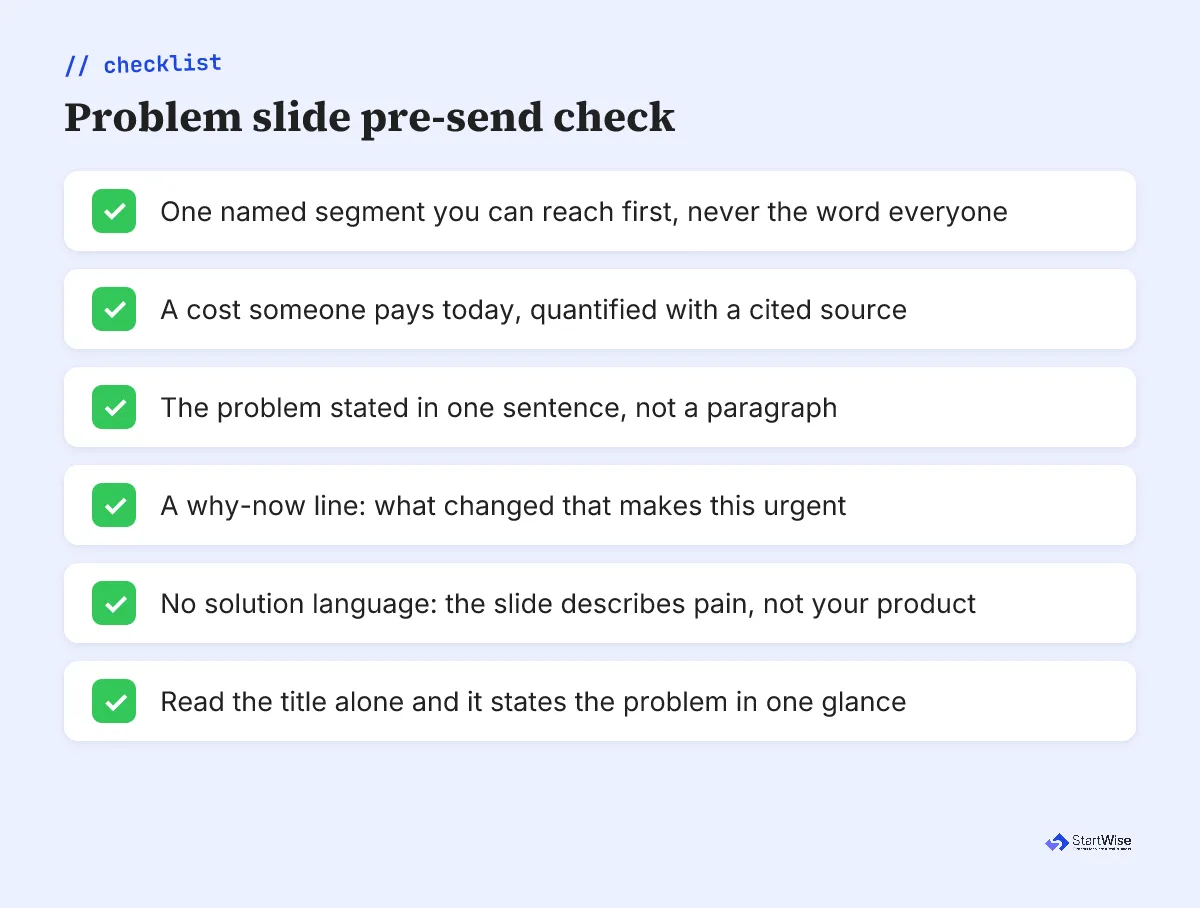
Rework your problem slide in one sitting with this order, then test it cold. It’s the sequence I run when we review one. The how-many-slides math says you don’t have room to waste, so make this one earn its 38 seconds.
- Write the problem as one sentence. If it needs two, you’re not done.
- Name the segment. Delete “everyone,” “all,” and “businesses of every size.”
- Add one number with a source: hours, dollars, or a rate someone recognizes.
- Cut every word that describes your solution. That’s the next slide.
- Read the slide title alone. If it doesn’t state the problem, rewrite the title.
Then hand it to someone who fits your segment and watch their face. A nod means the pain is real. A tilted head means you’ve got a situation, and you’re back to sentence one.