
 By
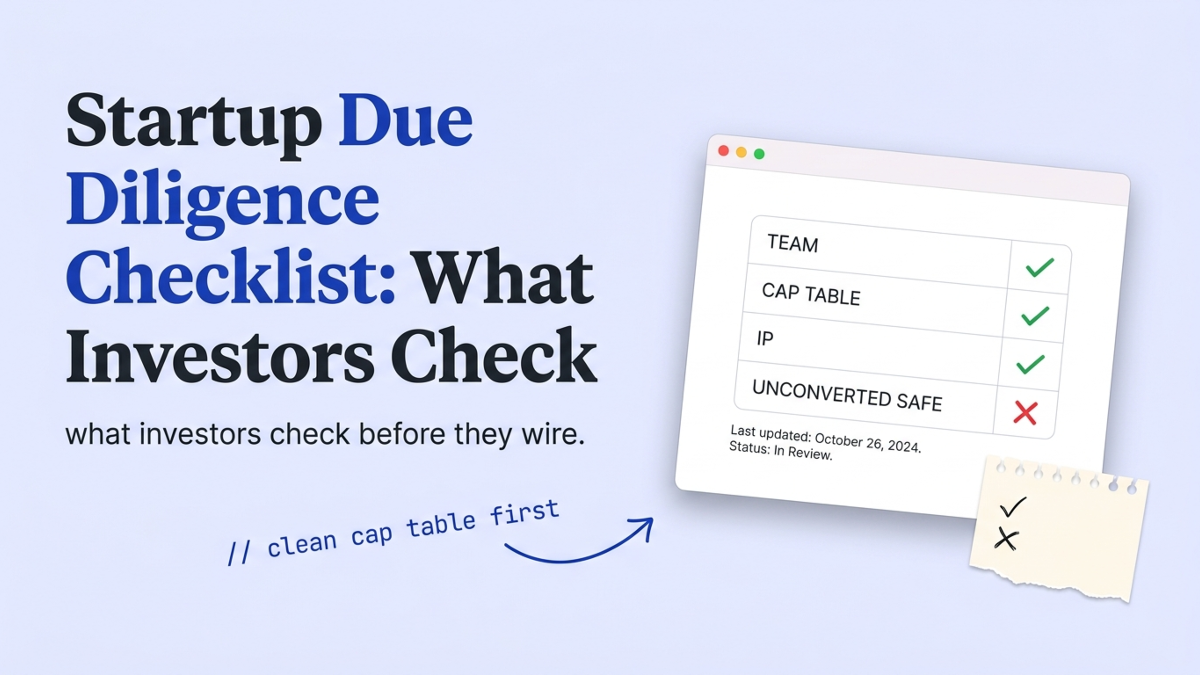
Due diligence is the checking phase investors run before they wire money: they verify that what your deck claims is actually true. Most first-time founders picture a 60-item audit and freeze. In the rooms we review at StartWise, the fear is almost always oversized for the stage. Seed diligence runs 2 to 4 weeks (SheetVenture, 2026), and pre-seed is often a reference call and a glance at your cap table. Here’s what gets checked, when, and what quietly ends deals.
What do investors check in due diligence?
Investors check six areas: team, market, product, financials, your cap table, and legal or IP risk. Each one asks a different question about whether the company is real and fundable. The weight on each shifts hard by stage, so the same word, diligence, means a two-line email at pre-seed and a data-room marathon at Series B.
The founder-facing version is simpler than the frameworks make it look, and it’s the version we use when we read a founder’s materials. Can we trust the people? Is the market big enough to matter? Does the product do what you said? Do the numbers reconcile? Is the ownership clean? Are there any legal landmines?
At pre-seed, diligence is weighted toward founding team, market opportunity, and the core idea, with checklists that are simple and often delivered as email text (Kruze Consulting, 2026). By seed, investors add revenue, user engagement, and proof of demand. The documents they open grow with each round, but the six questions stay the same.
How does diligence change from pre-seed to seed to Series A?
Diligence depth scales with the check size. A pre-seed investor writing a small first check on an insight can’t justify a month of legal review, so they don’t run one. A Series A firm wiring a much larger round orders a GAAP audit, customer calls, and a tech review. Same process name, three very different bars.
Here’s the shape by stage. Read across your row and ignore the rest.
| Stage | What investors check | Timeline | Depth |
|---|---|---|---|
| Pre-seed | Founding team, market, clean cap table, corporate hygiene | Days, often over email | Light |
| Seed | The above plus revenue, engagement, customer references | 2 to 4 weeks | Moderate |
| Series A | GAAP financials, unit economics, legal and tech review | 4 to 6 weeks | Heavy |
Most pre-seed rounds involve no real diligence beyond a reference call and a cap-table check. That’s the honest version nobody puts in a headline, because “download our 47-point checklist” converts better than “you probably don’t need one yet.” We keep seeing founders build the Series A version for a pre-seed round and exhaust themselves on files no one will ask for. If you’re raising your first round, build the light version and stop there. The heavy financial model comes later, when a lead actually asks.
When does due diligence start, and how long does it take?
Diligence starts after a term sheet or a verbal commit, not during your first meeting. That single fact reorders your whole prep plan. The investor decides they want in, then opens the hood to confirm nothing is broken. So your window to fix the cap table and line up references is before you pitch, not while the clock runs.
The founders we watch close fastest treat that pre-pitch window as sacred. The clock itself is short when you’re organized. Seed diligence averages 2 to 4 weeks and Series A four to six, with a rough weekly rhythm: data-room review, then customer calls and financial analysis, then partner discussions, then final legal (SheetVenture, 2026). Competing term sheets compress it to a week. A hesitant investor with a messy target stretches it past eight.
Past six weeks with no clear progress, diligence isn’t slow. It’s dying.
Speed comes from prep you control. An organized data room, a clean cap table, and references who pick up the phone move a deal fast. The reverse, hunting for documents after the investor asks, bleeds the momentum that got you the term sheet.
What actually kills deals in diligence?
Cap-table problems kill more deals than weak metrics do, and it’s the mess we flag most when we read a founder’s ownership docs. Investors rebuild your cap table from scratch during diligence, and the gaps surface within days: a SAFE that never got recorded, an option grant you promised a hire verbally and never papered, a co-founder who left with vested equity nobody cleaned up. None of these are fatal on their own. All of them signal that the ownership you’re selling might not be the ownership that exists.
The second killer is a reference that contradicts your deck. If your traction slide implies strong retention and a customer tells the investor they’re not renewing, the deal is usually over, and not because of the churn. It’s the gap between the story and the truth that ends it. Investors forgive a weak number they can see; they can’t forgive one you hid.
Legal landmines round out the list. Contractors who wrote significant code with no IP assignment agreement can stall a close until it’s fixed, and investors will require that fix before they wire (Dealroom, 2026). The common thread across all three:
- Cap table: unconverted SAFEs, verbal option grants, uncleaned founder departures
- References: customers whose story doesn’t match your metrics slide
- IP: code or design built by contractors who never signed it over
- Transparency: any risk you buried instead of disclosing on your own terms
Disclose the ugly stuff first. A risk you name upfront reads as honesty; the same risk found during diligence reads as concealment, and concealment kills trust faster than any single flaw.
Diligence moves fast when your plan, financial model, and data room already live in one place.
Pre-seed diligence is really a team-risk check
Pre-seed diligence is a bet on people, so the reference calls probe one thing above all: will this team hold together and out-execute the next founder with the same idea? Kruze’s data backs this: at pre-seed, diligence concentrates on the founding team and corporate hygiene, not financial history (Kruze Consulting, 2026). Investors also want a vesting schedule, because co-founder turnover between pre-seed and Series A is common enough that they plan for it.
StartWise's position
Pre-seed diligence is a team-risk check, and credentials answer the wrong question. The reference calls are really asking whether you'll fall apart or get out-executed. Relevant scars, having shipped the thing or lived the problem, settle that faster than any logo on your resume.
So the prep that matters at pre-seed isn’t a thicker deck. It’s a clean cap table with a vesting schedule, references who’ll vouch for how you work, and an honest account of what you’ve actually built. We keep seeing founders over-prepare the numbers and under-prepare the people, when the people are the whole bet.
What to do before diligence starts
Get diligence-ready before you send the deck, not after a term sheet lands. The prep is a weekend of organizing, and it’s the cheapest insurance you’ll buy this raise. Work this list top to bottom.
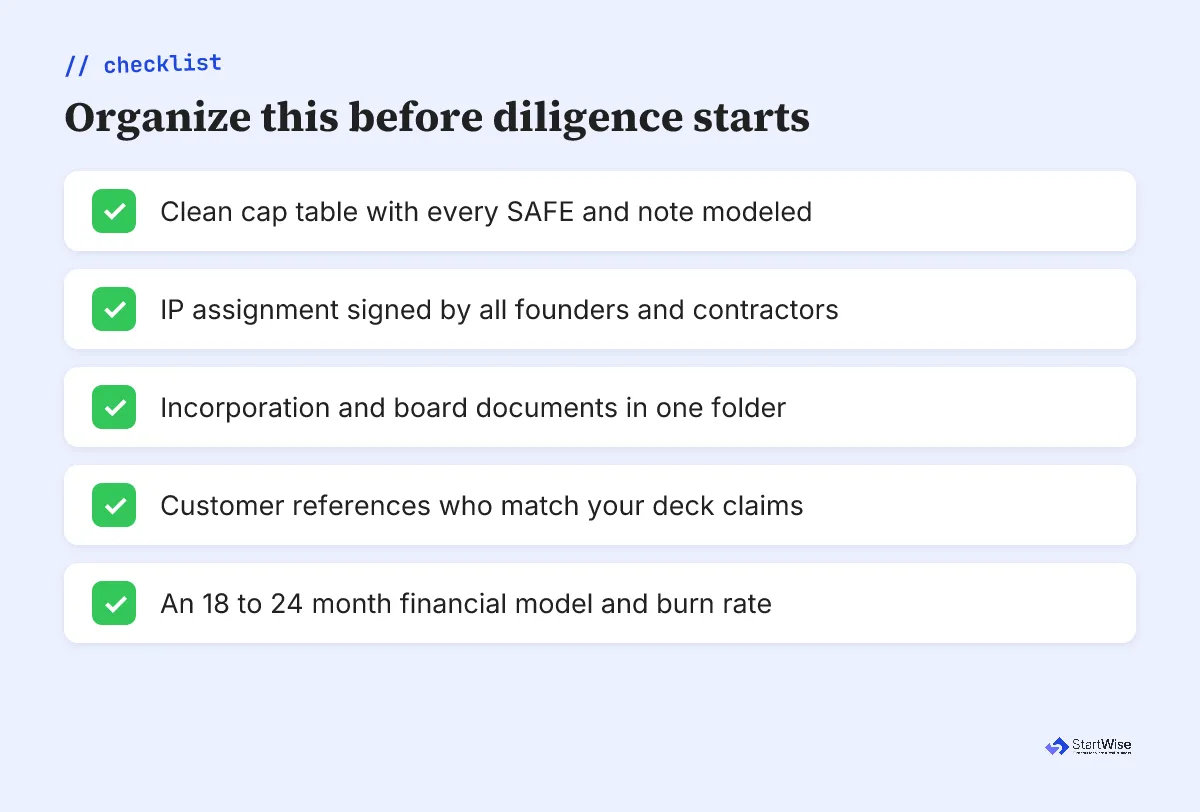
- Rebuild your own cap table. Model every SAFE and note as if converting today. If your number and your lawyer’s number disagree, fix it now, before an investor finds the gap.
- Paper every verbal promise. Option grants, advisor equity, and any handshake on ownership go into signed documents this week.
- Confirm IP assignment. Every founder and contractor who touched the product signs it over. One unsigned freelancer can stall your close.
- Line up three references who match your deck. Pick customers and colleagues whose account of you and your traction won’t contradict a single slide.
- Build the light data room. The 8 to 12 documents a pre-seed investor opens, in one shareable folder, ready before the first ask.
Do those five and diligence becomes a formality instead of a fire drill. The founders we watch close fast aren’t the ones with the best metrics. They’re the ones whose story survives a phone call and a cap-table rebuild, because they prepared for the raise before they needed to.