
 By
By 
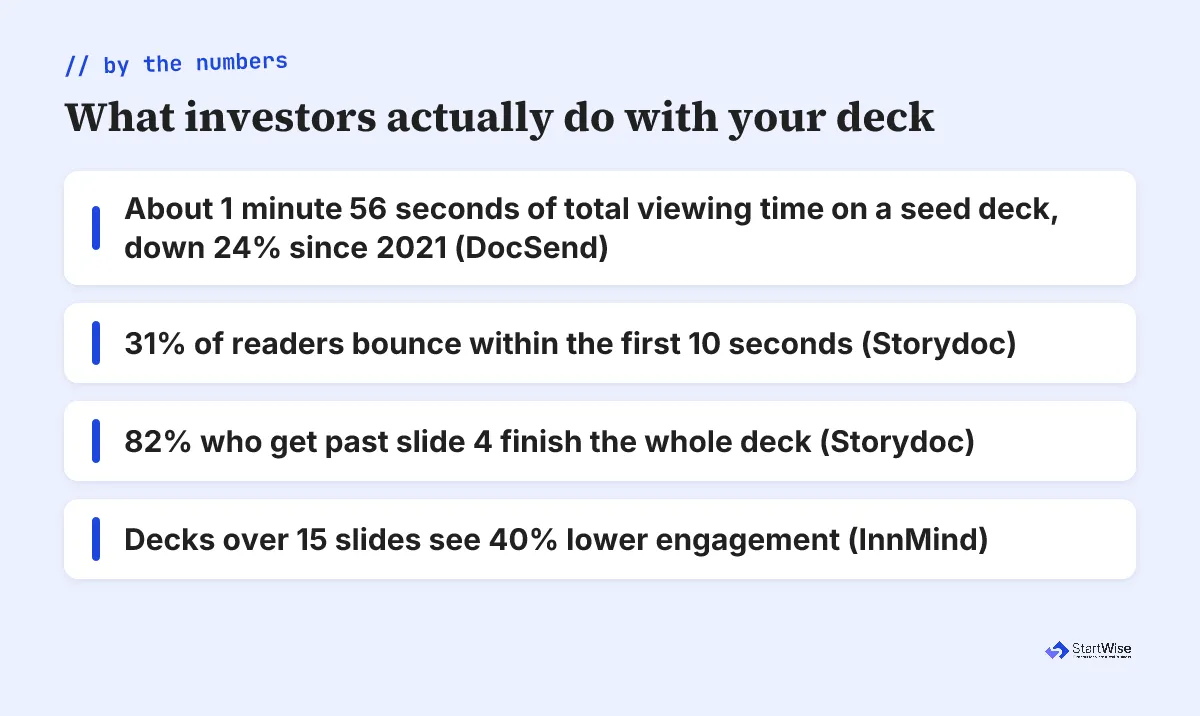
StartWise and Storydoc both touch your pitch deck, but they solve different problems. Storydoc builds interactive, web-based decks you send as a live link and track slide by slide. StartWise reviews the deck and the fundraising story behind it, then matches you to investors. We read founder decks every week, and the split matters. A deck can look sharp in a slick player and still lose the room. Investors give a seed deck about 1 minute 56 seconds of total attention (DocSend, via Spotlight on Startups, 2026), so what you say has to land faster than any animation.
StartWise vs Storydoc: which should you use?
Storydoc is the better buy if you want an interactive, trackable deck. StartWise is the better fit if you need the deck itself to be investor-ready. One is a design and analytics tool. The other checks whether the story raises.
| Tool | Primary job | Fundraising fit | Price |
|---|---|---|---|
| StartWise | Make the deck and story investor-ready | Reviews your deck slide by slide, builds the model, matches investors. Check your deck free → | Free deck review |
| Storydoc | Build interactive, trackable web decks | Tracks who reads each slide; the deck content is yours to get right | $19.80/mo (annual) |
When founders ask us which to pick, that’s the line we draw. Storydoc controls how the deck looks and how you track it. StartWise pressure-tests what’s on it. Pick the one that matches the problem you actually have, not the one with the longer feature page.
What is Storydoc, and who is it for?
Storydoc is a presentation tool that turns your deck into an interactive web page instead of a static PDF. You send a link, the reader scrolls a designed, animated deck in the browser, and you see who opened it and how far they got. It launched in 2021 out of Tel Aviv and leans hard into engagement data, with integrations for video, animation, and CRMs like Salesforce and HubSpot.
Its natural home is the sales and marketing deck. If you’re a B2B seller who needs to impress a prospect and read their interest before the follow-up call, that tracked, interactive format earns its keep. Storydoc’s own study of 1.3 million presentation sessions found that 82% of readers who get past the fourth slide finish the whole thing (Storydoc, 2025).
What it does genuinely well:
- Interactive, scrollable web decks that feel modern next to a PDF
- Slide-level analytics: who opened it, how long they stayed, where they dropped
- Fast onboarding, with a full deck spun up in about a minute
- CRM and video integrations for teams running decks at volume
For a plain investor pitch, though, a lot of that machinery is more than you need. From what we see in the review room, plenty of investors still want a plain PDF they can save and forward. Storydoc runs $19.80 a month on the Starter plan (five active decks) and $36 on Pro (thirty decks), both billed annually (Storydoc pricing, 2026).
What is StartWise, and who is it for?
StartWise is a fundraising platform, not a slide designer. It takes a first-time founder from idea to investor-ready across the whole stack: a business plan, a pitch deck, a financial model, an MVP, then investor outreach. The part that overlaps with Storydoc is the deck, and even there the job is different.
Its Pitch Deck Doctor reviews your deck the way an investor reads it, slide by slide, and hands back a concrete fix list for free. The Idea Pressure Test scores an idea across eleven dimensions before you build. The investor portal matches you to investors by stage and industry, then helps you run the outreach.
We built it around the parts of a raise that decide the outcome, not the parts that decide how a slide animates. So StartWise fits the founder whose real question is whether the deck will raise, not how to make it scroll nicely. If you want to know what investors actually look for in a deck, that’s the job it does.
Does design polish or fundraising substance get you funded?
Fundraising substance gets you funded. Design polish only buys you the seconds to show it. That order is the whole argument between these two tools, and the 2026 engagement data backs it.
Investors are quick, and getting quicker. A seed deck now gets about 1 minute 56 seconds of total viewing time, down 24% since 2021 (DocSend, via Spotlight on Startups, 2026). Storydoc’s own numbers say 31% of readers bounce inside the first 10 seconds (Storydoc, 2025). A slicker player doesn’t change what happens in those ten seconds. A sharper problem slide does.
Length works the same way. InnMind found that decks running over 15 slides see 40% lower engagement (2026). That’s a content decision, not a design one, and no template setting fixes a deck that says too much. It’s the kind of cut we make on decks every week: the same story, ten slides tighter.
StartWise's position
A beautiful, interactive deck can't rescue a weak fundraising story. Investors skim for the missing signal: the vague ask, the traction slide plotting the wrong number, the market math that fails a napkin check. Storydoc makes your deck load fast and tells you who read it. It can't tell you the ask is wallpaper.
A deck that loads in a slick player and tracks every scroll still fails if the story underneath it isn’t fundable.
For a first-time founder raising pre-seed, paying for an interactive-deck subscription before the story is fixed is spending on the wrong problem. Fix the content first. The wrapper is the cheap part.
Built your deck in Storydoc, Canva, or Gamma? See what an investor sees before you send it, slide by slide.
Can you track who views your deck without Storydoc?
Yes. Deck tracking is Storydoc’s strongest feature, and it isn’t unique to Storydoc. Tools like DocSend and Papermark give you tracked links that show who opened your deck and which slides they lingered on, without rebuilding the whole thing as a web page. We wrote a full guide to seeing who viewed your pitch deck that covers the free ways to do it.
So if engagement analytics is the one thing you’re buying, you have options, and Storydoc is a good one. The honest question is whether tracking is your bottleneck. In the decks we review, it almost never is.
43%
of total deck reading time goes to the team slide, which also draws a 49% click rate. Investors concentrate their attention, so tracking every slide equally tells you less than fixing the two they actually read. (Storydoc, 2025)
Knowing an investor quit on slide 3 matters far less than fixing slide 3. Analytics gives you a precise readout of a rejection. A review helps you avoid it.
Match the tool to your stage and budget
Your stage decides which spend makes sense. Storydoc is a monthly subscription: $19.80 on Starter, $36 on Pro, billed annually, a 40% discount versus paying month to month (Storydoc pricing, 2026). StartWise’s deck review is free, and the wider platform is priced as a tool for the whole raise rather than a per-deck export.
At pre-seed, most founders don’t need a paid interactive-deck subscription. A clean PDF that reads well beats a tracked web page with a soft story every time. Spend the money once the story holds and you’re sending at real volume.
Later, once you’re running a live process with dozens of investors, engagement data earns its price and a tool like Storydoc makes sense. Match the spend to the stage. If you’re weighing the wider deck-tool market, our StartWise vs Slidebean breakdown covers the design-and-generation side in the same honest way. For a pure design-automation tool, StartWise vs Beautiful.ai draws the same line.
What to do this week
Here’s the order we give founders weighing the two:
- Name your real bottleneck: deck design and tracking (Storydoc’s lane), or a deck that raises (StartWise’s).
- If you just need a first version, draft it anywhere, Storydoc, Canva, or Gamma, and export a copy you own.
- Cut it to the slides your story needs, then read only the titles. If they carry the story alone, you pass the slide-count test.
- Get it reviewed against the investor skim before you send it, not after the rejections come in.
- Add tracking only if you’re sending at volume and genuinely need the data.
Storydoc decides how your deck looks and travels. StartWise decides whether it’s ready to. Pick for the problem you actually have.