
 By
By 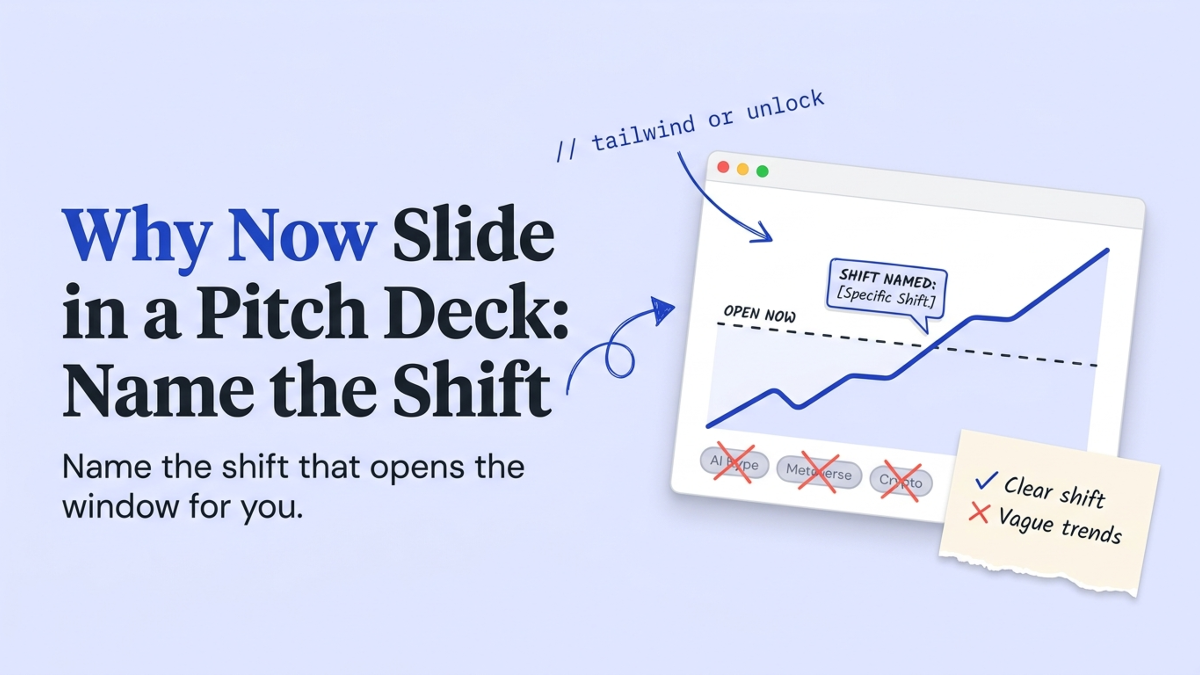
The why now slide is the pitch deck slide that answers one question: why is this fundable today, and not two years ago or two years from now? It names a specific outside shift, in technology, regulation, behavior, or cost, that cracked a window open. Most founders skip it. In Ben Yoskovitz’s 2025 review of 50 startup decks, 75% had no why now slide at all. The ones who include it usually make a subtler mistake, and that mistake is why their timing argument doesn’t land.
What is a why now slide in a pitch deck?
A why now slide states the external change that makes your company possible or urgent right now, then connects that change to what you’re building. It sits after your problem and solution slides and before market size, so the story reads in order: here’s the pain, here’s our fix, here’s why the moment for it is open. Sequoia’s own pitch template lists “Why now?” as slide four of ten, and puts it plainly: the best companies almost always have a clear why now.
Then it asks the harder half. Nature hates a vacuum, so why hasn’t someone already built this?
That question is the whole slide. Something in the world changed to make your idea buildable or urgent, and your only job here is to name that change precisely enough that an investor can’t wave it away. We treat this as the timing test for the entire deck, because it’s the slide that separates a company from a feature that could have shipped any year.
Why do investors care so much about timing?
Investors care about timing because a strong company built at the wrong moment still fails, and they’ve watched it happen more than once. A market can reject a product for arriving too early as easily as too late. The why now slide is where you prove you’re not early.
DocSend’s pitch deck research found a concrete pattern in the decks that raised. Successful pre-seed decks placed their product and why now sections earlier than decks that didn’t close, and they skipped the table of contents entirely. Position was part of the signal.
Timing also has a shelf life. If the window you’re describing has been open for five years, it isn’t a why now, it’s a why-didn’t-you. The strongest versions make an investor feel the window is open now and won’t stay open, so passing on you becomes a decision to miss it. In the decks we review, this is the slide founders treat as optional, and it’s the one that most often decides whether the rest of the deck gets a fair read.
A category tailwind is not a why now
The most common why now failure isn’t vagueness. It’s genericness. A founder names a shift the whole category already feels, “AI got cheap” or “remote work is normal now” or “regulation is opening up,” and stops there. That’s a tailwind. Everyone in the space feels the same wind, including the incumbents who have more money and more customers than you do.
A tailwind everyone feels isn’t a why now. It’s the weather.
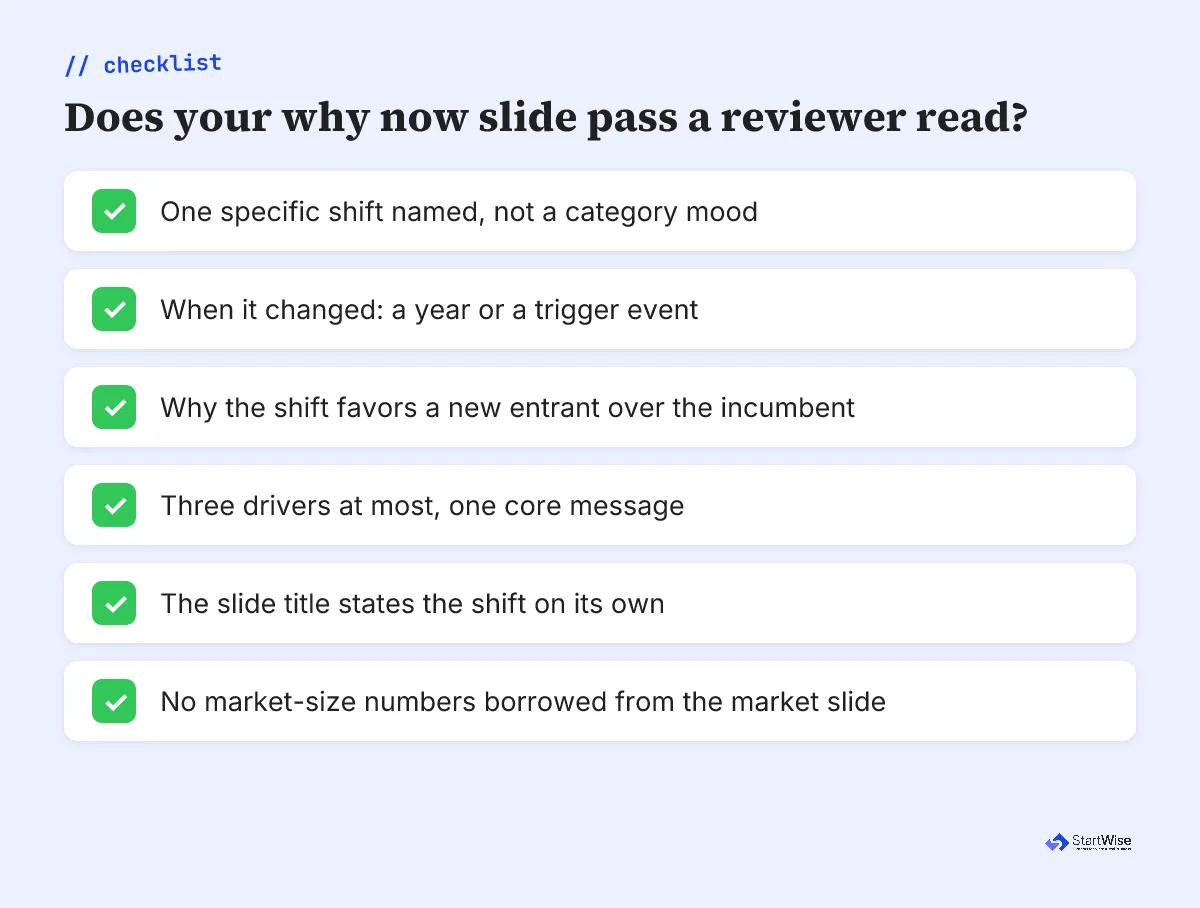
A real why now does one extra thing. It explains why the shift favors a new entrant over the people already here. Cheaper AI doesn’t help you if it helps Salesforce more. The window has to open wider for a two-person startup than for the company that would otherwise crush it, and your slide has to say why.
Here are the three tailwinds we hear claimed most, each real and each not a why now on its own:
- “AI is finally good enough” (so it is for your ten closest competitors)
- “Everyone works remotely now” (a five-year-old shift, not a fresh window)
- “New regulation is coming” (coming isn’t a trigger; passed and dated is)
Take Uber. “Smartphones got popular” is a tailwind. The sharper why now was this: once enough people carried a GPS in their pocket, a stranger’s car could be routed to your exact spot in seconds, and no taxi dispatcher’s radio could match that. The shift disproportionately helped a company with no fleet and no medallions. That’s an entrant unlock, not weather.
StartWise's position
The why now slides we flag aren't vague, they're generic. They name a shift the whole category feels and stop. After reviewing decks daily, our take is blunt: a fundable why now names the shift and why it opens the window for a new entrant before the incumbent moves. Sequoia asks why this hasn't been built before now, and 75% of decks (Yoskovitz, 2025) never answer.
So before you write a word, run your shift through one test. Does it hand you an edge the incumbent can’t copy by lunchtime? If the answer is no, keep digging. The trend is real, but it isn’t yours yet, and a slide that stops at the trend hands the same argument to every competitor who read the same headline.
What are the four kinds of shift you can point to?
Almost every credible why now points to one of four shifts: technology, regulation, behavior, or cost. Naming the category first keeps you honest, because it forces a specific “what changed” instead of a mood. The four we keep pointing founders to sort cleanly into a weak version and a strong one.
| Shift | Tailwind version (weak) | Entrant unlock (strong) |
|---|---|---|
| Technology | ”AI is powerful now” | A capability that just became buildable by a small team, named with the tool |
| Regulation | ”The rules are changing” | A dated rule that forces incumbents to open a door they won’t walk through |
| Behavior | ”People work differently” | A buyer habit that shifted who signs, so your sales motion finally reaches them |
| Cost | ”Everything got cheaper” | An input whose price crossed a line that flips your unit economics positive |
The left column is where most decks live. The right column is where funded ones do. Notice what the strong version always carries: a specific trigger, a rough date, and a reason the change tilts toward a newcomer rather than the giant across the street.
You don’t need all four shifts. One that genuinely favors you beats a slide crowded with all of them, which reads as a founder hoping volume covers for the absence of a real edge.
Not sure your why now names a real shift or just the weather? Get a slide-by-slide read.
Where does the why now slide go, and how long should it be?
The why now slide goes early, right after problem and solution, and it stays short: one message, three drivers at most, a single visual. Investors give a whole deck about 3.2 minutes and 23 seconds on the first slide, then roughly 15 seconds each after that (Papermark’s 2024 analysis of 3,000 decks). You get one skim to land the shift.
So the title has to carry it alone. If a reader skims past and reads only your headline, “Why now” teaches them nothing, while “Video moved to the browser, so real-time editing no longer needs an install” teaches them the whole argument. That’s the test we run first.
The version we flag most buries the timing argument down beside market size, four slides too late, where it reads as a footnote to the TAM. Keep it off your market-size slide. One slide says the window is open now; the other says how big the room is behind it. When they merge, an investor gets neither claim cleanly, and a 12-slide skeleton that already runs tight can’t afford a muddy slide.
What if you don’t have a dramatic why now?
Plenty of good pre-seed companies don’t sit on a headline shift. That’s fine. You don’t need a pandemic or a landmark law to make a fundable case for the moment. You need one honest reason the door is open now, even a small one. Maybe a platform just added the hook you depend on. Maybe a buyer segment started approving tools without procurement, or a cost quietly slipped under a threshold last year.
The mistake we see is founders in this spot inventing a grand macro trend to sound bigger, which falls apart the second an investor probes it. A modest, true why now beats a sweeping one you can’t defend. If the real answer is that you spotted an underserved wedge before anyone else bothered, say exactly that, and back it with what you’ve already watched happen in the market.
Honest and specific beats grand and hollow every time.
What to do this week
Open your deck to the why now slide, or add one if it’s missing, and read it the way we do in a review: as a claim you have to back.
- Write the one shift in a single sentence. Name it (a technology, a rule, a behavior, a price) and date it.
- Run the entrant test. Why does this window open wider for you than for the incumbent who feels the same shift?
- Cut to three drivers at most, one core message, one visual. Delete every trend you can’t tie to your edge.
- Move the slide up front, right after your solution slide, and pull any market-size math off it.
- Rewrite the title so it states the shift on its own, then check the whole deck against the pitch deck mistakes that cost meetings.
Read the title alone. If it names what changed and why it’s yours, you’ve got a why now. If it still just says “Why now,” you’ve got a placeholder.