
 By
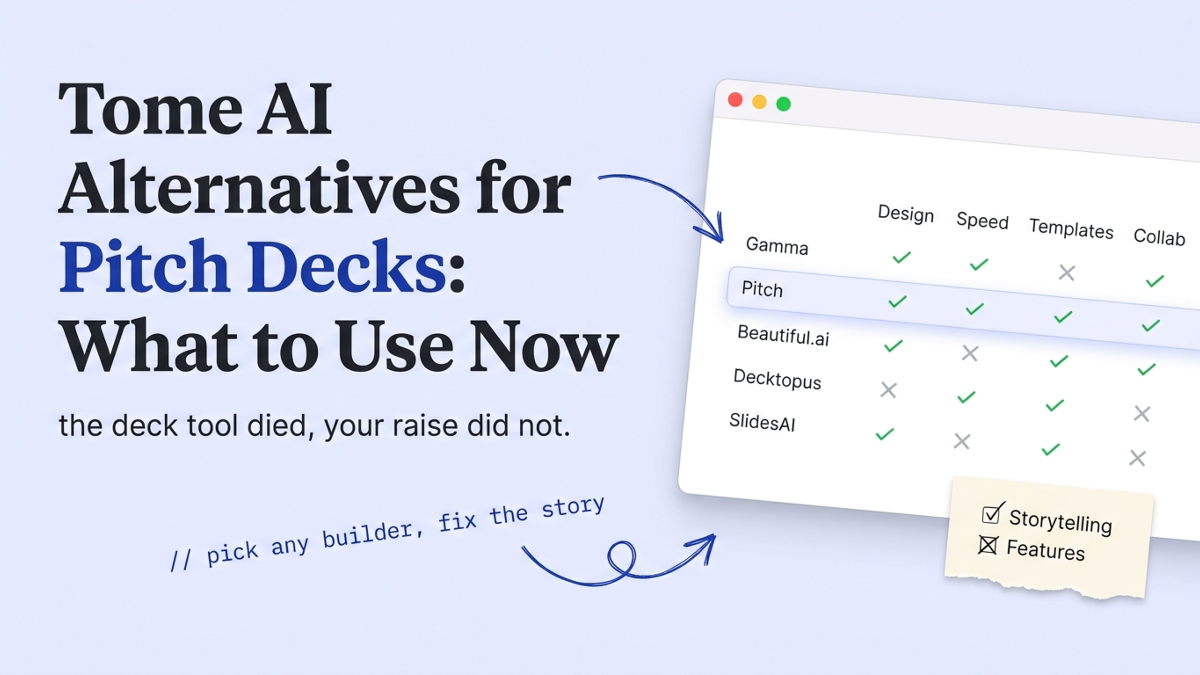
Tome was an AI presentation tool that built slide decks from a text prompt, and for a while it was the hot pick for founders who wanted a deck fast.
Then it died. Tome sunset its slides product on April 30, 2025, and the decks people had built inside it went with it. If you’re hunting for a replacement, the good news is there are several. The better news is that the tool you pick barely decides whether you raise. We review founder decks every week, and the leaderboards everyone else publishes miss the point.
What are the best Tome alternatives for a pitch deck?
The best Tome alternatives for a pitch deck are Gamma, Canva, Beautiful.ai, and Pitch, plus Slidebean for founders who want startup-specific templates. Each one builds slides. None of them tells you whether the slides will land with an investor, and that gap is the whole reason this post exists. The table below splits what each tool does well from what it leaves you to figure out alone.
| Tool | What it is best at | Builds slides? | Watch out for |
|---|---|---|---|
| StartWise (Pitch Deck Doctor) | Reviewing the deck before you send it. Check your deck free → | No, it scores decks you build elsewhere | Not a slide generator |
| Gamma | Fast AI generation from a prompt | Yes | PowerPoint export can break layouts |
| Canva | Largest template library | Yes | AI output starts generic, needs editing |
| Beautiful.ai | Design enforced so slides stay consistent | Yes | Less control over custom layouts |
| Pitch | Team collaboration and viewing analytics | Yes | Built for teams more than solo founders |
| Slidebean | Startup-shaped templates with a CRM | Yes | Locks design into its own system |
Those picks aren’t controversial. Beautiful.ai’s own alternatives roundup and Slide Gamma’s ranked migration guide land on roughly the same names, and so does investor Trace Cohen’s founder tool ranking, which puts Pitch and Beautiful.ai on top. Where we part ways is what they rank on: design polish, export fidelity, and AI speed. All useful. None of it is what gets you funded.
What happened to Tome AI?
Tome shut down its presentation product in stages through early 2025, and the timeline is worth knowing because it carries a lesson for anyone picking the next tool. The company announced a pivot toward sales and marketing automation in October 2024, confirmed it would sunset the slides product in March 2025, and switched it off at the end of April. User decks were deleted. The team rebranded as Lightfield, an AI sales-intelligence company, and AngelList bought the Tome name.
The numbers behind the shutdown still surprise founders. Tome had raised $81.6M at a $300M valuation and reached 20 million users in 18 months, yet its annual recurring revenue stayed under $4M. We break down what happened to Tome AI and why it failed in a separate piece.
Growth without revenue.
A product 20 million people touched still couldn’t pay for itself, so it went away, and every deck built inside it went too.
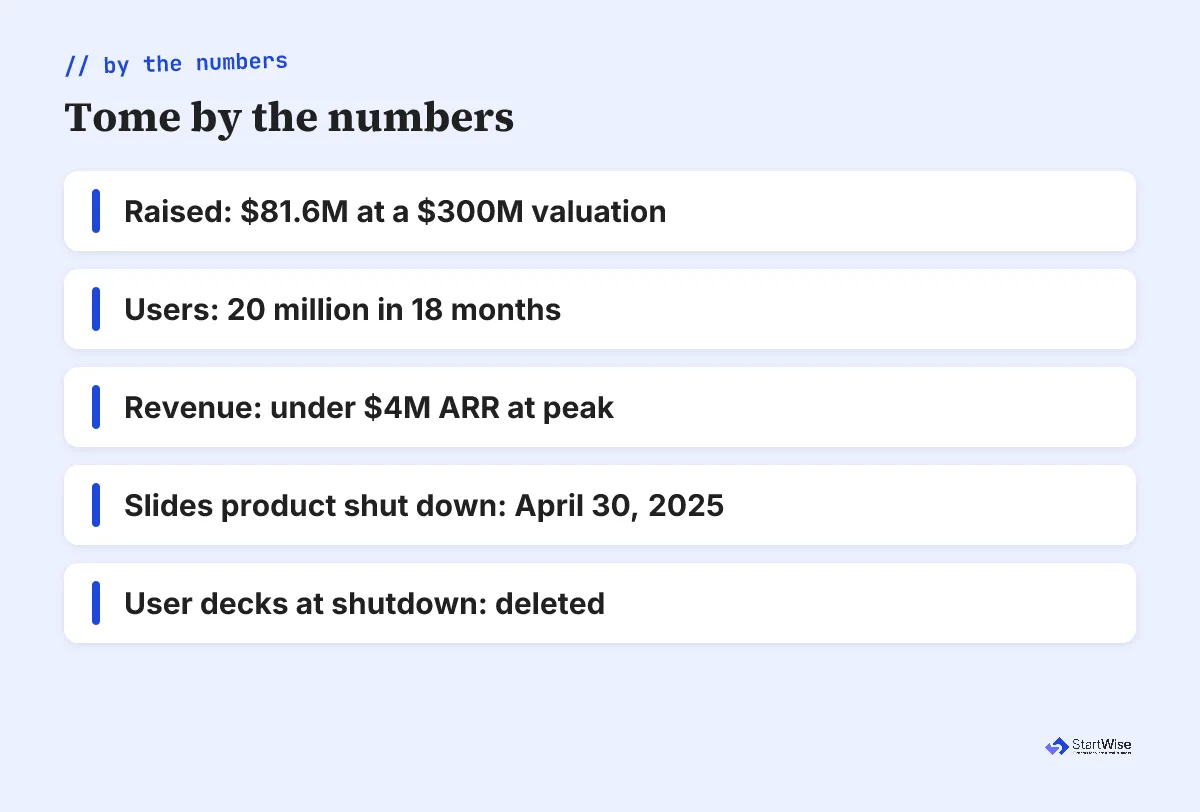
Deleted
Every deck built inside Tome and never exported was wiped when the slides product shut off on April 30, 2025. Keep your deck in a format you can export and own. (Slide Gamma, 2026)
Here’s the lesson we take into every review: own the artifact, not the app. A deck that lives only inside one vendor’s tool is one shutdown email away from gone, so whatever you pick next, save a PowerPoint or PDF copy you control.
That’s also the one place your tool choice carries real weight. If a builder can’t hand you a clean file, skip it. Investors still ask for a PowerPoint or PDF, and Gamma’s exports are known to mangle layouts on the way to .pptx. Before you commit to any of these, export a deck and open it somewhere else. If it survives the trip, you’re set.
Does the deck tool you choose affect whether you raise?
The deck tool you choose has almost no effect on whether you raise, and the data on how investors read decks explains why. Investors don’t sit with your deck. They skim it. Papermark analyzed roughly 3,000 decks in 2024 and found investors spend about 3.2 minutes on a full deck and 23 seconds on the first slide, then around 15 seconds on each slide after. That short, brutal window is all your design has to work in.
In 23 seconds, no investor notices whether Gamma or Canva drew your title slide. They notice whether the slide says something.
The tool renders pixels; the slide titles carry the story, or they don’t.
StartWise's position
Decks die in the first 90 seconds of a skim. Build for the skim first and the deep read second. If reading only your slide titles tells the story, you pass the skim test, and it won't matter which tool set the type. Switching builders never saves a deck that fails that test.
Even the tool rankings half-admit this. Cohen, who has reviewed decks from 65-plus investments, writes that the tool is “5% of the equation” and the story is the other 95%. Then he ranks the 5%. We’d point your energy at the 95%.
Switching tools never saves a deck that fails the 23-second test.
Which Tome alternative fits your situation?
Which alternative fits depends on how you work and what you’re missing, not on a leaderboard. After Tome, founders scatter across these tools by need, and the honest matches are simple:
- Want a deck from a prompt in minutes? Gamma is the closest spiritual replacement for Tome, with the same generate-first feel.
- Care most about not breaking the design? Beautiful.ai enforces layout so a non-designer can’t make it ugly.
- Need templates and control on a budget? Canva has the deepest library, though the AI output starts generic.
- Pitching as a team, or want to see who opened the deck? Pitch adds collaboration and viewing analytics.
- Want startup-shaped templates out of the box? Slidebean is built for fundraising decks, with a CRM attached, and we weigh it against StartWise head to head if you’re choosing between the two.
Pick one and move on.
We tell founders the build is the easy 20% now that any of these spits out a competent draft. The hard 80% is what goes on the slides, and no generator does that part for you. If you want to see what strong decks actually do with that 80%, our teardown of famous pitch decks reads them slide by slide.
Built your deck in Gamma, Canva, or anything else? Get a free slide-by-slide review with a concrete fix list before an investor skims it.
What to fix in any pitch deck tool
What you fix matters far more than what you build it in, and the fixes are the same in every tool. These are the flags we see most in the review room, and not one of them is a design problem a generator solves:
- A first slide that names what you do in one plain line. You get 23 seconds. Don’t spend them on a logo animation.
- Slide titles that tell the story on their own. Read them top to bottom, and if the narrative breaks, fix the titles before the visuals.
- A traction slide that shows a slope, not a vanity total. Direction beats a big number with no trend behind it.
- An ask tied to a milestone, not a round figure. “Eighteen months to $50K MRR” beats “$500K to grow.”
- Numbers an investor can find in seconds, because a buried metric reads as no metric at all.
Notice what’s missing from that list: a theme, a font, a transition. None of the five is something a generator decides for you, and none is what an investor writes back about. The deck that loses a meeting almost always loses on one of these flags, not on whether the gradient matched the brand.
If you want a structured read on where a deck stands, a grader-style score flags these in minutes, in whatever tool you built it. The point isn’t the score itself. It’s seeing the deck the way a skimming investor will, before they do.
What to do this week
Pick a builder this week and stop shopping. Any of Gamma, Canva, or Beautiful.ai will render a clean draft, so choose one, export a copy you own, and pour the saved hours into the slides themselves. Read your titles cold to check the story survives without the visuals. Run a free review to catch what an investor would flag in their first skim, then send it. We’ve sat with founders who spent a week comparing tools when the deck was the problem the whole time. If your tool is alive but uneven rather than shut down, the same lesson runs through our PitchBob alternatives guide. The founders who raise fastest aren’t the ones with the prettiest builder. They’re the ones whose first slide we can read in five seconds and know exactly what the company does. The tool that replaced Tome was never going to raise your round. What the deck says will. The rules we publish under are on the About page, and the byline is accountable at the author profile.