
 By
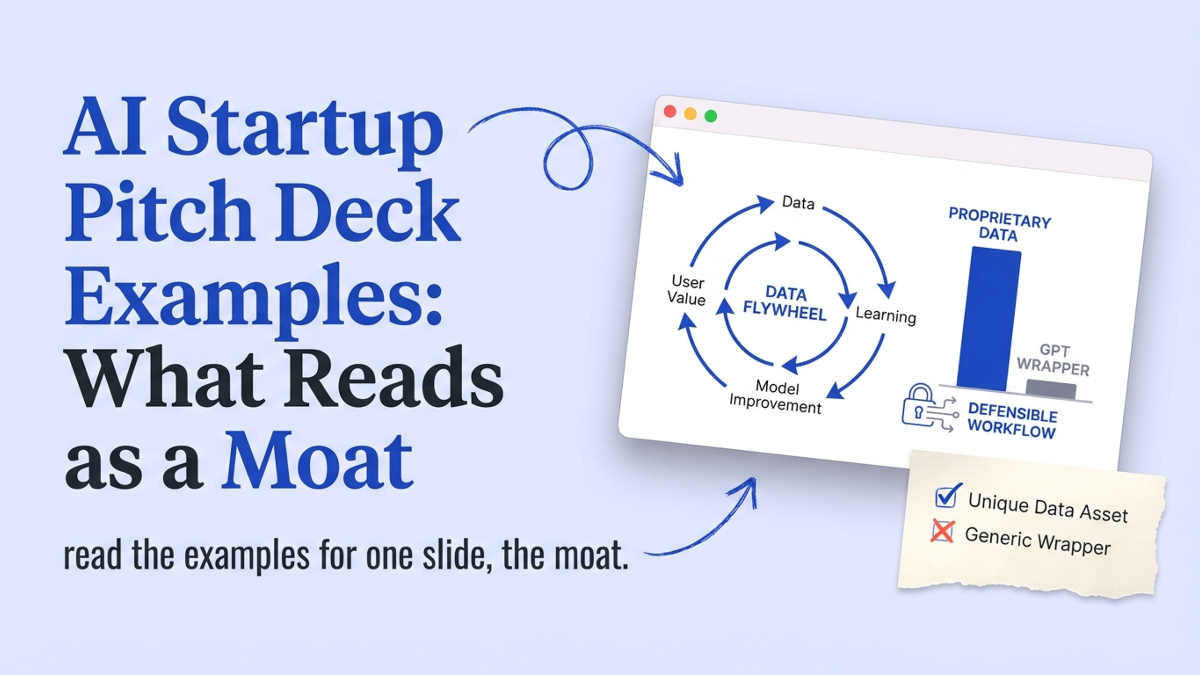
AI startup pitch deck examples are everywhere, and most of them teach you to admire the wrong thing. The galleries ranking for this search hand you finished decks from companies that already raised nine figures, with no note on which slide actually did the work. At StartWise we review founder decks every day, and in 2026 an AI deck lives or dies on one slide the templates barely mention: the moat. Here’s what reads as defensible on that slide, what gets flagged as a wrapper, and how to read the famous AI decks for it.
What makes an AI startup pitch deck different?
An AI startup pitch deck differs from a generic deck on one slide: the moat, or defensibility, slide. Cover, problem, solution, market, team, and ask are the same slides every founder builds, in the same order. What changes is that an AI investor reads your deck asking one hard question the templates skip. Why can’t a competitor rent the same model and copy this in a weekend?
We see the pattern in review every week. A founder nails the design, borrows a famous deck’s flow, then leaves the one slide that carries an AI business empty or hand-wavy.
The stakes are higher than they were even a year ago. AI companies captured 65% of all venture value in 2025, up from 46% a year earlier (Forbes and TrueBridge Capital’s 2026 State of VC report, via DECKO). The capital is concentrating too: the top five startups alone took 20% of all venture funding in 2025, about $84 billion (Crunchbase, via DECKO). More money chasing AI means more decks in every partner’s inbox, and investors have grown ruthless about the slide that separates a company from a feature. The shared slides still matter, and we’ve covered how many slides a pitch deck needs and what each one does. On those, an AI deck looks like any other. The category shows up on the moat.
Why “we use GPT” is not a moat
“We use GPT” is not a moat, and it’s the most common thing we flag on AI decks. A moat is the reason a well-funded competitor can’t catch you once you’re winning. Access to a model anyone can license is not that reason. Investors call these decks wrappers, and the label kills a raise.
DECKO’s 2026 read puts it plainly: investors want to see where AI creates defensibility, a proprietary data flywheel, a cost-structure advantage, or a workflow integration that’s hard to replicate, and they reject undifferentiated AI wrappers. Qubit Capital says the same thing in four words. In AI, data is the moat.
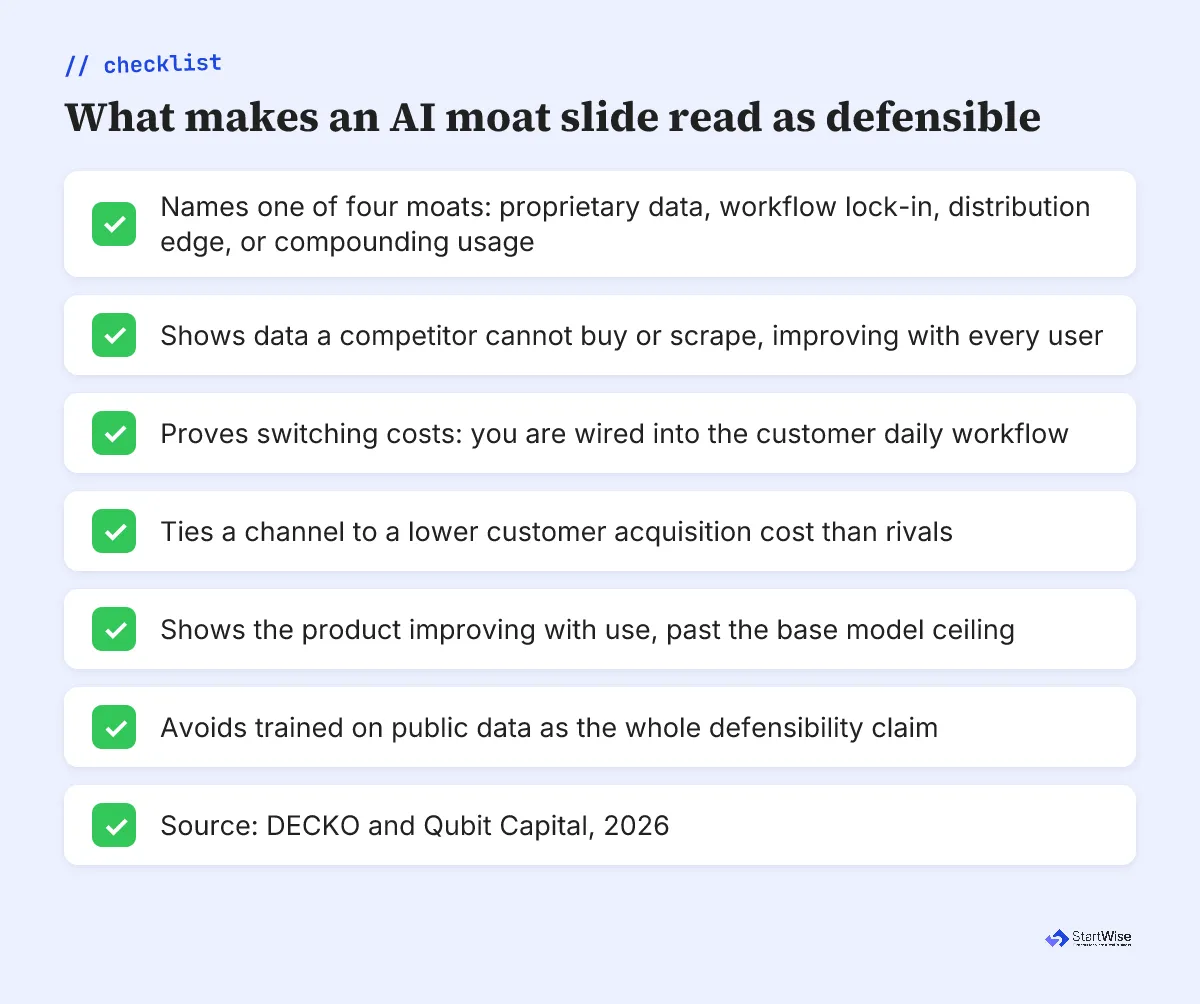
So what actually reads as defensible? In our reviews, a real AI moat sorts into one of four buckets, and everything else is a wrapper wearing a nicer font.
| The real moat | What reads as defensible | What gets waved off as a wrapper |
|---|---|---|
| Proprietary data | Data no rival can buy or scrape, improving with every user | ”Trained on public data” or a set anyone can license |
| Workflow lock-in | You’re wired into the customer’s system of record; ripping you out breaks their process | A standalone tool a user can cancel and forget in a month |
| Distribution edge | A channel that lowers acquisition cost below what rivals can match | ”We’ll run ads and publish content” |
| Compounding usage | The product gets smarter or more valuable the more it’s used | Output that plateaus at the base model’s ceiling |
If the only true sentence on your moat slide is that you use a frontier model, you don’t have a moat yet, and no amount of slide design hides that from someone who funds AI for a living. Pick the bucket you can defend, then put the evidence on the slide.
Here’s the rewrite we walk founders through, as a pattern. “Proprietary AI that resolves support tickets” is a line every rival can write, so it reads as a wrapper. The defensible version names the asset behind it: years of a niche industry’s resolved-ticket data no competitor can access, feeding a model that measurably improves each month. Same product, same base model. One sentence is wallpaper. The other is a data moat. That fix takes no new technology. It takes one honest, specific sentence about why your lead compounds instead of resetting every time a new model ships.
A model you rent is a feature. A moat is what a competitor can’t rent.
"We use GPT"
The line we flag most on AI decks, and the fastest way to read as a feature instead of a company. A rented model is table stakes now, not an edge. the moat mistake reviewers see most in 2026
What do the best AI startup deck examples actually show?
The best AI startup deck examples show a moat built from data, distribution, or lock-in, years before the advice caught up. Papermark’s 2026 breakdown of ten funded AI decks makes the pattern easy to read once you know where to look.
Anthropic raised a $13 billion Series F on roughly $1 billion in revenue, and its deck leaned on Constitutional AI and deep cloud partnerships as the durable edge (Papermark). Hugging Face’s Series D valued it at $4.5 billion on the back of a community hosting more than 68,000 models, a network effect a competitor can’t simply buy. Runway raised a $141 million Series C at a $1.5 billion valuation on proprietary video models, not a thin layer over someone else’s. Copy.ai reached $1.2 million in ARR in seven months and raised an $11 million Series A, and it led with that revenue slope rather than a feature list.
Here’s the trap in the galleries. Most of these companies were miles past your stage when they raised the deck you’re studying. Read them for the moat logic, not the numbers. A pitch deck example teaches you mechanics, never the specific figures, and the discipline we apply to SaaS deck examples and fintech deck examples applies double to AI: study the one slide that carries the category, and skip the rest.
Not sure your moat slide reads as defensible or as a wrapper? Get a free, slide-by-slide review of your deck with a concrete fix list, in minutes.
How should an AI startup’s team slide read in 2026?
An AI startup’s team slide reads best as a risk slide, not a resume. Its real job is to answer why this team won’t get out-executed once the idea is proven. In a field where the core model is rentable, investors bet on the people who can build the moat faster than anyone else can copy it.
Look at how Anthropic framed its team: the founders who led GPT-2 and GPT-3 development, not a wall of logos (Papermark). That’s proof of shipping. We keep seeing founders spend the slide on pedigree when the investor is hunting for evidence they can execute.
StartWise's position
The team slide is a risk slide, and on an AI deck that's truer than anywhere else. Its real question is why this team won't fall apart or get out-executed once the model is commoditized. Credentials answer the wrong question. Relevant scars answer the right one: what you shipped, what you sold, which version of this problem you've already lived. A row of prestigious logos tells an investor where you worked, not whether you can out-build the next team holding the same API key.
What traction do AI investors want to see?
AI investors want traction that shows the product is sticky and the economics work, not a big raw user count. The questions in 2026 are retention, engagement, and unit economics. A million signups that don’t come back is a warning, not a win, and reviewers read it that way fast.
The bar mirrors the SaaS one we’ve mapped before: an LTV to CAC ratio of at least 3 to 1, and retention or engagement trending up month over month rather than a cumulative total. At pre-seed you won’t have those numbers, and inventing them is worse than the gap. Show the slope instead. A waitlist converting, weekly active use climbing, a pilot expanding, each with a mechanism you can name out loud.
Whatever you show has to read in seconds. Investors spend about 3.2 minutes on a deck and 23 seconds on the first slide (Papermark, 2024), so a traction slide crowded with vanity totals loses the reader before your best number lands. We tell AI founders to put the one number that proves stickiness where the eye hits first. Our walkthrough of what reviewers flag on pre-seed pitch deck examples covers the before-traction version slide by slide, and what financial model investors want covers the numbers behind the slope.
Where to find real AI startup pitch deck examples
Real AI startup pitch deck examples live in a few public galleries, and you should read every one for the moat slide, not the design. Failory’s AI collection catalogs more than 50 funded decks with the round and amount for each. Papermark’s breakdown is the rare one that walks ten decks slide by slide, so you can see the moat logic instead of guessing at it.
The example we point AI founders to is never a gallery on its own. A finished deck with no notes tells you what a company chose, not why it worked or where a reviewer would flag it. Read each one with three questions in hand:
- Find the moat slide first. If the deck doesn’t have one, it can’t teach you the thing that matters most in 2026.
- Ask which of the four moat types it’s claiming, and whether the evidence on the slide actually backs it.
- Check the stage. A Series C deck’s moat is a different animal from a pre-seed one’s, and copying up a stage will sink you.
What to do this week
This week, rebuild your moat slide before you touch the design on any other slide. It’s the slide we fix first in almost every AI review, because it’s the one that decides whether an investor sees a company or a feature.
- Write your moat in one sentence. If it only says you use a frontier model, keep working until the sentence names data, lock-in, distribution, or a compounding effect.
- Move proof of shipping onto the team slide. Cut the logo wall and name what each person built.
- Replace raw user totals with a retention or engagement line that moves week over week.
- Open three funded AI decks, go straight to their moat and team slides, and copy the logic, never the numbers.
- Put it in front of someone who reads AI decks the way investors do, before an investor does.
An AI deck with a real moat slide earns the meeting. One built on a rented model, however polished, gets read as a feature and set aside. Fix that slide first.