
 By
By 
Pitch deck examples are the real decks that raised real rounds: Airbnb in 2008, Uber’s 25-slide UberCab pitch, Facebook’s 2004 media kit. Galleries show you the slides. Almost none explain why a slide worked.
We review founder decks every day at StartWise, and the same failure shows up so often we have a shorthand for it: copying the artifact instead of the mechanism. The 25 slides instead of the market thinking. The projection bravado instead of the comparables underneath it.
This teardown separates the parts that still transfer from the parts that don’t.
Why do founders study pitch deck examples at all?
Founders study pitch deck examples because decks are the one fundraising artifact with public precedents: you can read the exact slides that raised real money.
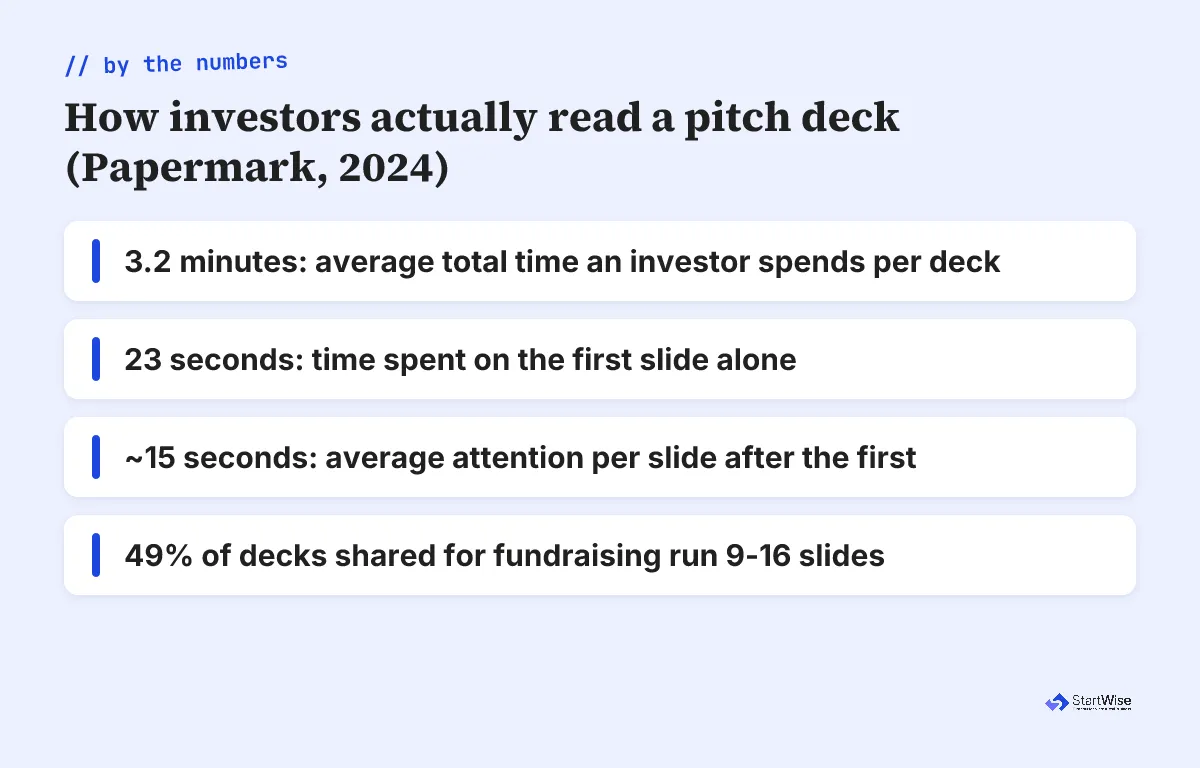
That precedent isn’t worth as much as it looks, because the reading conditions changed. Papermark’s 2024 analysis of roughly 3,000 fundraising decks, drawn from over 8 million data points, puts the average investor read at 3.2 minutes per deck. DocSend’s deck-engagement research, summarized by Dropbox, likewise pegs typical investor attention at under three minutes.
A famous example, studied properly, teaches three things:
- Skim mechanics. How a deck survives a three-minute read.
- Narrative shape. The order of the arguments, slide to slide.
- Evidence discipline. What proof sits under each claim.
What an example can’t teach is the thing founders copy most: format. Slide counts date fast. So do visual fashions and traction-bar bravado. Stage dates fastest of all, which is why the pre-seed pitch deck examples worth studying are the ones read for what a reviewer flags, not the ones you copy slide for slide.
There’s a second problem: the pages that rank for pitch deck examples are galleries, not guides. They index the slides, attach a template, and stop; the why never arrives. That’s the gap we’re filling here.
Study the famous decks like a reviewer, not like a fan. It’s the same lens an AI pitch deck review turns on your own slides, and the same rubric a pitch deck grader scores them against.
Five famous pitch deck examples, compared
Five decks dominate the example canon: Airbnb, Uber, Facebook, YouTube, and Buffer. Together they span 2004 to 2011, and that date range is the first thing to notice before you copy anything.
| Deck | Year & round | Copy this | Skip this |
|---|---|---|---|
| Airbnb | 2008 angel, $600K raised | Problem framing; market math built from Craigslist and Couchsurfing comparables | Projection bravado without the comparables that earned it |
| Uber (UberCab) | 2008 seed | Thorough market thinking | 25-slide length; vague claims; missing team and business-model slides |
| 2004 pre-seed | Engagement metrics as proof when revenue is zero | Metrics-only structure without runaway usage behind it | |
| YouTube | 2005 Series A, $11.5M | Classic problem → solution → competition structure | Treating bare slides as permission to ignore design |
| Buffer | 2011 seed | Transparency: it published its real numbers | Copying a revenue-stage traction slide pre-revenue |
The row details come from Failory’s annotated teardowns and Visme’s roundup of funded decks. The sections below tear down the two decks we see founders copy most.
What should you copy from the Airbnb pitch deck?
Copy the Airbnb deck’s problem framing and its market math. Treat everything else as a 2008 artifact.
The facts first. Airbnb pitched in 2008 after Y Combinator, asked for $500K on the financial slide, and closed $600K in its angel round, according to Failory’s teardown. Even the slide count is unstable: Visme’s copy shows 10 slides, while Failory’s annotated version runs 14.
Most founders studying the Airbnb deck are studying a reconstruction, not the original.
What earned the money still transfers.
Failory credits short sentences, market validation built on Craigslist and Couchsurfing comparables, and user testimonials proving the founders had talked to customers. Every big claim sits next to a believable mechanism.
The ask is the most copyable slide in the deck. Failory’s annotated copy runs from welcome through the financial ask, and that closing slide names the amount and what it buys: $500K for 12 months of operations. The phrase “strategic growth capital” appears nowhere; the whole slide is a number tied to runway.
What doesn’t transfer is the bravado. The deck projected a ~$21 billion business value off a $2.1 billion revenue target, and in Airbnb’s case hindsight made those numbers look conservative. In the decks we review, the copied version keeps the giant number and drops the comparables that made it credible.
Founders copying Airbnb copy the confidence and skip the comparables.
What does Uber’s 25-slide deck teach founders?
Uber’s 2008 deck teaches market thinking, and almost nothing about deck length.
Unlike Airbnb’s circulating copies, the original is public: Uber co-founder Garrett Camp published the original UberCab deck on Medium in 2017, so this is one example where you can study the artifact itself rather than a reconstruction.
Failory’s teardown calls the UberCab deck thorough: it covered the key information an early-stage investor would want. The same teardown lists what 25 slides still managed to miss:
- No business model slide
- No team slide
- No deal terms
- A solution stretched across six-plus slides that needed two or three
- Unsupported claims like “statistically optimized response time”
The length is the trap. 49% of fundraising decks now run 9-16 slides, per Papermark’s 2024 data. A 25-slide deck spends the three-minute attention budget twice over.
Uber got away with it in 2008, in a different market with different deck norms. The founders we review aren’t pitching into that market.
Copy the thoroughness of the thinking. Put most of it in the appendix.
What do the Facebook, YouTube, and Buffer decks teach?
Facebook, YouTube, and Buffer each teach one mechanic the bigger names don’t. Each carries its own copy trap.
Facebook, 2004. The deck was closer to a media kit than a modern investor deck, and it used usage and engagement statistics as its proof instead of financial data, per Visme’s roundup. The mechanic: pick the proof you actually have and commit to it. The trap: metrics-only swagger only works when the metrics are genuinely startling.
YouTube, 2005. The deck walked the traditional arc, problem to solution to competition to distribution, with almost no design polish, and raised an $11.5 million Series A (Visme). Structure carried a plain deck, which is the mechanic worth keeping. The trap is assuming 2026 forgives bare slides the way 2005 did; the reviewer data below says it doesn’t.
Buffer, 2011. Buffer published its deck openly on its own blog, and Visme credits it with pioneering deck transparency. The mechanic here is blunt: real numbers, shown plainly, build trust faster than adjectives.
Buffer’s trap is the quietest of the three, and the one we flag most at pre-seed: its traction slide had revenue behind it.
Copy that slide pre-revenue and you’ve imported a format your numbers can’t fund. Traction formats are stage-specific. More on that below.
Why do founders copy famous pitch decks badly?
Founders copy famous pitch decks badly because every famous example is an artifact of an era, a stage, and a company the copier doesn’t share.
Three mismatches do most of the damage in the decks we review:
- Era mismatch. Facebook pitched in 2004, Airbnb and Uber in 2008, Buffer in 2011. Those decks predate the send-ahead skim economy: roughly 15 seconds of attention per slide after the first, in Papermark’s 2024 numbers.
- Stage mismatch. YouTube’s famous deck raised an $11.5 million Series A (Visme). A pre-seed founder copying its structure inherits sections they have no data to fill.
- Survivorship. Galleries index winners. The decks that looked identical and raised nothing appear in no gallery. Slidebean’s 35-deck list and Pitch Deck Hunt’s 1,000-deck index can’t show you what failure looks like.
StartWise's position
The 10-slide ceiling is wrong for pre-seed. Most "perfect deck" advice optimizes for partner meetings, not cold outreach. A cold-outreach deck has one job: earn a 20-minute call. That usually means fewer slides and a sharper problem slide than the famous templates suggest.
None of this makes the examples useless. It makes them raw material that needs translating to your stage and your year. That translation is exactly the work the galleries skip.
What do recently funded decks change?
Recently funded decks change the benchmark: the public examples worth copying now closed their rounds in the last two years, not the last two decades. The canon still teaches mechanics. It stopped setting the format.
Take Octave, an AI go-to-market startup. Its 12-slide deck raised a $5.5 million seed round in 2025, published by Bonfire Ventures and Business Insider. Twelve slides. That sits dead-center in the 9-16 band half of decks now use, and it runs less than half the length of Uber’s celebrated 25.
The decks we review look far more like Octave’s twelve slides than Uber’s twenty-five. When a founder shows up with a 24-slide deck, the reference they copied is almost always a decade old.
$2B+
raised across 100+ real startup decks published in the last 18 months. Alai pitch deck examples library, 2025
There’s a filterable library of the recent set too. Alai’s collection indexes 100+ decks from the last 18 months, from Krepling’s $1.2M pre-seed in March 2024 to Finix’s $18M round that October. Read one 2025 deck before you read Airbnb. The old legends show you the mechanics; a recent deck shows you the format investors are opening this quarter.
What do deck reviewers flag when founders copy examples?
Reviewers flag the same copy-induced gaps again and again: design working against the founder, no answer to “why now”, and a missing go-to-market plan.
The cleanest public tally comes from startup advisor Ben Yoskovitz, who reviewed 50 early-stage decks and published the results on Focused Chaos in August 2025:
- Design worked against the founder in 93% of decks
- 75% had no “Why now?” slide
- About 40% skipped the go-to-market plan or phoned it in
- More than a third contained typos
Notice what’s on that list. Uber’s celebrated deck skipped the business model and team slides entirely, per Failory. Founders still trace it as a structural template.
We see the same imports in review week after week: Uber’s length, Airbnb’s projection bravado, Facebook’s metrics-only swagger with none of the metrics.
Founders copy the famous omissions right along with the famous slides.
Copied a famous deck's structure? See what a reviewer would flag on yours: slide-by-slide, with a concrete fix list, free.
How long do investors spend reading a pitch deck?
Investors spend an average of 3.2 minutes reading a pitch deck, according to Papermark’s analysis of about 3,000 decks shared between January and December 2024.
The budget breaks down unevenly. The first slide gets 23 seconds, more than twice the attention of any later page, and slides after the opener average roughly 15 seconds each. DocSend’s research, summarized by Dropbox, describes the standard deck as roughly 20 pages with about 50 words per slide.
This is also why Guy Kawasaki’s 10/20/30 rule (ten slides, twenty minutes, thirty-point font) needs translating before you apply it. It was written for live pitches. A send-ahead deck never gets its twenty minutes; it gets the skim.
Read the famous examples against that clock. Airbnb’s 10-14 slides fit the attention budget with room to spare; Uber’s 25 slides would burn it twice over before the ask. We run the full numbers, per audience and with a 12-slide skeleton, in how many slides a pitch deck actually needs.
Build for the skim first; the deep read is the second pass.
How do you read a pitch deck example like a reviewer?
Reading a pitch deck example like a reviewer means interrogating it with five questions before copying anything from it.
- What round, what year? A 2008 angel deck and a 2026 seed deck are different documents. Date every example before you study it.
- What evidence sits beside each claim? Airbnb put Craigslist comparables next to its market number. Find the proof on every slide. Notice when there isn’t any.
- What did the deck omit, and why did it survive the omission? Uber skipped the team and business-model slides (Failory) and raised anyway. You need a reason to believe you’d survive the same gap.
- Which slides survive a 15-second read? That’s the per-slide attention budget in Papermark’s 2024 data. Slides that need a minute of study were built for a meeting, not a cold send.
- What would a stranger say this company does after slide two? If the answer is fuzzy on a famous deck, the deck succeeded despite it, not because of it.
Run those five questions against any example and you’ve turned the gallery into a syllabus.
The same lens works on your deck. It’s exactly how we read one in a structured review.
Which pitch deck galleries are worth your time?
Three galleries cover nearly everything worth studying, and you’ll use each one for a different job.
- Slidebean’s examples library has 35+ famous decks with funding context per company. Best for a quick tour of the canon; expect template upsells, not analysis.
- Pitch Deck Hunt indexes 1,000+ decks, searchable by category. Best for volume and finding decks in your industry.
- Failory’s deck database filters by stage, industry, and amount raised, with annotated teardowns per deck. It’s the only one of the three that critiques, which makes it the only one that explains why a slide worked.
Having sent founders to all three: Failory is the only one I’d call study material. The other two are flipbooks: useful flipbooks, but flipbooks.
None of the galleries date-stamp the norms their decks were built under. Carry the five reviewer questions with you, or you’re just multiplying the copy trap.
Steal the mechanics, not the slides
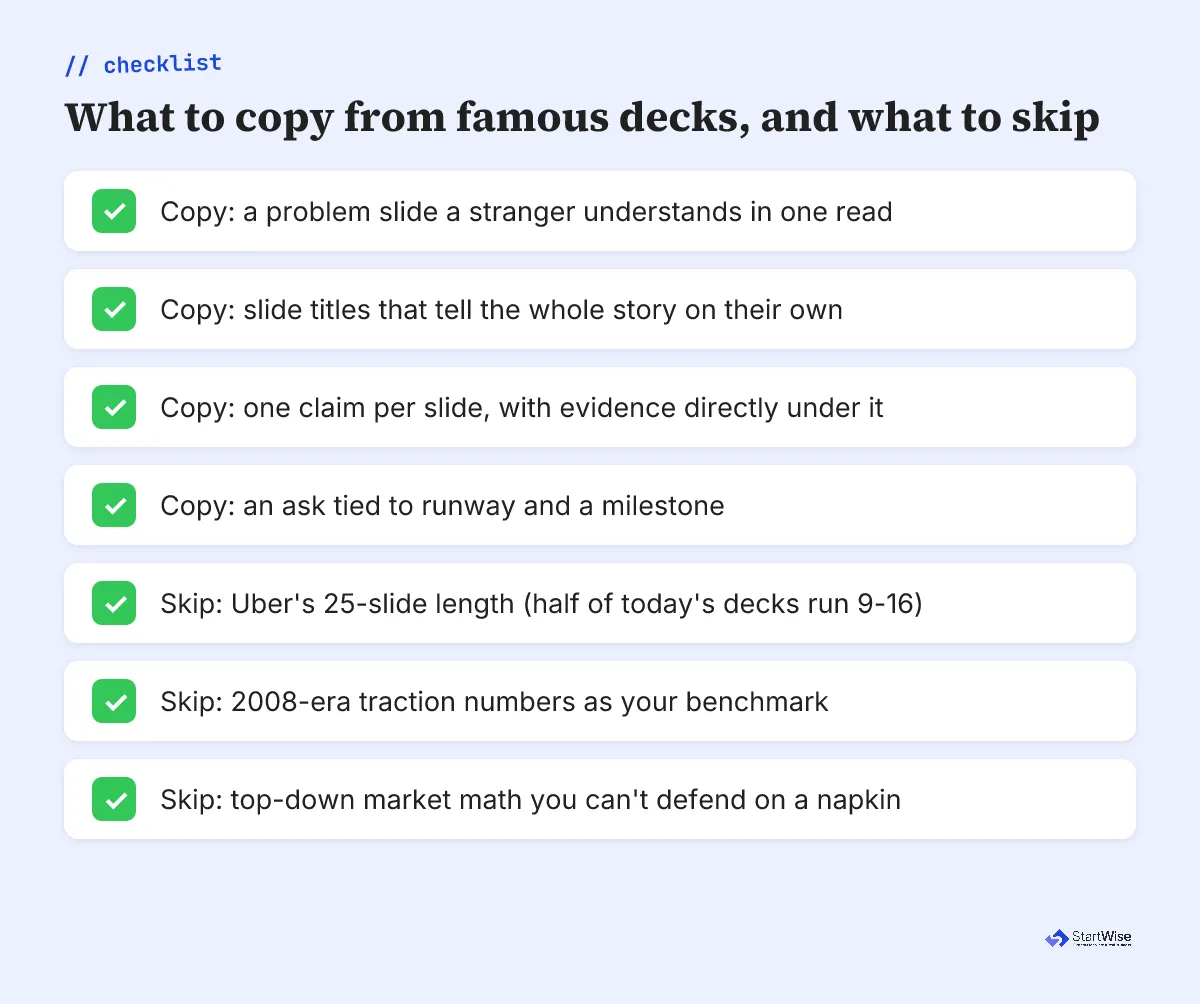
The transferable parts of a famous pitch deck are mechanics: problem framing, narrative titles, evidence discipline, bottom-up math, and a concrete ask.
- Frame the problem for strangers. Airbnb’s deck reads clean because a stranger gets the problem in one pass. Failory credits its short sentences and plain claims. If your problem slide needs industry context, it isn’t done.
- Make slide titles carry the story. Read only your titles. If the narrative survives, the skim survives. Titles are the one part of every famous deck we’d trace slide by slide.
- Put one claim per slide, evidence under it. Facebook’s 2004 deck used engagement statistics as its proof when revenue was zero (Visme): claim, then number, nothing else.
- Build market math bottom-up. Airbnb sized its market from Craigslist and Couchsurfing comparables. A reachable-customers count beats a trillion-dollar TAM (total addressable market, the entire market you could theoretically serve).
- Tie the ask to a milestone. Airbnb’s deck asked for $500K to fund 12 months of runway (Failory). An amount plus a runway plus a milestone is an ask; an amount alone is wallpaper.
Match the example to your stage before you copy it
A pitch deck example only helps when it matches your stage: a Series A deck teaches a pre-seed founder the wrong lessons.
YouTube’s deck raised an $11.5 million Series A in 2005 (Visme). Copy its competition section at pre-seed and you end up defending a product that doesn’t exist yet.
| Your stage | What the famous example can’t show you | What yours must show |
|---|---|---|
| Pre-seed | Real traction: the famous decks had explosive usage or skipped the slide | Direction and speed: week-over-week movement with a believable mechanism |
| Seed | 2008-sized rounds and 2008 expectations | Early revenue or usage depth, plus the model behind the projections |
The difference between the two rows is rigor, not slide order. The skeleton holds across stages; what each slide must prove tightens as the round grows. A seed traction slide carries numbers a pre-seed deck honestly can’t. The same goes by industry: if you’re building software, SaaS pitch deck examples reads the famous decks for the one slide that’s actually SaaS-specific, the metrics slide, and AI startup pitch deck examples does the same for the moat slide an AI investor now weights most.
If that first raise is the one in front of you, our guide to how to raise a pre-seed round covers the sizing, timeline, and outreach mechanics behind the deck.
StartWise's position
Traction is a slope, not a number. Pre-revenue founders keep putting absolute counts on the traction slide. At pre-seed, investors read direction and speed: week-over-week movement with a believable mechanism beats a vanity total every time.
Stage- and industry-specific example teardowns are next on this blog. The editorial rules they follow (answer-first, named sources, no email gates) are on the About page, and every post carries the same accountable author profile.
What to do this week
Turn the examples into edits. Four jobs, in the order we’d run them:
- Run the title skim test. Read only your slide titles. If the story doesn’t survive, rewrite the titles before touching anything else.
- Napkin-check your market slide. Rebuild the number bottom-up from reachable customers, the way Airbnb used comparables. Math that dies on a napkin dies in meetings.
- Cut to the attention budget. 49% of decks run 9-16 slides (Papermark, 2024). Earn every slide past that band or move it to the appendix.
- Get a cold read. Whatever tool you built it in, hand the deck to someone who’s never heard the pitch and give them three minutes. The average investor gives you 3.2. Fix whatever they stumbled on, then repeat. New teardowns land here six days a week; the RSS feed carries every post, no email required.
The famous decks already did their job: they raised. Yours hasn’t yet.
Study the mechanics, skip the artifacts, make the three-minute skim easy. That’s the whole game.