
 By
Edtech pitch deck examples are easy to find and hard to learn from. The galleries ranking for this search hand you a wall of famous edtech logos with no note on which slide actually raised the round. We review founder decks every day at StartWise, and an edtech deck breaks from every other deck on one slide: the outcomes slide, which has to prove your product changes a measured result for whoever pays. Edtech funding fell to $1 billion in the first half of 2026, down 26 percent year over year (HolonIQ). Here’s how to read the examples for that.
What makes an edtech pitch deck different?
An edtech deck lives or dies on proof that learning actually happens for the person or institution writing the check. Investors have watched a decade of decks sell screen time and sign-ups, so they skim the product tour and hunt for a measured result instead. The slide that carries the story is the outcomes slide, where a SaaS deck leans on retention and a consumer app deck leans on daily engagement.
The first thing I flag on an edtech deck is a hero number for users or downloads, with no line on what those users learned. Big reach, no result.
Edtech hides a second trap most decks ignore. The person using the product isn’t usually the one paying for it, which reshapes the business model slide and the go-to-market slide more than in almost any other category.
Five edtech decks worth studying slide by slide
The edtech pitch deck examples worth your hour are the ones where you can reverse-engineer the outcome-and-buyer story, not the ones with the cleanest animation. Here’s what we’d pull from recent raises.
- Careerist raised $8 million on a 12-slide deck (VIP Graphics) that led with job placements at Google, Apple, and Amazon, then tied revenue to the outcome with a money-back guarantee if a graduate didn’t land a tech job within a year.
- Preply raised a $150 million Series D at a $1.2 billion valuation in January 2026 (EdTech Innovation Hub), positioning AI as an amplifier for human tutors rather than a replacement, the exact distinction investors now reward.
- Multiverse raised $70 million at a $2.1 billion valuation in May 2026 (New Market Pitch) by selling workforce apprenticeships against an employer-facing outcome: hired, productive staff.
- MagicSchool raised $45 million in 2025 (World Assessment Council) as an AI tool built to support teachers, with distribution into schools instead of a consumer download funnel.
- Medly AI secured $8 million for an AI tutoring platform already used by more than 400,000 students (New Market Pitch), a case where reach is real but the outcomes slide still has to carry the round.
Study four of these properly. Skimming thirty galleries teaches you layout, not fundraising.
How should the outcomes slide prove learning gains?
Show a measured result with a comparison, and name who pays for it. The strongest edtech decks we review put an effect size on the slide, a number for how much students using the tool improved against a control group, rather than a chart of logins climbing. An effect size is simply the gap between the group that used your product and the group that didn’t.
2%
Only this share of consumer technologies used in classrooms had evidence that met the U.S. ESSA standard, and just 52.5 percent of Instructure's top 40 tools reached Level IV. Evidence is the price of entry now. HolonIQ, 2026
ESSA is the U.S. benchmark for whether an education product has proof it works, and buyers increasingly ask for it by name. The galleries never show you this, because a static deck image can’t hold a control-group chart or the study behind it. So founders copy the big engagement headline and they’ll skip the slide that moves the money.
Engagement is not an outcome. An investor who has seen a hundred time-on-app charts funds the founder who shows a score that actually moved.
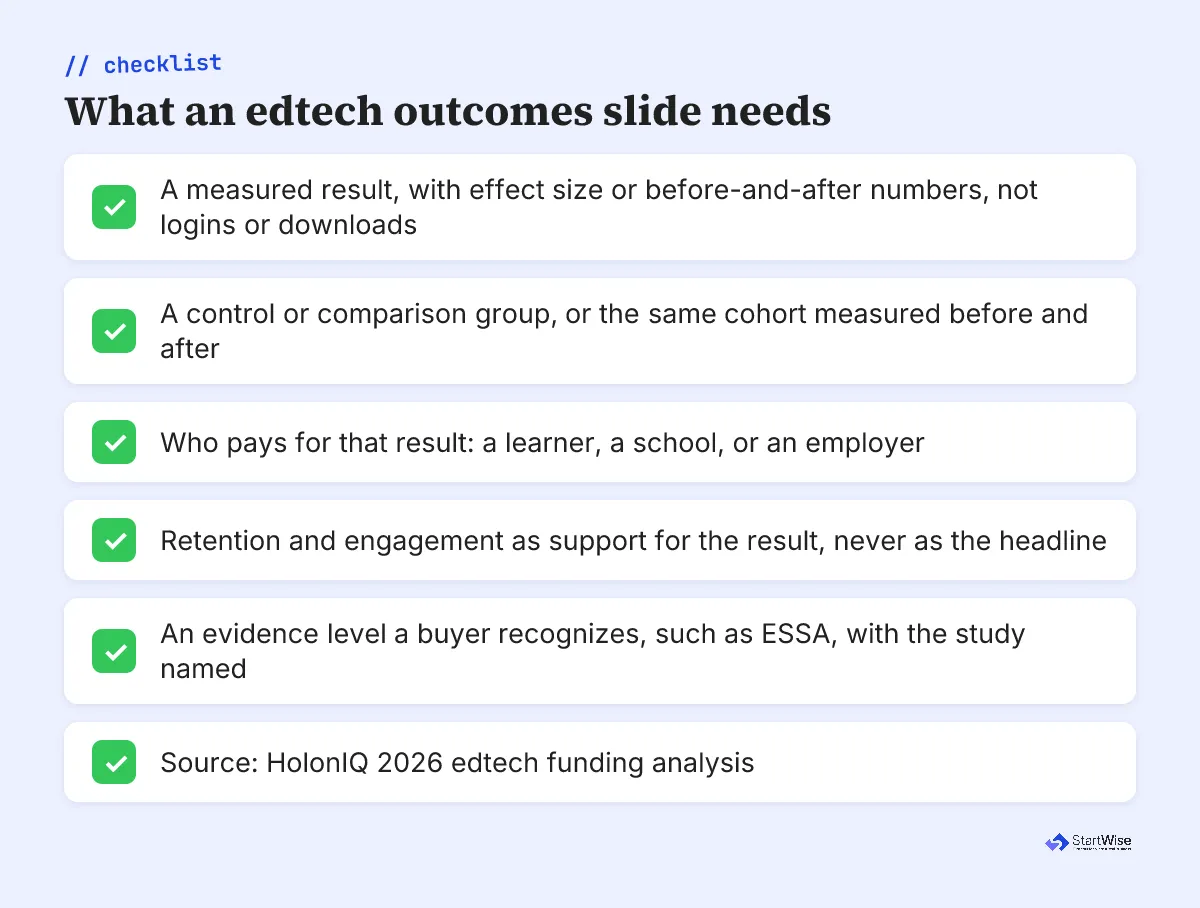
Your edtech outcomes slide needs a few specific things, and the checklist below is the version we hand founders before a review.
Who actually pays for your edtech product?
In edtech, the user and the buyer are usually different people, and your deck has to name the one who pays. A student uses the app. A district, a university, or an employer signs the contract, and each buyer carries a different sales cycle and budget. A school purchase can run a full academic year from pilot to signature, while a consumer subscription closes in a session.
That split decides your business model slide. A B2C self-serve deck and a B2B2C deck, where you sell to a school that serves the learner, read like two different companies. We see founders lose the room when they’re not clear which one they’re pitching.
StartWise's position
Most edtech market slides are theater. After reviewing decks daily, our take is that a $7 trillion global education TAM tells an investor nothing. A bottoms-up count of the buyers who will pay for your outcome, districts, departments, or employers, tells them everything. Count the checks, not the learners.
Map your market slide to that buyer, and your business model slide to how they actually buy. A founder who names 400 reachable districts at a real contract value beats one who waves at the whole education economy.
Not sure your outcomes slide would convince an investor your product actually works?
What edtech funding numbers should shape your deck?
Edtech funding in 2026 is smaller and far choosier, and your deck has to read the room. Investment fell to $1 billion in the first half of 2026, down 26 percent year over year, and the whole category sits 89 percent below its 2021 peak of $20.8 billion (HolonIQ via QS; World Assessment Council).
| Edtech segment | 2025-26 funding signal | What it means for your deck |
|---|---|---|
| Workforce and upskilling | 38% of 2025 deals, largest share | Tie the outcome to a hire or a promotion an employer pays for |
| K-12 institutional | Active at smaller ticket sizes | Lead with district-ready evidence and a realistic sales cycle |
| AI tutoring and consumer | Crowded and commoditizing | Prove a result a free chatbot can’t, not an “AI-powered” label |
| Higher ed and workforce AI | Larger rounds like Preply at $150M | Show AI amplifying humans, with outcome and retention data |
Source: World Assessment Council, 2026.
Here’s what that means for you. If you’ve built an AI tutoring tool, you’re fishing in the most crowded part of the pool, so your outcomes slide has to prove something a general-purpose chatbot can’t. I’d rather see a sharp wedge into one buyer with a measured result than a slide claiming the whole market is yours.
What changes from pre-seed to seed edtech decks?
Between pre-seed and seed, the edtech bar moves from “could this teach” to “is the result holding up at scale.” At pre-seed, investors fund a credible outcome hypothesis and a team close to the problem, sometimes before a paying customer exists. A pilot with one school or employer and an early effect size can carry the round.
By seed, they’ll want the outcome proven with a buyer who pays: a renewed district contract, a cohort whose result held across a full term, a retention curve that doesn’t collapse after week three. Investors spend about 3.2 minutes on a deck (Papermark, 2024-2025), so that proof has to read in seconds. The jump mirrors what we cover in the pre-seed and seed round deck breakdowns.
What to do this week
Rebuild your edtech deck around the outcomes slide, then work outward. Here’s the order I’d fix it in to get the most from an hour:
- Put one measured result on the outcomes slide, with an effect size and a comparison group, and cut every vanity reach number.
- Name the buyer who pays for that result, and match your business model and sales cycle to them.
- Replace a global education TAM with a bottoms-up count of the districts, departments, or employers you can reach in year one.
- Add the evidence level a buyer recognizes, ESSA or an equivalent, with the study named on the slide.
- Read four recent edtech decks like Careerist and Preply for the outcome-and-buyer story, then cut any slide of yours that doesn’t move it.
A wall of monthly active users doesn’t pencil in 2026. A result someone will pay for does, and that’s the number that earns the next round. Count the checks, not the learners, and the rest of the deck gets a fairer read.