
 By
By 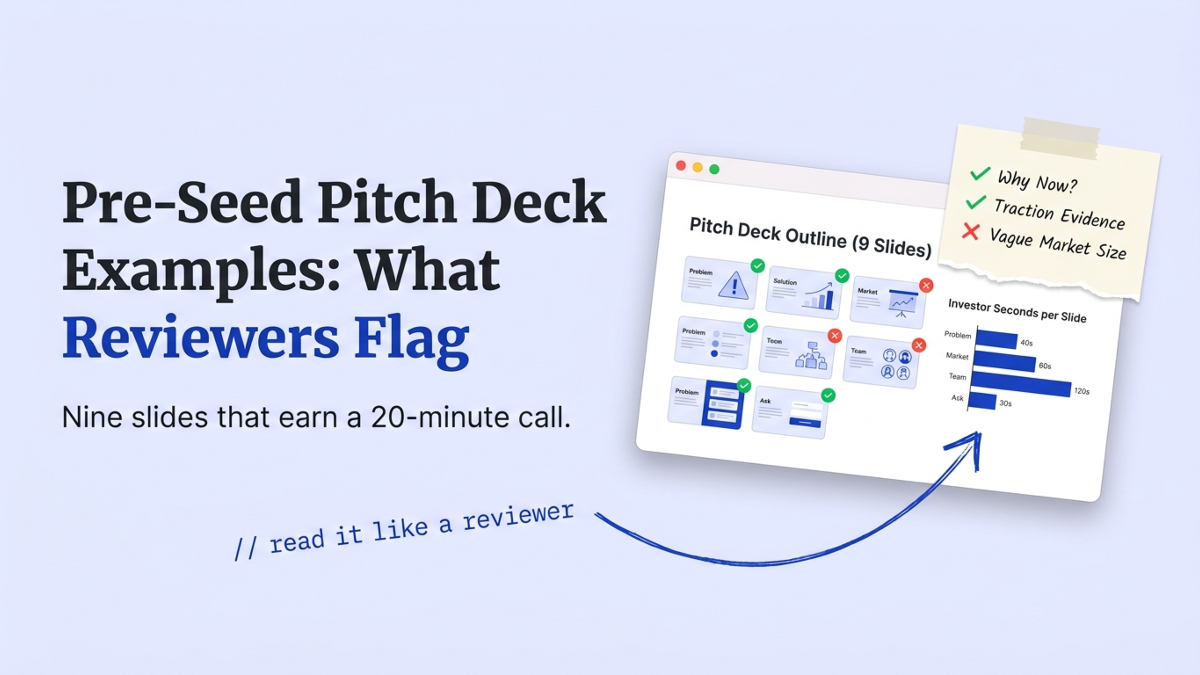
Pre-seed pitch deck examples are easy to find and hard to learn from. The galleries that rank for this search show you finished decks with no notes on why a slide works or where it would get flagged. At StartWise we review founder decks every day, and the pre-seed ones fail in a pattern: too many slides, a buried team, and a problem slide that explains a market instead of a pain. Here’s what a pre-seed deck should contain, slide by slide, and how to read the examples you find.
What goes in a pre-seed pitch deck?
A pre-seed pitch deck needs nine slides that prove one thing: this founder, in this market, is worth a 20-minute call. Cover, problem, solution, why now, market, product, team, traction, and the ask. Everything else is an appendix you send only if someone asks for it.
The order matters more than most pitch deck templates admit. We keep seeing the team slide buried at slide ten, when at pre-seed an investor is betting on you, not on numbers you don’t have yet.
| Slide | Its one job | What we flag at pre-seed |
|---|---|---|
| Cover | Say what you do in one line | Taglines nobody parses in two seconds |
| Problem | Name a sharp, frequent pain | Describing a market, not a pain |
| Solution | Show the product, even rough | A feature list with no screenshot |
| Why now | Explain the timing | Missing entirely, the most common gap |
| Market | Bottom-up reachable customers | A $1T top-down number with no math |
| Team | Why this team wins | Buried late, logos over scars |
| Traction | An upward slope | Vanity totals with no mechanism |
| Ask | One milestone, one number | A round number tied to nothing |
Read your own deck against that right-hand column before you read it against any example. It catches more than a gallery will.
Two slides decide most pre-seed outcomes: the cover and the problem. The cover has to name your category in one readable line, because it gets the longest look and the shortest patience of any slide. The problem slide right after it has to land a pain a real person feels this week, not a trend you read about. Get those two right and an investor keeps reading.
How is a pre-seed deck different from a seed deck?
A pre-seed deck sells potential; a seed deck sells proof. The labels stay the same, but what each slide has to do changes once you have real traction and revenue to point at. Antler found investors spend 55 seconds on the competition slide at pre-seed and only 34 seconds once you’ve raised, so the earlier you are, the more they probe what could kill you.
| Slide | Pre-seed version | Seed version |
|---|---|---|
| Problem | A sharp, named pain | The same pain, now quantified |
| Traction | Waitlists, pilots, a slope | Revenue, retention, growth rate |
| Market | Bottom-up reachable count | TAM backed by your own funnel data |
| Team | Why you’ll figure it out | What you’ve shipped together already |
| Financials | None, or a 12-month sketch | An 18 to 24 month model |
| Ask | $750K to $1.5M on a SAFE | $2M-plus, often priced |
The traction slide is where the stage gap shows most. At pre-seed you might have a waitlist of 400 and three signed pilots; at seed you’d point to $15K in monthly recurring revenue growing 20% a month. Same slide title, completely different bar. Borrow the seed bar too early and your own deck makes you look behind.
The mistake we see most is a pre-seed founder borrowing a seed deck’s skeleton, then padding the empty slides with projections to fill the gap. A SAFE, short for Simple Agreement for Future Equity, is the standard pre-seed instrument, so you rarely need the valuation and cap-table detail a priced seed round demands. If you’re still deciding what to raise, our pre-seed fundraising checklist walks the round sizes line by line.
Which slides do reviewers flag most on a pre-seed deck?
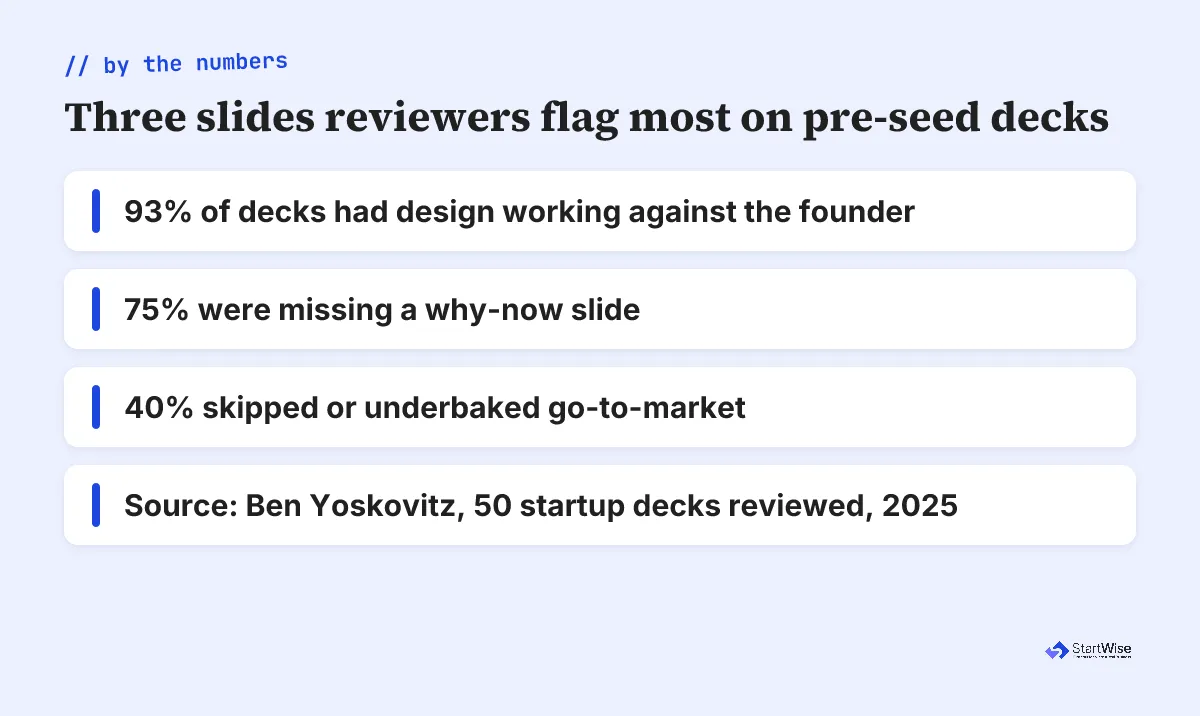
Reviewers flag the same three slides on pre-seed decks again and again: the missing why-now, the weak go-to-market, and a problem slide that reads like a market report. When we review a pre-seed deck, the why-now is the first slide we look for, because its absence predicts the rest.
Ben Yoskovitz read 50 startup decks in 2025 and found 93% had design working against the founder, 75% were missing a why-now slide, and 40% either skipped go-to-market or underbaked it. Over a third had typos. None of that is about the idea. It’s execution an investor reads as a proxy for how you’ll run the company.
The why-now is the cheapest fix on this list and the most skipped. At pre-seed, 92% of successful decks worldwide include one (Antler). If you can’t say why this company has to exist now and not three years ago, an investor assumes you haven’t thought about it.
The problem slide is the other repeat offender. Founders describe a market when they should name a pain. “The $200B logistics industry is inefficient” is a market. “Warehouse managers rebuild the same shift schedule by hand every Friday” is a pain, and it’s the version that earns a nod. We rewrite more problem slides than any other slide in a review.
Market sizing is the quiet third flag. A $1T top-down number signals you Googled it; a bottom-up count of how many customers you can actually reach in year one signals you’ve done the work. Investors trust the small honest number over the big borrowed one, and our TAM SAM SOM example shows how to build it.
How long should a pre-seed pitch deck be?
A pre-seed pitch deck should run about nine slides, not the 13 or more that later-stage templates push. Investors spend about 3.2 minutes on a deck and 23 seconds on the first slide (Papermark, 2024), so every extra slide steals attention from the ones that earn the meeting.
There are really two pre-seed decks. We tell founders to write the teaser first: the five-or-so slides you attach to a cold email, built to earn a reply. The send-ahead deck you share after interest runs 10 to 13. Bluewire’s deck, which Antler highlights, was nine slides, and it worked.
A teaser usually runs five slides: cover, problem, solution, a sliver of traction, then the ask. That’s it. You’re not closing anyone on five slides; you’re earning the reply that gets the full deck in front of them. The send-ahead version expands each of those and adds market, team, why-now, and product.
Nine sharp slides that earn a call beat sixteen thorough ones that lose the room by slide four.
Across the 3,000 decks Papermark analyzed in 2024, 49% ran 9 to 16 slides. The famous long decks are outliers you shouldn’t copy. For how the count breaks down by audience, see our guide to how many slides a pitch deck needs.
StartWise's position
The 10-slide ceiling most advice repeats is wrong for pre-seed cold outreach. A cold deck has one job, earning a 20-minute call, and that usually means fewer slides and a sharper problem slide than any template suggests. Optimize the first three slides for a 23-second skim (Papermark, 2024), not a partner meeting you haven't been invited to yet.
Not sure which of your nine slides a reviewer would flag? Get a free, slide-by-slide review of your deck with a concrete fix list, in minutes.
Should a pre-seed pitch deck include financial projections?
A pre-seed deck should not include three years of financial projections. You have no revenue to forecast from, so the numbers are guesses, and investors know it. Show a traction slope and a simple use of funds instead.
Pre-seed investors underwrite the team, the thesis, and early demand, not a model built on assumptions you invented last week. A 12-month sketch of how the raise gets spent is useful, and it maps to what financial model investors actually want at your stage. A hockey-stick chart climbing to $40M in year three is the slide we most often tell founders to cut.
What you show instead is simple. A 12-month view of where the money goes, broken into a few buckets such as hiring, product build, and the runway to your next milestone. That tells an investor you’ve thought about the spend without pretending you can forecast revenue you don’t have yet.
On the traction slide, direction beats totals. A pre-revenue founder showing week-over-week signups climbing with a clear reason behind the climb tells an investor more than one big number with no mechanism. Tie the ask to that direction, not a round figure.
Where to find real pre-seed pitch deck examples
Real pre-seed pitch deck examples live in a handful of public galleries, but galleries teach format, not judgment. Pitch Deck Hunt and Failory each host more than 50 real decks, and Antler annotates a few, like Castle, which raised $270,000, and Manpacks, which raised $500,000.
Antler’s annotated examples beat the raw galleries for exactly this reason: someone tells you why Castle’s problem-first flow worked. A plain gallery just hands you the file and wishes you luck.
The trap is copying what you see. Most galleried decks raised in a different market, at a different stage, with a story that fit that founder. We read every example deck title-first, because that’s how an investor skims yours. Read them for mechanics:
- Read the slide titles alone. If they tell the story without the body, the deck passes the skim test.
- Check the problem slide. Does it name a pain, or describe a market?
- Find the why-now. If it’s missing, you’ve found the gap your deck can beat.
For the famous decks, Airbnb and Uber and the rest, read the same way, see what to copy and what to skip in pitch deck examples. The mechanics travel across eras; the formats don’t. And if you’re building software, SaaS pitch deck examples covers the metrics slide that changes once you have recurring revenue to show.
What to do this week
Rebuild your deck to nine slides this week, in the order we’d use, and pressure-test each one against what a reviewer would flag.
- Cut to nine slides and move the team slide to position two or three.
- Write a why-now slide if you don’t have one. It’s the most-skipped slide and the cheapest win.
- Delete the financial-projections slide. Replace it with a traction slope and a 12-month use of funds.
- Rewrite the problem slide to name a pain, not a market.
- Read your slide titles alone. If they don’t carry the story, fix the titles before the bodies.
Then put it in front of someone who reads decks the way investors do, before an investor does. The gap between a deck that’s polished and a deck that’s fundable is almost always one of the eight flags in that first table.