
 By
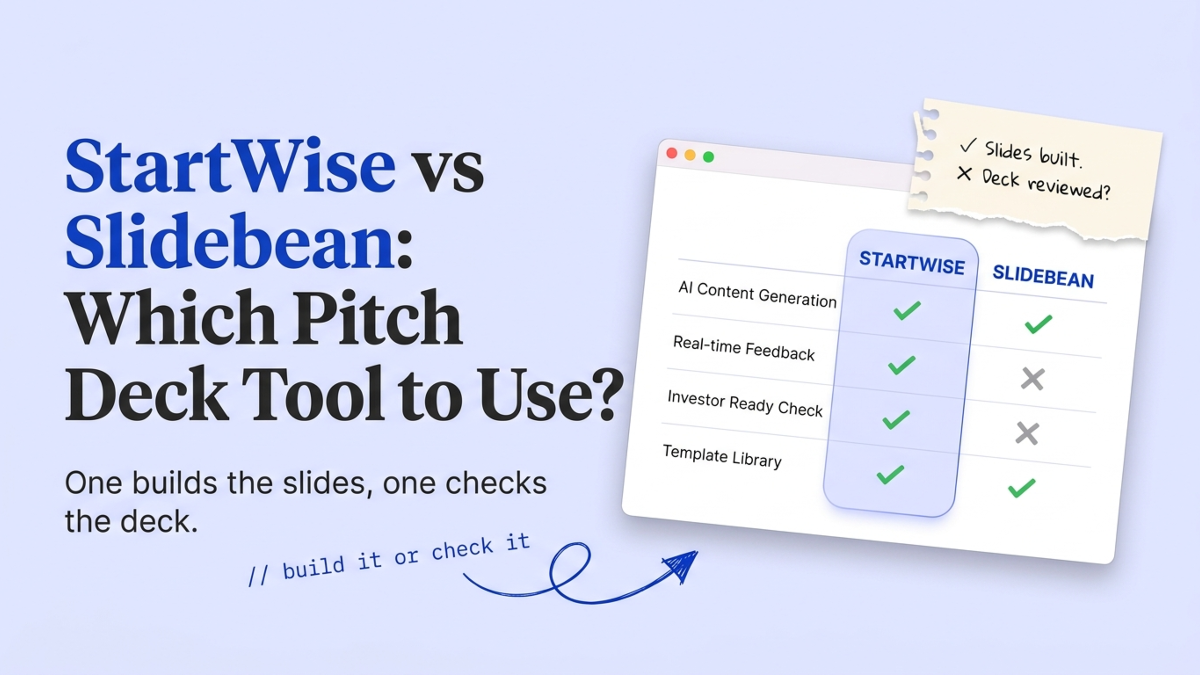
Slidebean and StartWise both help founders raise money, but they solve different jobs. Slidebean is an AI pitch deck builder and paid design agency that’s run for more than ten years and says its clients have raised $400M. StartWise is a whole idea-to-investor-ready platform, and its deck tool reviews slides instead of drawing them. We read founder decks every week. The honest verdict on “which one” tends to surprise people, because for most of them, it isn’t either-or.
Slidebean vs StartWise: which should you use?
Use Slidebean when you need slides built or designed for you, and StartWise when you need the deck checked and the rest of the raise handled. They sit in different categories, so the sharpest way to read the choice is by the job you’re hiring the tool to do. The table below splits that job cleanly, with StartWise first because its review is the piece a builder can’t give you.
| Tool | Best for | Builds or reviews the deck | Starting price |
|---|---|---|---|
| StartWise (Pitch Deck Doctor) | The whole raise: idea test, deck review, model, investors. Check your deck free → | Reviews decks you build anywhere, slide by slide | Free check |
| Slidebean | Building and designing a startup deck fast | Builds slides with AI or a paid agency | $7/mo |
Neither row wins outright. One makes the slides; the other tells you whether the slides work. We see founders reach for a review only after they’ve paid to build, which is backwards more often than not. If you’re comparing StartWise against an all-in-one generator instead of a builder, StartWise vs PitchBob runs that head-to-head, and if the choice is an interactive, tracked web deck, StartWise vs Storydoc covers that one.
What does Slidebean actually do?
Slidebean does three things: it builds decks with AI, it designs them for you through a paid agency, and it wraps a few fundraising tools around both. You type in your content, and its automated design engine lays out the slides so a non-designer can’t make them ugly. It ships more than 100 investor-shaped templates, tracks who views your deck and for how long, and includes a cap table tool and an AI deck review on the paid tiers.
Pricing is genuinely cheap. A free tier lets you build unlimited decks but not export them. Starter runs $7 a month billed yearly, and the $99-a-month Accelerate plan adds an investor CRM, financial forecasting, and a strategy call with founder Caya. The done-for-you design agency is a separate quote.
The traction is real, too. Slidebean says about 30,000 new startups use its builder each month and its clients have raised $400M, with more than $500M raised in the last 18 months through decks its agency built.
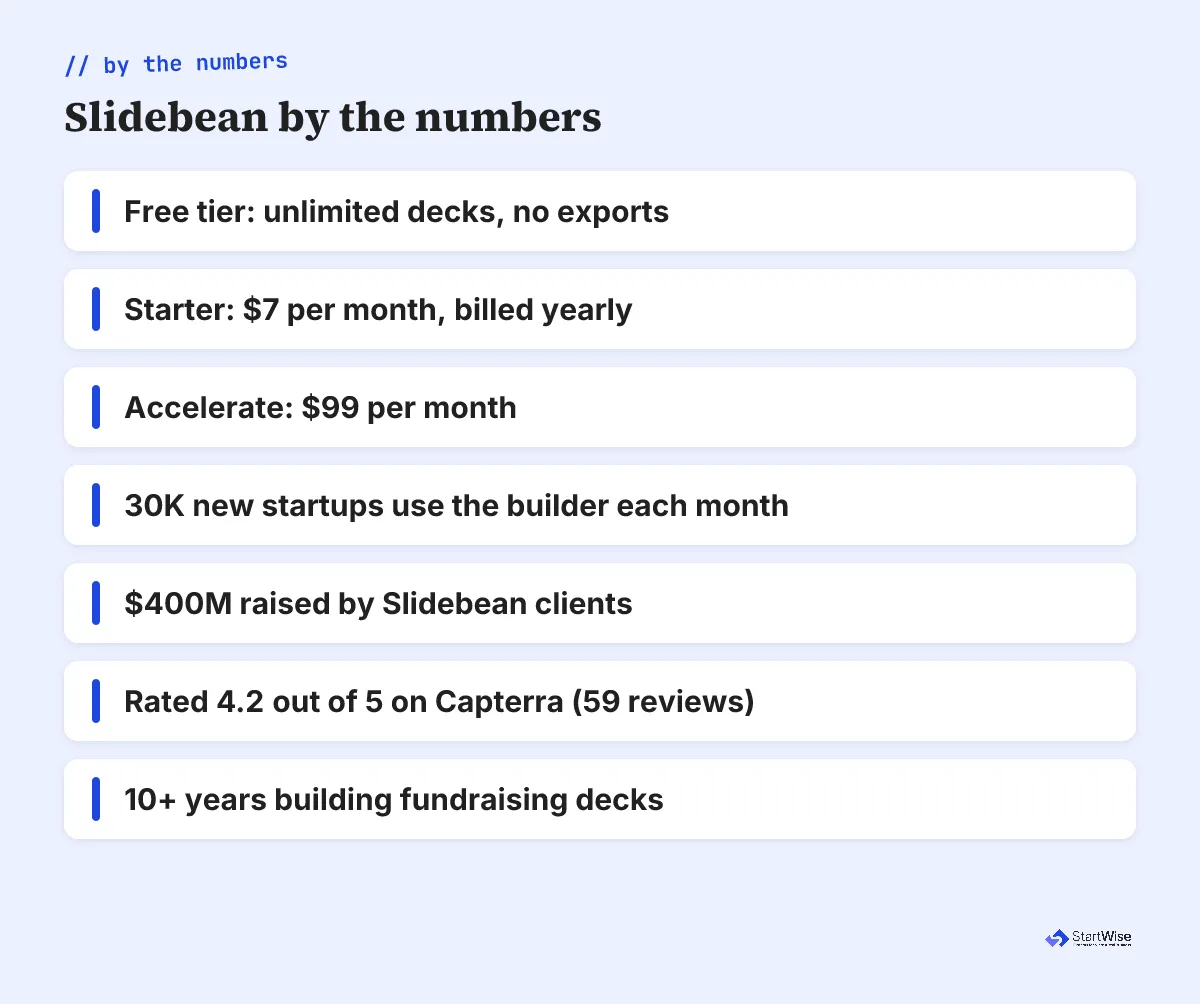
I’ll be fair about the rough edges, because a rigged comparison reads as marketing. Slidebean holds a 4.2 out of 5 on Capterra across 59 reviews. The recurring complaints are worth knowing before you commit: PowerPoint exports that lose fonts and turn charts into flat images, limited customization, and slow support. If you need pixel control or a clean .pptx, test those first. If you haven’t committed to Slidebean yet, our ranked roundup of AI pitch deck generators weighs it against Gamma, Canva, and the rest by bottleneck, and our Slidebean alternatives roundup groups the same tools by the job you actually need done. For design automation specifically, StartWise vs Beautiful.ai covers that trade-off.
What does StartWise do that Slidebean doesn’t?
StartWise doesn’t build slides at all, and that’s the biggest difference between the two. It reviews the deck you already have, and it covers the parts of a raise that sit before and after the slides. That’s a different product than a builder, aimed at a different moment.
The span is wider than a builder’s. StartWise covers the raise in stages:
- Before you have a deck, the Idea Pressure Test asks six questions and scores your idea 0 to 100 across eleven dimensions.
- Once you have one, Pitch Deck Doctor gives it a free, slide-by-slide review and a concrete fix list, the way we read decks in the review room.
- Around the deck sit a business plan, a stage-aware financial model, an MVP path, and an investor portal that matches you with investors and tracks outreach.
So the honest framing isn’t “better builder.” It’s coverage. Slidebean is deep on one artifact. StartWise is broad across the raise, and the deck tool checks work rather than producing it.
Where Slidebean and StartWise overlap
The two overlap on three fronts: deck analytics, financial modeling, and investor CRM. Both let you see who opened your deck and how long they lingered. Both help you build a financial model. Both keep some kind of investor list or pipeline. On paper, that looks like head-to-head.
It isn’t, once you zoom in, and we bump into that confusion a lot. Slidebean’s core is generation and design, so its analytics and CRM orbit a deck it made for you. StartWise never touches the slide-making. Its version of those same features orbits a deck you built elsewhere and a raise it’s trying to run end to end.
The overlap is real, but it’s the edges of each tool meeting, not the center.
Put simply, Slidebean owns “make me a deck,” and StartWise owns “is this deck fundable, and what’s next.” The shared features are the seam where the two categories touch.
Does either tool decide whether you raise?
Neither tool decides whether you raise, and the data on how investors read decks is why. Investors don’t study your slides. They skim them. Papermark analyzed roughly 3,000 decks in 2024 and found investors spend about 3.2 minutes on a full deck, 23 seconds on the first slide, and around 15 seconds on each one after. That’s the whole window your design gets.
In 23 seconds, no investor notices whether Slidebean or StartWise touched your title slide. They notice whether it says anything.
StartWise's position
A deck dies in the first 90 seconds of a skim, so build for the skim first and the deep read second. Neither a builder nor a paid design agency saves a deck whose slide titles don't carry the story. If reading only your titles tells the tale, you pass the test, and it won't matter which tool set the type.
That’s why the slide titles do the heavy lifting, not the theme. Slidebean can make the deck pretty in an afternoon. Whether it earns a 20-minute call still comes down to what’s on it, and in every review we run, that gap is where a deck lives or dies.
Switching tools never saves a deck that fails the 23-second test.
Built your deck in Slidebean or anywhere else? Get a free, slide-by-slide review with a concrete fix list before an investor skims it.
Which one fits your situation?
The fit comes down to what you’re actually missing this week, not a feature scorecard. After sitting with a lot of founders at this exact fork, here’s how the honest matches shake out:
- Need slides built and you’re no designer? Slidebean, or hand it to its agency if you’d rather not touch the file at all.
- Already have a deck and want to know if it lands? StartWise’s review is the piece Slidebean doesn’t give you.
- Still testing whether the idea even holds? Start with StartWise’s Idea Pressure Test, before either of you opens a slide.
- Want one place for the plan, model, deck, and investor outreach? StartWise is built for that span.
- On a tight budget and you just need a competent draft? Slidebean’s free tier does it, and so do Canva or Gamma.
Most founders I talk to don’t sit on one side of that list. They build in one tool and check in another, which is why “versus” is the wrong word for these two.
What to do this week
Pick the job before you pick the tool. If you don’t have a deck yet, build one this week in Slidebean, Canva, or Gamma, whichever you’ll actually finish, and export a copy you own. If you already have slides, stop tweaking the design and read your titles cold to see if the story survives without the visuals. Then run a free review to catch what an investor would flag in their first skim, and only after that go back and polish. We’ve watched founders burn a week comparing builders when the deck was the problem the whole time. The tool you pick won’t raise your round. What the deck says will. If you want a worked look at what strong decks do on the page, our teardown of famous decks reads them slide by slide. The rules we publish under are on the About page, and the byline is accountable at the author profile.