
 By
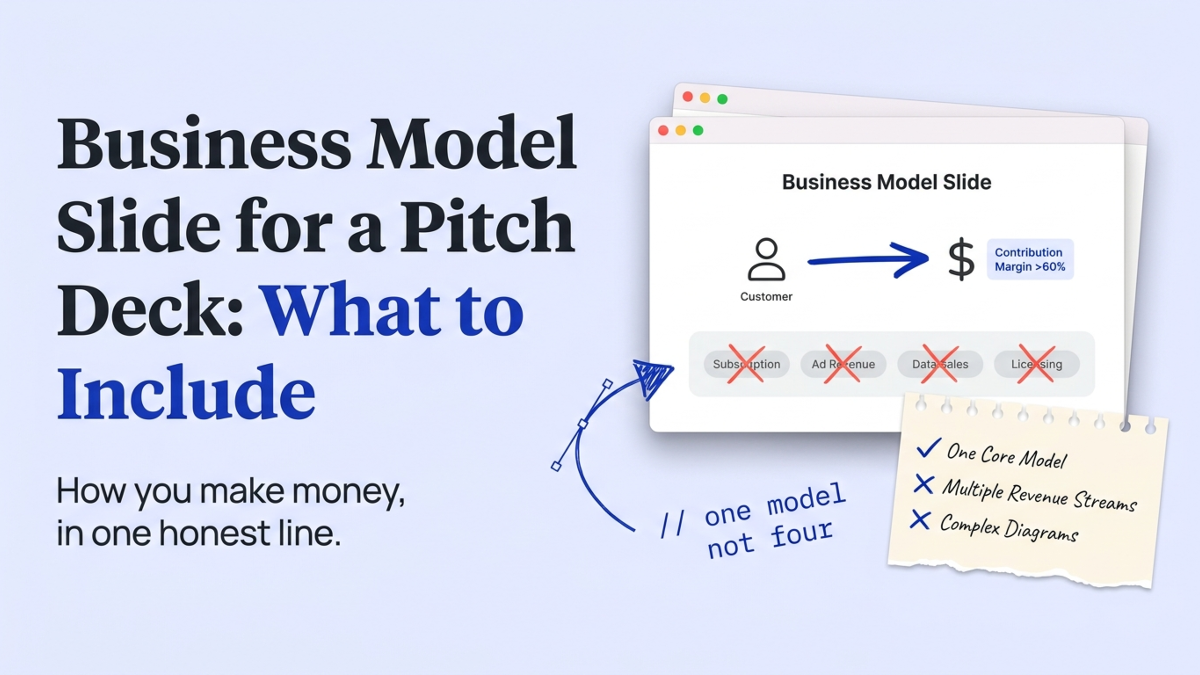
The business-model slide is the pitch deck slide that shows how your company turns customers into money: who pays, for what, how often, and at what margin. It sits beside the financials slide but does a different job. One shows the mechanism; the other shows the projected numbers. In the decks we review, founders blur the two, then pad the slide with three or four revenue streams to look bigger. That padding is the tell. Investors read about 15 seconds per slide after the first (Papermark, 2024), and a slide they can’t restate in one line gets skipped.
What goes on a business model slide in a pitch deck?
A business-model slide carries one revenue model and the shape of its economics: who the customer is, what they pay, how often, and what you keep after the cost of serving them. Everything past that belongs in a data room. In the decks we review, the strongest version reads like a sentence you could say out loud.
So try the test. Can a stranger read your slide and repeat it back? “Clinics pay $300 a month per seat, and we keep about 80% after hosting and support.” That’s a business model. A grid of nine boxes copied from a canvas isn’t.
The other half of the job is knowing what this slide does not own. Four slides get confused with it, and each has its own question to answer.
| Slide | The question it answers | What lives here |
|---|---|---|
| Business model | How do you make money? | Revenue model, pricing, margin per sale |
| Financials | What do the numbers become? | Projections, forecast, burn |
| Market | How big is the prize? | TAM, SAM, SOM |
| Traction | What already happened? | Revenue to date, users, growth |
Keep the projection math on your financials slide, the market size on your market slide, and past results on your traction slide. This slide answers one question: when money changes hands, how?
Why do investors read the business model slide so closely?
Investors read the business-model slide as a test of whether the business can ever be profitable, not as a look at your pricing page. Your problem and solution slides prove people want the thing. This one proves that selling it doesn’t lose money on every unit.
That’s where the quiet failures hide. 19% of startups die on unsustainable unit economics, and 43% on poor product-market fit (CB Insights, 2026, across 431 shut-down companies). Both show up first here: a model that costs more to deliver than it charges, or a customer who pays too little, too rarely, to matter.
We see the same reflex every week. A founder senses the model looks thin, so they bolt a second and third revenue line onto the slide to fill the space.
A business-model slide with four revenue streams usually means the founder hasn’t proven one.
Four half-answers don’t add up to a business. One answer, backed by a number, does.
Why one revenue model beats a stack of four
One clear revenue model beats three or four stacked streams because focus is the thing investors are buying at this stage. Count the ways your slide says you’ll make money. More than two, and a reviewer reads ambition where you meant to show range.
Here’s the stack we see too often:
- Subscriptions
- Transaction fees
- Ads
- Data licensing
- A marketplace take rate
Five ways to make money, and none of them making any yet. It feels like optionality to a founder and lands as a lack of focus to an investor. Pick the one closest to real revenue, and give it the whole slide.
StartWise's position
The business-model slides we flag most stack three or four revenue streams to look bigger. After reviewing decks daily, our take is blunt: one line that names who pays, for what, how often, and how much beats a menu of maybes. Investors give the slide about 15 seconds (Papermark, 2024), and a second revenue stream you can't defend spends every one of them on doubt.
This is usually the fastest edit in the deck. You’re not adding anything. You’re deleting the streams you can’t back and letting the one that works stand alone.
Not sure your business-model slide reads as one clear model or a stack of maybes? Get a slide-by-slide read.
What one number makes a business model slide credible?
The number that turns a business-model slide from a claim into a business is the margin on a single sale. Sell one more unit, and do you make money? Name it, even roughly, and the model stops being a story. For a physical-product brand that math gets read hardest of all, which is why ecommerce pitch deck examples live or die on the contribution-margin slide.
For a recurring business, the shorthand investors run is LTV against CAC. A healthy B2B SaaS lands near a 3:1 lifetime-value-to-acquisition-cost ratio, with anything below 2:1 treated as a model that can’t fund its own growth, and CAC payback expected under 12 months (Foundry CRO, 2026). LTV is the total value a customer brings; CAC is what you spent to win them. Waveup, which has rebuilt over 800 decks, puts it well: this is a strategy slide that happens to use dollars, so lead with how the model scales, not with a pricing table.
Below 2:1
an LTV:CAC ratio investors read as a model that can't fund its own growth (Foundry CRO, 2026 B2B SaaS benchmarks)
You won’t have clean numbers at pre-seed, and no reviewer expects them. What we do expect is that you’ve done the arithmetic once. “Each clinic pays $3,600 a year, costs us about $400 to serve, so we keep roughly $3,200.” That single line shows you think in unit economics, which is the entire reason the slide exists.
How does the business model slide change by funding stage?
The business-model slide sells a different thing at each stage, because the proof you can honestly show changes. At pre-seed it’s a hypothesis: one model, one margin estimate, and the math you used to get there. By seed it has to show a model that already works, with a real price a real customer has paid and margins that hold up when the sale repeats. By Series A it’s closer to a machine, the model running across segments while the economics improve as you scale.
We never flag a pre-seed deck for missing net revenue retention or cohort curves. We flag it for having no view at all on whether one sale makes money. An honest estimate always reads better than a blank.
Whatever the stage, the go-to-market slide carries the cost of finding customers and the financials slide carries the forecast. This one stays about the model itself.
What to do this week
Open your deck to the business-model slide and read it the way we do, as a claim you have to back.
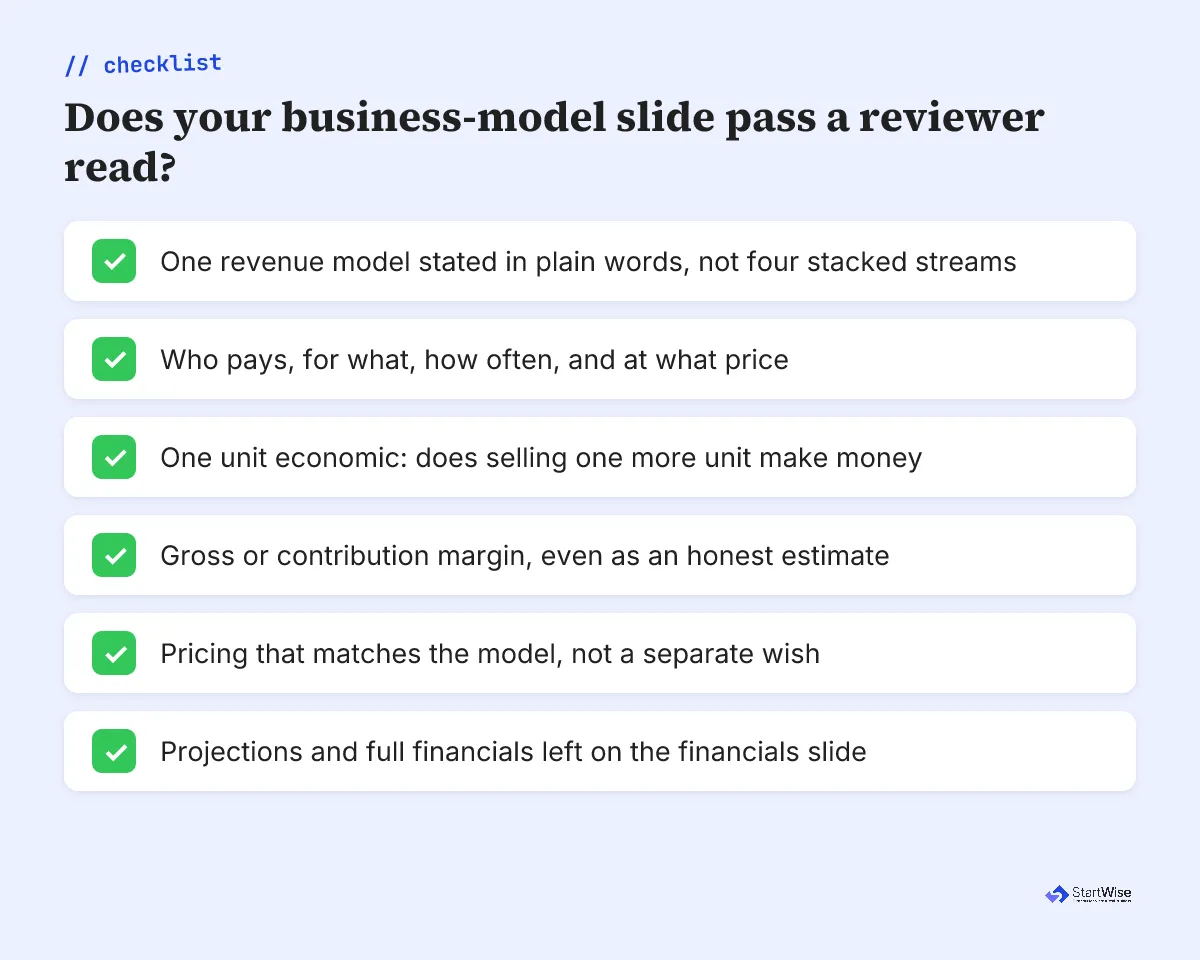
- State one revenue model in plain words. Cut every stream you can’t defend with a number or an early signal.
- Write the one-sentence version: who pays, for what, how often, and at what price.
- Add the margin on a single sale, even as an honest estimate, with the math beside it.
- Move projections to your financials slide and market size to your market slide, so this one stays about the model.
- Read the slide title alone. If it names how you make money, you’re done.
Then check it against the wider pitch deck mistakes that quietly cost meetings. If your slide still lists four ways you might make money someday, you’ve got cutting to do. And cutting is the fastest edit in the deck.