
 By

The go-to-market slide is the pitch deck slide that shows how you’ll reach and win customers, repeatably and without spending more than they’re worth. It answers a question an investor can’t skip: once people want this, can you actually get to them and sell at a price that works? In the decks we review, this is the slide that most often reads like a marketing plan instead. TechCrunch’s Haje Jan Kamps, who has torn down over 300 decks, calls that mix-up “downright problematic,” and flags it in roughly every other one.
What goes on a go-to-market slide in a pitch deck?
A go-to-market slide carries three things: who you sell to, how you reach them, and how that reach turns into paid customers. Everything else belongs in a data room, not on a slide a reader skims in seconds. In the decks we review, this is the slide founders pack hardest, and packing it is the mistake.
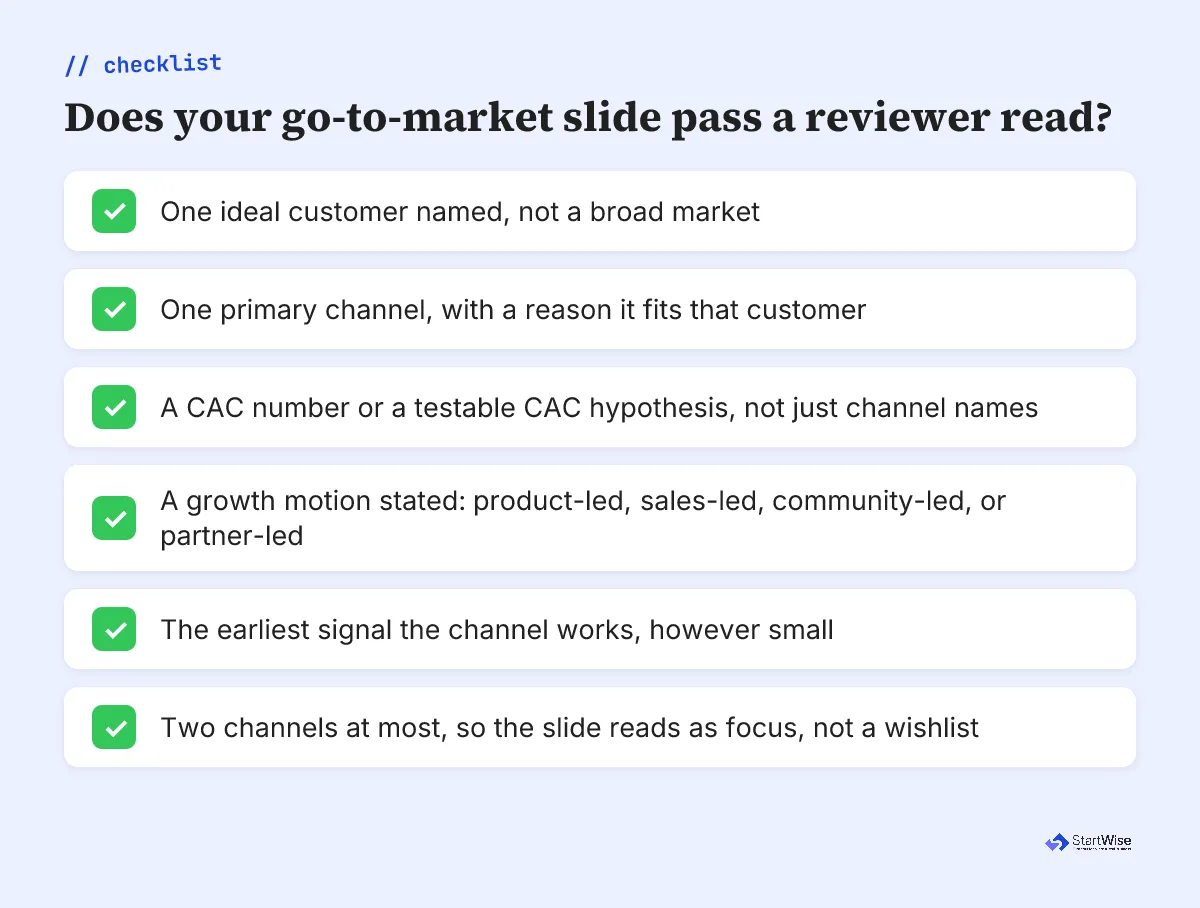
Start with the ideal customer, and get specific. “Small businesses” isn’t a customer. “Independent physiotherapy clinics with 2 to 5 staff” is. Your market sizing lives on the market slide; the go-to-market slide zooms into the sliver you’ll actually attack first, the beachhead.
Then the channel. One primary way you get in front of that customer, with a reason it fits them. And the motion behind it: product-led (users sign up themselves), sales-led (a rep closes them), community-led, or partner-led. Name the motion. It tells an investor how your costs behave as you grow.
Last, the mechanism that turns interest into revenue: a signup, a demo call, a trial that converts. This is where a real number earns its place.
Keep it to those pieces. This slide isn’t your traction slide, which shows what already happened, and it isn’t your business-model slide, which shows how you price. Merge all three and you get a slide that says nothing clearly.
Why do investors read your go-to-market slide so closely?
Investors read the go-to-market slide as a test of whether you can acquire customers repeatably and affordably, not as a marketing to-do list. The problem and solution slides prove people want the thing. This one proves you can reach them and make the math work.
That’s why the money questions hide here. 19% of startups fail on unsustainable unit economics, and 43% on poor product-market fit (CB Insights, 2026, from 431 shut-down companies). Both show up first on this slide: a channel that costs more than a customer returns, or a customer you can describe but can’t actually find.
We see the same tell every week. A founder lists five channels they’ll “try” after the round, which reads as “we haven’t found one that works yet.” Investors don’t fund experiments they have to run for you.
A go-to-market slide full of channels you’ll try is a slide admitting none of them work yet.
They fund a channel that’s already pulling, plus the money to pour on it. So the slide’s real job is evidence: one channel doing something, and a plan to do more of it.
One proven channel beats a menu of ten
The strongest go-to-market slides name one channel that already returns customers, not ten a founder plans to test. Count the channels on your slide. If it’s more than two, a reviewer reads the whole thing as a wishlist, and a wishlist reads as no focus at all.
Here’s the menu we see too often:
- SEO and content
- Paid social
- Partnerships
- Outbound sales
- Influencers and community
- “Viral” referrals
Six channels, zero evidence any of them work. It feels safe to a founder (“we’ve got options”) and lands as a red flag to an investor. TechCrunch’s teardown makes the point directly: dumping generic channels like SEO and social with no rationale is the core failure.
The fix is subtraction. Pick the one channel already returning customers, or the one you have the strongest reason to believe in, and give it the whole slide. Keep a second only if you can say something real about it: an early conversion rate, a partner conversation already started, a test that returned a number.
StartWise's position
The go-to-market slide we flag most lists five channels a founder plans to try. After reviewing decks daily, our take is blunt: one channel already returning customers for less than they cost beats a full funnel of intentions. Investors give the slide about 15 seconds (Papermark, 2024), and a wishlist wastes all of them.
This is the fastest edit in most decks we review. You’re not adding work. You’re deleting the channels you can’t defend and letting the one that works stand alone.
Not sure your go-to-market slide shows a real channel or just a wishlist? Get a slide-by-slide read.
What CAC number makes a go-to-market slide credible?
The number that turns a go-to-market slide from a plan into a business is CAC, your customer acquisition cost, set against what a customer is worth. Name it, even roughly, and the slide stops being a story.
At the healthy end, a B2B SaaS business wants CAC payback under 12 months and an LTV:CAC ratio near 3:1, with seed-stage companies often at 2:1 to 3:1 while they find their footing (Improvado, 2026). You won’t have clean numbers at pre-seed, and no reviewer expects them. What we do expect is a hypothesis: “early tests put CAC around $40 against a $600 first-year contract,” with the math you used to get there.
12 mo
the CAC payback a healthy B2B SaaS is expected to beat, with LTV:CAC near 3:1 (Improvado, 2026 B2B SaaS benchmarks)
The point isn’t precision. It’s that you think in unit economics at all. A founder who can’t estimate CAC hasn’t tried to sell yet, and that gap shows the second an investor asks “so how do you get customers?” and hears a list of channels instead of a cost. Your ask slide then has to explain what that money buys, and vague economics here make a vague ask there.
How does the go-to-market slide change by funding stage?
The go-to-market slide sells a different thing at each stage, because the proof you can honestly show changes. At pre-seed you sell a testable plan. By seed you sell a channel that already works. The bar climbs, and the slide climbs with it.
| Stage | What the GTM slide sells | Proof it carries |
|---|---|---|
| Pre-seed | One beachhead customer, one channel to test | An early signal: a waitlist, a pilot, a hand-sold first customer |
| Seed | One channel that works, with economics | CAC, conversion, and payback that hold up on a repeat |
| Series A | A repeatable machine across channels | Channel economics and integration, ready to scale |
At pre-seed, nobody expects a proven funnel, and we never flag one as missing. They expect focus: the one customer you win first, and the one channel you’ll test to reach them. Jonathan Crowder, who has reviewed $3.75B in decks, found the winning go-to-market slides across 85 startups that raised $375M shared one shape. A leading indicator plus a result, not a roadmap of intentions.
By seed, an intention isn’t enough. Investors spend about 3.2 minutes on the whole deck (Papermark, 2024), and more of that lands here, checking whether your one channel survives being run twice.
What to do this week
Open your deck to the go-to-market slide and read it the way we do in a review: as a claim you have to back.
- Cut the channel list to one, maybe two. Delete every channel you can’t attach a real number to.
- Name the one customer you win first, the beachhead, not the whole market.
- Add a CAC figure or an honest hypothesis, with the math beside it.
- State the motion in a word: product-led, sales-led, community-led, or partner-led.
- Move anything that already happened to your traction slide, and your pricing to the business-model slide, so this slide stays about acquisition.
Then check it against the wider pitch deck mistakes that cost meetings, and read the slide title alone. If it names a customer and a way to reach them, you’re done. If it still lists channels you’ll “try,” you’ve got cutting to do.