
 By

A seed round pitch deck is the deck you send once you have proof, not a promise. Same slide names as your pre-seed deck, higher bar on every one. At StartWise we review seed decks every week, and the common miss is founders downloading a fresh template when they should be upgrading the deck they already have. Investors spend under four minutes on it (DocSend, 2024), so the fix is rarely more slides. It’s sharper proof on the ones you’ve got.
What goes in a seed round pitch deck?
A seed round pitch deck runs about 10 to 15 slides and does eight jobs: problem, product, traction, the insight only you have, business model, market, team, and the ask. That list comes straight from CRV, and it’s the same spine as your pre-seed deck. What changes is how much weight each slide has to hold.
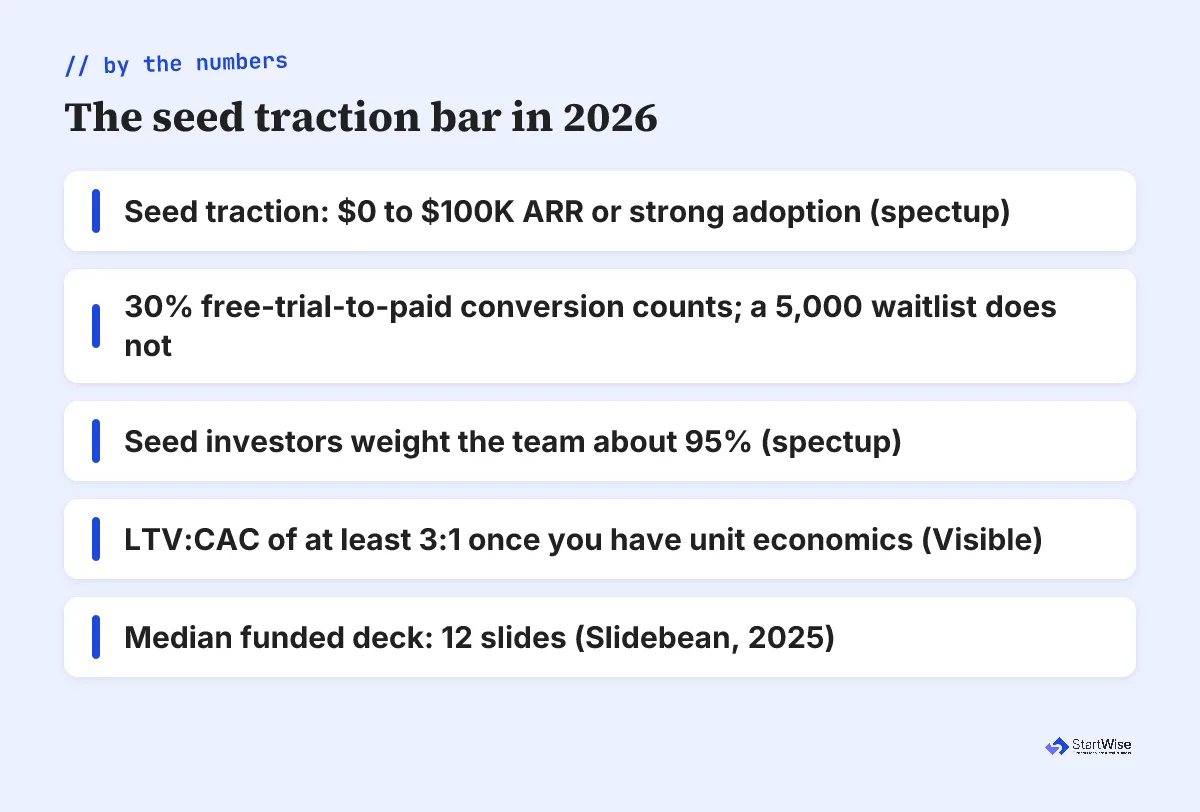
Most funded seed decks land at 12 slides (Slidebean’s 2025 analysis, via Waveup). Airbnb’s was 10, Buffer’s 13, Uber’s original a bloated 25 (Visible). The number matters less than the order, and we’ve broken the count down by audience elsewhere. Put traction in the first third, because a VC reading for under four minutes decides fast whether to keep going.
Here’s the order we’d use for a seed send-ahead deck:
- Cover: your category in one readable line.
- Problem: a sharp, named pain, now with a number behind it.
- Product: the working thing, with a screenshot or demo.
- Traction: your best proof, full width, one hero metric.
- Market: bottom-up, backed by your own funnel data.
- Business model: how the money actually works.
- Team: why this team, specifically, wins.
- The ask: one number tied to one milestone.
Why now, competition, and financials slot in where your story needs them. If a slide doesn’t move an investor closer to a yes, it’s an appendix.
How is a seed deck different from a pre-seed deck?
A seed deck sells proof where a pre-seed deck sold potential. The slide names hold steady, but the evidence bar jumps, and it jumps hardest on the traction and financials slides.
At pre-seed, an investor backs the founder and the thesis. By seed, they want to see what you did with the pre-seed money. CRV puts it plainly: seed investors evaluate team quality and market opportunity alongside early signals of product-market fit, and the bar for revenue has climbed. More companies now take three or more years to reach their Series A than in earlier cohorts, which means your seed deck has to buy you a longer runway of belief.
So don’t rebuild from a blank template. Upgrade the deck you already have. If you shipped a solid pre-seed deck, most of the work is re-underwriting three slides:
- Traction moves from a slope to real numbers. The waitlist becomes revenue or activated users.
- Financials move from a 12-month sketch to an 18 to 24 month model with unit economics an investor can pressure-test.
- Team moves from why we’ll figure it out to what we’ve already shipped together.
A seed deck is your pre-seed deck that grew up, re-underwritten around proof.
Everything else gets sharper, not longer. Your market slide swaps the borrowed TAM SAM SOM guess for a bottom-up number your own funnel now supports. Your problem slide keeps the same pain, but you can quantify it. We see this every week: the seed decks that work read like a pre-seed deck that grew up.
What traction do investors want to see at seed?
Seed traction sits at roughly $0 to $100K in ARR, or strong adoption signals if revenue is thin (spectup). The trap is thinking a bigger number always wins. It doesn’t. Investors buy trajectory and quality, and one clean conversion metric beats a vanity total every time.
Here’s the test that sorts real traction from noise:
| Counts as seed traction | Doesn’t count |
|---|---|
| A free trial converting 30% to paid | A 5,000-person email waitlist |
| Revenue growing week over week | One big number with no trend |
| 50 signed letters of intent | 50,000 pageviews |
| Pilots with named, credible partners | Press logos and awards |
That first row is the one founders fight us on. A 5,000-person waitlist feels like proof; a 30% trial-to-paid rate is proof (spectup). One is intent, the other is behavior, and investors have been burned by intent too many times to weigh it heavily.
Put your single best metric full width with a trendline, and stack supporting proof (retention, a pilot result, a logo or two) in a small grid beneath it. On the traction slide, direction with a believable mechanism beats a snapshot. That hasn’t changed since pre-seed. The bar for how far your direction has to point has.
Read seed pitch deck examples for the mechanic, not the format
The best way to read seed pitch deck examples is to hunt for the one mechanic that earned the check, then ignore the layout. Galleries hand you the file and wish you luck. Pitch Deck Hunt hosts more than a hundred real seed decks, but a finished deck tells you what a company shipped, not why it worked.
Two things trip founders up here. First, most famous decks (Airbnb, Uber, the usual gallery) raised in a market that no longer exists, and many would get flagged today for slides investors now skip. Second, recent wins teach more. We tell founders to study the fresh ones, not the legends. In 2024 and 2025, Rogo raised $7M, Charta Health $8.1M, and Doctronic $5M at seed (Waveup). Those are the decks worth studying, because they cleared the exact bar you’re clearing now.
Read any example like a reviewer would:
- Read the slide titles alone. If they carry the story, the deck passes the skim.
- Find the hero metric. Is there one clear proof point, or five competing ones?
- Check the ask. Is it a milestone, or a round number tied to nothing?
And remember the volume game behind every polished deck. Buffer’s team emailed over 200 investors, took 50 meetings, and closed 18 (Visible). A great deck raises your reply rate. It doesn’t close the round on slide one.
Not sure which of your seed slides an investor would flag? Get a free, slide-by-slide review of your deck with a concrete fix list, in minutes.
Why does the team slide still decide a seed round?
The team slide still decides a seed round because seed investors are betting mostly on the founders, about 95% on the people (spectup). Even with real traction, the question underneath every slide is whether this specific team will out-execute the next one.
CRV is blunt about what wastes the slot: nobody reviewing your seed deck cares about your advisors. They care about what makes you and your co-founders suited to solve this exact problem. A wall of advisor logos reads as borrowed credibility, and reviewers discount it on sight.
StartWise's position
The team slide is a risk slide. Its real question is why this team won't fall apart or get out-executed, and credentials answer the wrong one. Relevant scars (you shipped the thing, sold into this buyer, lived the problem) beat a row of prestigious logos every time. We flag more team slides for listing pedigree over proof than for any missing metric.
So write the team slide to answer one thing: why you, why now, why together. A short line each on the two or three founders, focused on what you’ve built or survived that maps to this problem. Save the logos for the appendix.
Get the financials and the ask right at seed
Seed financials mean an 18 to 24 month model with unit economics an investor can interrogate, and the ask is one number tied to one milestone. This is the jump we watch founders stumble on most, because at pre-seed a 12-month sketch was enough.
By seed, the model has to show you understand your own economics. A clean LTV:CAC ratio of at least 3:1 signals the business can grow without lighting money on fire (Visible). You don’t need five years of fantasy. You need two years you can defend line by line, plus the assumptions behind the top three drivers. Our guide to what financial model investors want walks the depth by stage.
Then the ask. A seed ask names the amount, the runway it buys, and the milestone it clears. “We’re raising $2.5M for 18 months of runway to reach $2M ARR” is an ask. “$2.5M to accelerate growth” is wallpaper. Whether you raise on a SAFE (a Simple Agreement for Future Equity, the standard early instrument) or a priced round, tie every dollar to the next proof point an investor cares about.
What to do this week
Pull up your current deck and upgrade it for seed this week, one slide at a time.
- Move your best proof to slide four and make it a single hero metric with a trendline.
- Swap any waitlist number for behavior: conversion, revenue, retention, or activated users.
- Rebuild financials into an 18 to 24 month model, and check your LTV:CAC clears 3:1.
- Rewrite the team slide around scars, not logos. One line per founder on why you win this.
- Make the ask specific: amount, runway, milestone. Cut every round number tied to nothing.
Then hand it to someone who reads decks the way a seed investor does, before a seed investor does. Most of the distance between a polished deck and a fundable one, in our experience, is the four slides that had to grow up since pre-seed.