
 By
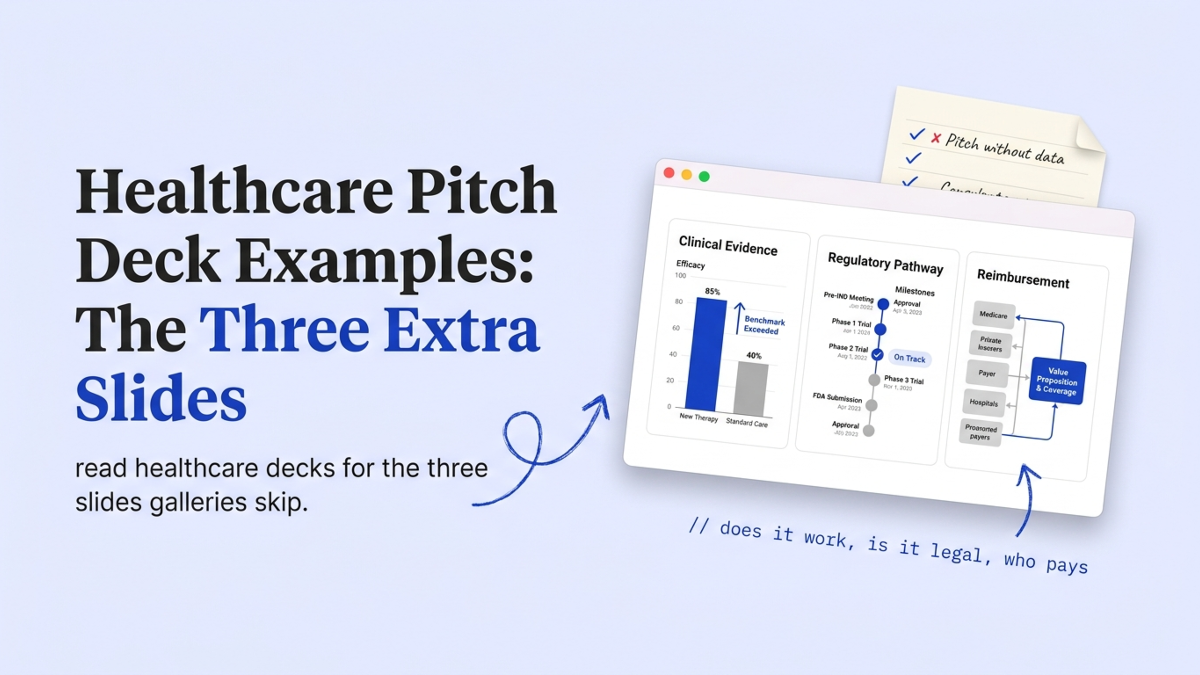
Healthcare pitch deck examples fill the same galleries as every other deck, and founders copy the polish instead of the parts that matter. A healthcare pitch deck is an investor presentation that has to clear three questions a generic deck never faces: does it work, is it legal, and who pays. At StartWise we review founder decks every day, and a healthcare deck stands apart on exactly three slides: clinical evidence, regulatory path, and reimbursement. US digital health startups raised $14.2 billion in 2025 (Rock Health), so investors read those three first. Here’s how to read the famous decks for them.
What makes a healthcare pitch deck different from a normal deck?
A healthcare pitch deck differs from a normal deck on three slides, each answering a question a software investor never has to ask. The cover, problem, market, team, and ask look the same as any startup deck. What changes is that a healthcare investor is also underwriting clinical risk, regulatory risk, and payment risk before they trust the rest of your story.
Miss those and a promising product reads as a science experiment. Investors have seen that graveyard.
We watch the same split in review most weeks. Founders sweat the design and skip the three slides that actually carry a medical business, then wonder why a beautiful deck stalls. Those extra slides are also why a healthcare deck runs a little longer than a generic one, closer to 12 or 14 slides than 10.
Build the evidence, regulatory, and reimbursement slides
The three slides that set a healthcare deck apart each prove one thing, and each is a plan before it’s a result. Build them as three tight slides, never a compliance sub-deck that drowns the pitch. Here’s what each one carries:
- Clinical evidence. Show your product works, or your honest plan to prove it. At pre-seed that’s published research, a clinical benchmark, or a study design with a timeline, not outcomes you don’t have yet.
- Regulatory path. Name your FDA route in plain words. A 510(k) clears a device similar to one already sold; a De Novo creates a new low-risk category; a PMA is the heavy clinical-trial path for high-risk devices. Say which one you’re on and where you stand.
- Reimbursement. Show who pays when it works: the payer, the billing code or procurement route, and why they say yes. This is the slide we see founders skip.
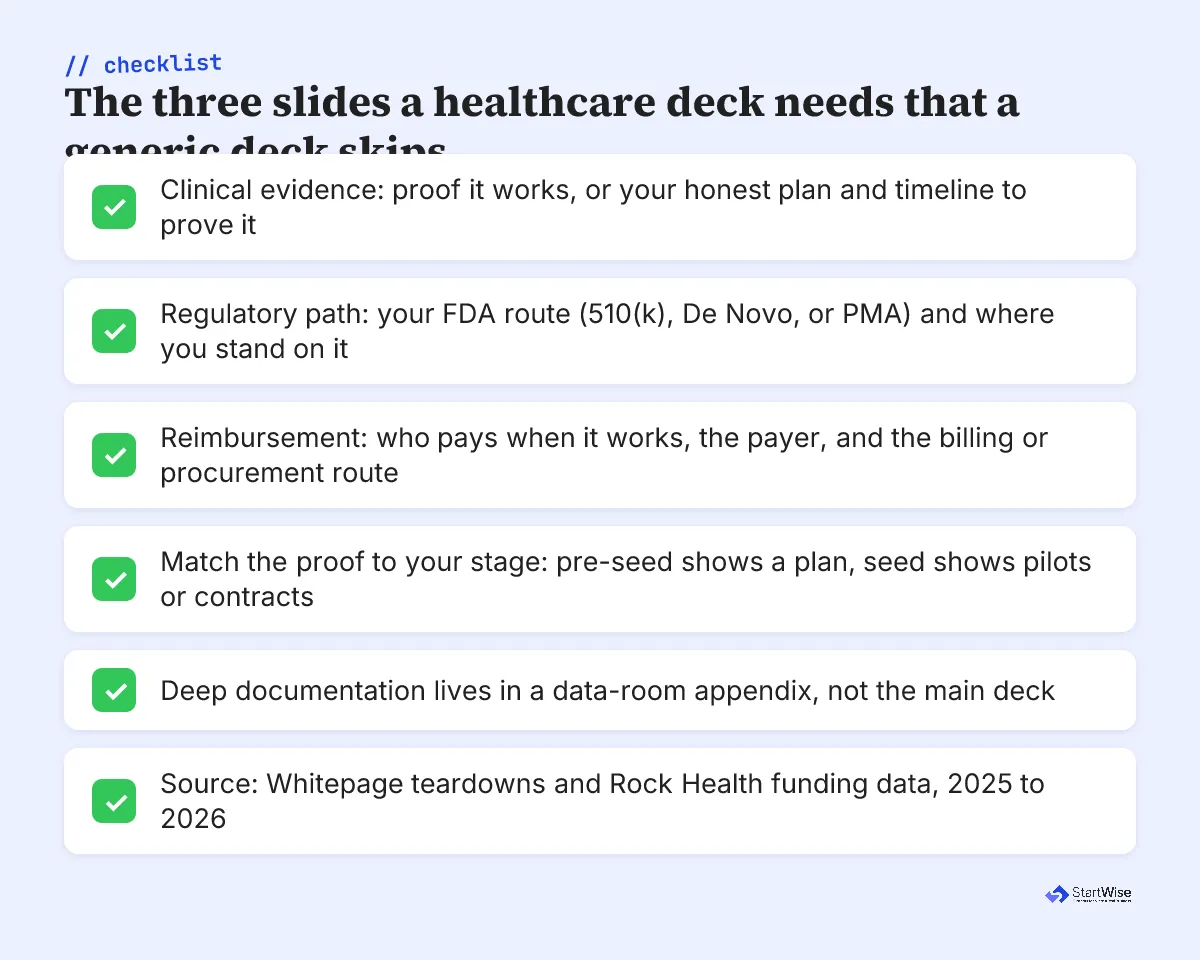
The deep material belongs in a data-room appendix, not the main deck. Push full trial protocols, your quality system, and payer contracts there, then link to them. The deck is the trailer. The data room is the film. The main-deck slide earns its place by proving you know the terrain in the seconds an investor gives it.
A healthcare deck that can’t say who pays reads as research, not a company.
Who actually pays for a healthcare product?
Who pays is the question that separates a fundable healthcare deck from a science project, and the answer is rarely the person using the product. A patient uses it; a payer, provider, employer, or pharma partner usually writes the check. Name that buyer on the slide, because the proof that convinces them changes with who they are:
- Payers (insurers, CMS, the federal Medicare and Medicaid agency): a billing code and a cost-savings or outcomes case.
- Providers (hospitals, clinics): a workflow that saves clinician time or lifts a quality metric they’re scored on.
- Employers: lower total health spend and healthier staff, bought on a benefits cycle.
- Patients paying cash: a price they’ll cover out of pocket and a reason insurance won’t yet.
The decks that clear this fast don’t explain reimbursement in a paragraph. Hopscotch put eight insurance-company logos on its seed deck as a payer wall, which says more than any sentence about coverage (Whitepage). A logo row is proof; prose is a promise.
StartWise's position
In a healthcare deck the slide that kills the raise is not the one founders sweat over. It's the reimbursement slide they skip. The decks we review lead with elegant clinical science and never answer who writes the check when it works, so a real business reads as a project. Capital is concentrating: the average 2025 digital health round hit $29.3 million and mega-rounds took 42% of all funding (Rock Health). That money goes to teams that can name their payer. Put reimbursement early, not next to the financials.
Not sure your evidence, regulatory, and reimbursement slides read as a business rather than a science project? Get a free, slide-by-slide review of your deck with a concrete fix list, in minutes.
What do the funded healthcare pitch deck examples show?
The funded healthcare pitch deck examples show proof matched to stage, with the three medical slides baked into the story rather than stapled on. The gallery most people study, Failory’s list of 50 healthcare decks, is a useful directory but light on why any of them worked, and it skews late-stage.
The pre-seed and seed teardowns teach more for a first raise. Whitepage’s slide-by-slide read is the sharpest I found. Jimini Health raised $8 million at pre-seed on a problem slide that opened with clinical stagnation research, not market size, and carried a published-science appendix as its credibility signal. Crosby Health raised $2.2 million at pre-seed by leading with a 91.8% clinical benchmark score in place of pilot data it didn’t have yet, and reframing its market as a $10 billion recoverable loss instead of a vague total. Flo’s $200 million later-stage deck opened with a penetration metric, one in four US women. Study the small raises instead.
3 rounds
ahead is what most famous healthcare decks model. Galleries host Series C and later decks with a compliance team you won't have for years. Study pre-seed and seed teardowns instead.
Read these the way we read them in review: open the evidence and reimbursement slides first, then ask what actually earned the round. The cross-industry classics get the same disciplined read in what to copy and skip in pitch deck examples. If you’re adjacent, fintech examples covers the regulation slide and SaaS examples reads them for the metrics slide.
How does the proof shift from pre-seed to seed?
The proof on those three slides shifts hard as you move from pre-seed to seed to Series A, and mismatched proof is what gets a deck passed on. At pre-seed you show a credible plan. By Series A you show it working at scale, with the paperwork behind it. We see both misses in review.
| The question | Pre-seed | Seed | Series A |
|---|---|---|---|
| Does it work? | Published research or a benchmark | Early pilots or a study underway | Outcomes data at scale |
| Is it legal? | FDA pathway named, timeline drawn | Filing underway or clearance in hand | Clearance plus a compliance function |
| Who pays? | A believable payer and billing route | A signed pilot or a payer letter of intent | Repeatable contracts and net revenue |
Overshoot and you’ll look naive, promising Series A rigor you can’t back. Undershoot and you’ll look unfundable. The financials slide then has to carry that same stage-honest tone, projecting from the evidence you actually have.
What to do this week
This week, add or rebuild the three slides before you touch the design on any other. They’re the ones we fix first in almost every healthcare review, because they’re what separates a deck that looks medical from one that reads as fundable.
- Add three slides if they’re missing: clinical evidence, regulatory path, reimbursement.
- Write the reimbursement slide first. Name the payer, the billing or procurement route, and why they say yes.
- State your FDA pathway in one line, and where you stand on it today.
- Match each slide’s proof to your stage, and push documentation to a data-room appendix with a link.
- Open two funded pre-seed or seed healthcare decks, jump to their evidence and reimbursement slides, and copy the posture, never the numbers.
Then put it in front of someone who reads healthcare decks the way investors do, before an investor does. The gap between polished and fundable is almost always these three slides.