
 By
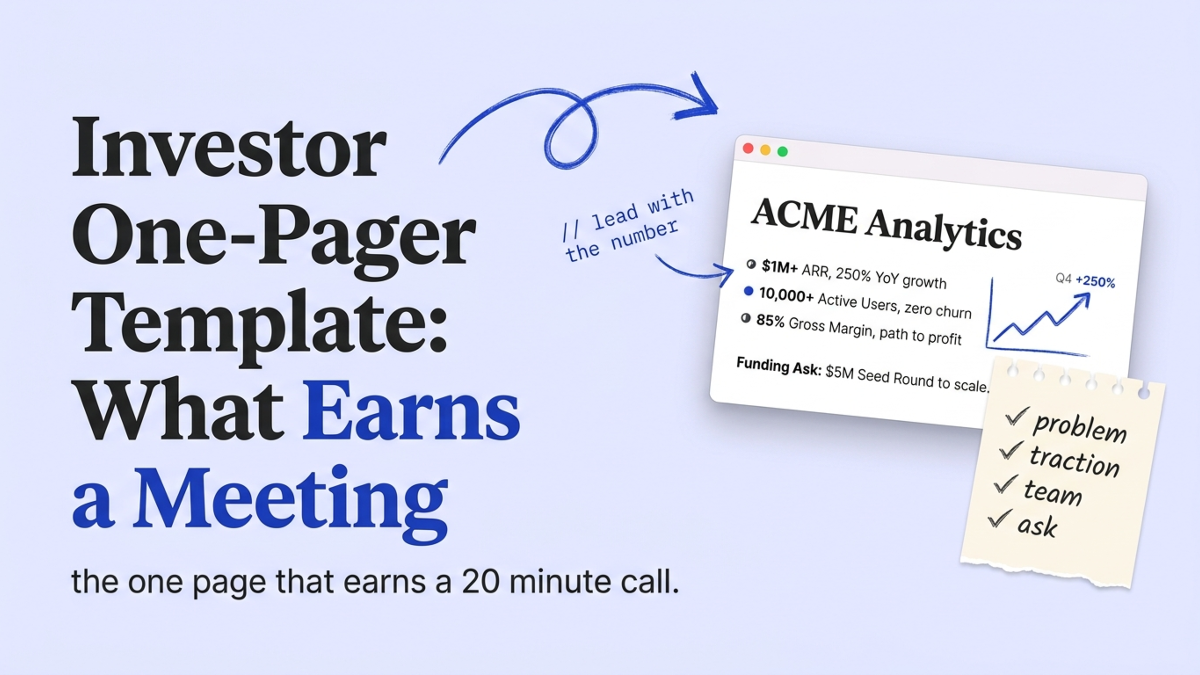
An investor one-pager is a single-page fundraising teaser you send to earn a first call, not to close the round. Think of it as your deck compressed to what an investor can read in under a minute. We review a lot of these, and the version that works looks nothing like the polished PDFs the template tools push. It leads with a number. Cold decks convert to a meeting just 3 to 5% of the time, per DocSend data, so your one page has one job: qualify you fast enough to be worth 20 minutes.
What is an investor one-pager?
An investor one-pager is one page of proof sized for the skim: company, problem, traction, team, market, and the ask, in roughly 300 words. It’s not your deck, and it’s not the two-line teaser you drop in a warm-intro email either. Founders blur these four documents constantly, so here’s how they actually split by job.
| Document | Length | Its job | When you send it |
|---|---|---|---|
| Teaser | 2 to 3 lines | Get a forward or a reply | Inside a warm intro |
| One-pager | 1 page, ~300 words | Earn a 20-minute call | Cold outreach, first touch |
| Pitch deck | 9 to 16 slides | Win the meeting | After they reply |
| Data room | 20+ documents | Survive diligence | After term-sheet talk |
The one-pager works when it stops imitating the deck. In the drafts we read, the common miss is twelve deck sections shrunk to fit one page, so nothing lands. Its job is narrower. Make an investor curious enough to open the real thing.
What goes on an investor one-pager?
An investor one-pager carries six blocks and cuts everything else. Each one is a line or two, not a paragraph, because the whole page has to breathe. Here’s the template we hand founders:
- Headline: company name, a five-word one-liner, and your single sharpest metric. “Acme: warehouse robots, $22K MRR up 30% MoM” does more work than a logo.
- Problem: one sentence on who hurts and how much it costs them today.
- Solution: one sentence on what you built. No feature list, no roadmap.
- Traction: the slope, not the total. Week-over-week or month-over-month movement with the mechanism behind it.
- Team: why this team specifically, in scars over titles. What you shipped, sold, or lived that makes you hard to out-execute.
- The ask: how much, at what structure, tied to a milestone that de-risks your next round.
Then a contact line and one tracked deck link for the investor who wants more. That’s it. I keep pushing founders to delete their “vision” paragraph, because a cold investor hasn’t earned it yet and won’t read it.
What order should a one-pager follow?
The order that works front-loads proof, because investors don’t read your one-pager top to bottom the way you wrote it. DocSend’s 2024 data shows where their attention actually goes on a deck: team gets 1 minute 2 seconds, financials 52 seconds, and traction 49 seconds, while the problem gets 38 and the product just 21. Proof wins the seconds. Narrative loses them.
Most templates tell you to open with the problem. On a cold one-pager, that’s backwards. A cold investor isn’t studying your market, they’re deciding whether you clear their bar for a call, and that call runs on evidence: who you are and what’s moving. Put your best number in the headline. Put the traction slope right under it. Put the ask where the eye lands, not buried at the bottom where founders like to hide it.
On a cold one-pager, your traction slope earns the meeting. Your problem statement just fills space until it does.
This is also why we tell founders the traction line on your one-pager matters more than the same line on a deck. On the deck you have context. On the one-pager it stands alone, so it has to carry direction and speed in a single glance.
How long should an investor one-pager be?
One page, which in practice means about 300 words with real white space. The skim math forces it. Investors give a full deck about 2 minutes 30 seconds, per DocSend, and a one-pager competes for a slice of that. Go long and it gets skimmed and dropped.
Papermark’s 2024 report on 3,000 decks found investors spend 23 seconds on the first page and around 15 seconds on each page after. Your one-pager is that first page. We can usually tell on one read which founders wrote for 23 seconds and which wrote for a patient reader they don’t have. Write for the 23 seconds. You’ll cut hard, and you’ll keep the investor you actually got.
Why most one-pagers fail on the ask
Most one-pagers fail on the ask, the two lines founders treat as an afterthought and the two lines we end up rewriting most. “Raising $500K to grow” tells an investor nothing and reads as wallpaper. The fixable version names a number, names a structure, and ties the money to a milestone that de-risks your next round.
StartWise's position
The single most common fixable flaw we flag is a shy ask. "18 months of runway to reach $50K MRR" is an ask an investor can weigh. "$500K to accelerate growth" is filler. Tie every dollar to the milestone it buys, and the ask stops being the weakest line on your page and starts being the reason someone replies.
If you’re coming out of an accelerator, name the structure so it reads as normal. A standard Y Combinator deal is a $125,000 SAFE for 7% plus a $375,000 uncapped SAFE, per Papermark. Investors recognize these shapes on sight. Saying which one you’re offering, and what it funds, signals you know how the game is played.
Your one-pager earns the deck open. Make sure the deck delivers: get free, slide-by-slide feedback from Pitch Deck Doctor before you send it.
Should you send a one-pager as a PDF or in the email body?
Send it as the body of the email, not a designed PDF attachment, at least for cold outreach. The template tools sell you a designer because that’s their product. But a PDF is a click, and a cold investor triaging 40 pitches a day often won’t take the click. Text in the inbox gets read now; an attachment gets read later, which usually means never.
There’s a tracking reason too. Papermark found 77% of founders gate their deck behind an email capture and most enable view notifications, because the open is the signal that tells you who to chase. So save the designed one-pager for a tracked link you can watch, and keep the plain-text version in the email itself. My honest take, after reading a lot of cold outreach: the founders who paste the proof into the body get more replies than the ones who make an investor download anything.
This is where the one-pager and the cold email to investors become almost the same document. The best cold email is a one-pager with a greeting, and a tracked pitch deck link at the end for anyone who wants the full story.
What to send this week
Start with the one number that has to carry the page. Before you touch layout, find your single sharpest proof point, because everything else on the one-pager is scaffolding around it. If you don’t have a metric yet, your slope is the number: signups growing week over week, three design partners signed, a waitlist that’s moving.
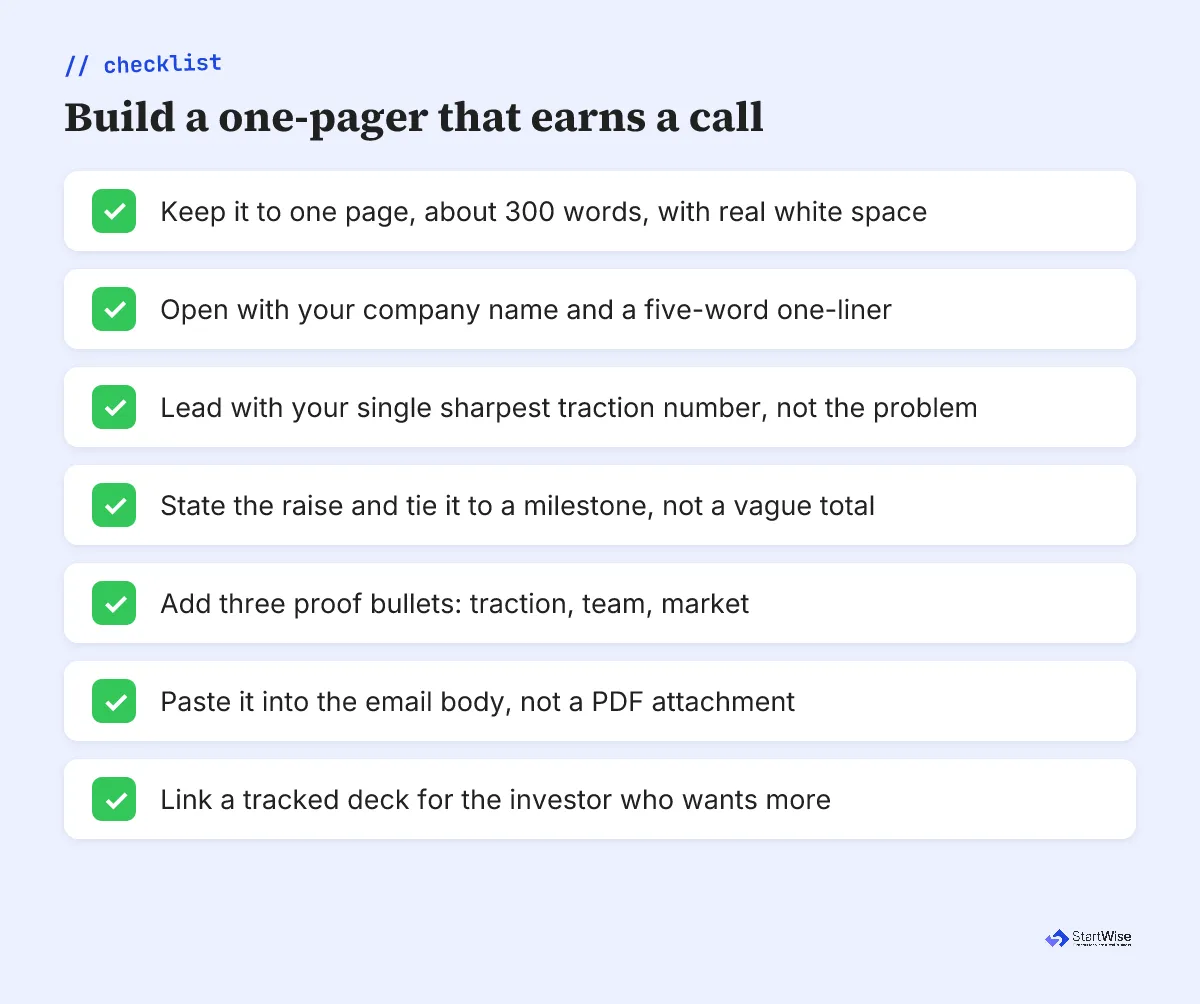
- Draft the six blocks in plain text, one page, about 300 words.
- Put your sharpest number in the headline, traction second, the ask where the eye lands.
- Tie the ask to a milestone: “18 months to $50K MRR,” never “to grow.”
- Paste it into the email body and add one tracked deck link at the end.
- Send it as part of a tight pre-seed raise, warm intros first, cold list second.
A one-pager won’t raise your round, and it won’t rescue a deck an investor drops on page three. What it does, in the raises we watch, is turn a cold name into an open thread. Get the number on top, keep the ask honest, and the question stops being who read it. It becomes who replied.