
 By
PitchBob.io is an AI startup co-pilot that turns a questionnaire into a pitch deck, a business plan, a financial model, and about twenty other documents. Founders reach for it to skip the blank page. Then they hit the output. On Product Hunt it sits at 2.6 out of 5 across 7 reviews, and the complaints are specific: misaligned slides, spelling mistakes, decks that name the wrong city. We review founder decks every week, and the ones built by a generator share one problem. The tool filled the slides. Nobody checked whether they’d survive an investor.
What are the best PitchBob alternatives?
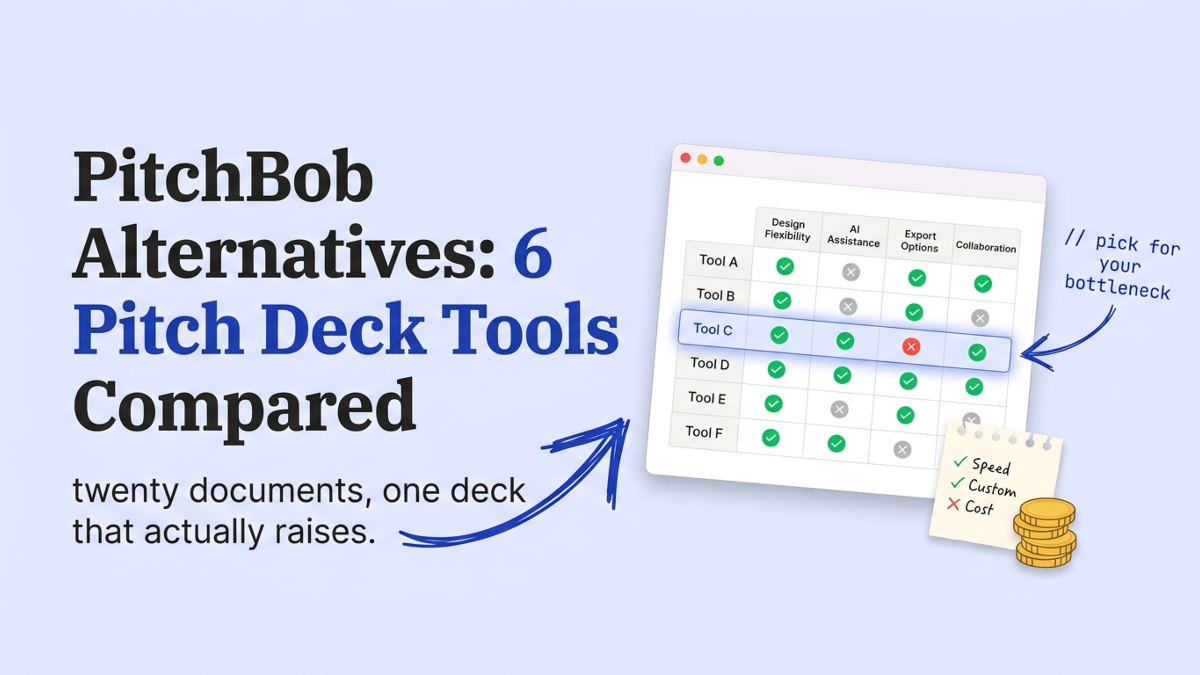
The best PitchBob alternatives depend on your bottleneck, but for most founders the shortlist is Gamma, Slidebean, Beautiful.ai, Canva, and StartWise. PitchBob tries to do everything; each of these does one job well. We’ve watched founders switch to all of them, so here’s how they stack up for a fundraising deck.
| Tool | Best for | Price | The catch |
|---|---|---|---|
| StartWise | Getting a deck investor-ready, then outreach | Free deck check. Check your deck free → | Reviews and routes your deck; not a from-scratch slide designer |
| Gamma | A fast first draft from a prompt | Free tier; Plus from $10/user/mo | Output looks generic until you rewrite it |
| Slidebean | Investor-template structure | Founder from $19/mo | Styling is rigid; upsells consulting |
| Beautiful.ai | Enforced, consistent design | Pro from $12/user/mo | Less control over custom layouts |
| Canva | Free template library | Free; Pro from $14.99/mo | You do the fundraising thinking yourself |
| PitchBob | A cheap all-in-one rough draft | One-time from $29.90; sub from $19.90/mo | 2.6/5 on Product Hunt for quality |
Prices and positioning are from each tool’s site and Storyflow’s 2026 roundup, checked this week. The link in the StartWise row runs the deck you’ve already built, from any of these tools, through a free slide-by-slide review. If PitchBob is the tool you’re actually deciding on, our StartWise vs PitchBob head-to-head compares the two whole-stack co-pilots directly.
Why do founders look for a PitchBob alternative?
Founders leave PitchBob over output quality, not price. Its Product Hunt rating is 2.6 out of 5, and the reviews read like a QA log:
- Slides “badly structured, misaligned, with spelling mistakes”
- A deck that placed the startup in the “heart of Silicon Valley,” a location the tool invented from nothing
- PitchBob’s own branding left on materials meant to represent the founder’s company
Those aren’t edge cases. They’re the reviews founders left on the product’s own page.
We keep seeing the same thing in generated decks: they look finished, so nobody reads them closely enough to catch what’s broken.
The pattern underneath is breadth. PitchBob generates decks, business plans, P&L statements, Lean Canvases, 100-step roadmaps, investor letters, and startup-visa applications in 14 languages, and 60,183 founders have run it. That’s a lot of surface area. When one questionnaire feeds twenty documents, each one gets shallow. A human writing a pitch deck makes maybe thirty small judgment calls per slide about what to cut. A questionnaire-to-deck pipeline makes none of them.
A tool that fills twenty documents from one questionnaire optimizes for output, not for the one deck an investor will actually open.
The investor-matching adds risk too. PitchBob returns a “Top 50” from a 150,000-investor database, and one reviewer flagged the contact lists as “questionable quality.” A generic list plus a generic deck is a fast way to burn your warm-ish intros.
Which alternative fits your bottleneck?
The right alternative fits the specific thing slowing you down, so name that first. If your problem is a blank page, use Gamma: it drafts a full deck from a prompt and lets you refine it by chatting (“make slide 4 punchier”), starting free and running $10 per user per month on Plus. If your problem is design, Beautiful.ai auto-formats every slide to consistent rules for $12 a month, and Canva hands you the largest template library with a genuinely usable free tier.
If your problem is fundraising structure, Slidebean is built around investor deck templates from $19 a month, though its styling is rigid and it’ll nudge you toward paid consulting. If your problem is knowing what happens after you send, Storydoc and Pitch add tracking so you can see whether an investor actually opened the thing, from $40 and $8 a month respectively. That data matters more than founders think. A deck opened once for eight seconds tells you the intro line failed, and no amount of redesign fixes an intro nobody reads.
Here’s the honest part. None of these decides whether you raise. They decide how fast you get a decent-looking draft.
I keep telling founders the same thing: pick the tool that clears your bottleneck, then stop shopping for tools. If you’re still deciding which one to start with, our ranked roundup of the best AI pitch deck generators sorts them by bottleneck. A second generator won’t fix a weak story.
What no deck generator checks before you send it
No AI deck generator, PitchBob included, checks whether your deck survives how investors actually read it. That’s the gap every tool on this list shares. Papermark analyzed 3,000 decks across 2024 and found investors spend an average of 3.2 minutes on a full deck, 23 seconds on the first slide, and roughly 15 seconds on each one after. Thirty percent of them spend more time on that first page than anywhere else.
A generator can’t see that skim. It fills your slides to a template’s length and calls it done. So you’ll end up with a clean, generic 12-slide deck that reads fine at your desk and dies in 23 seconds on a partner’s laptop.
StartWise's position
The default 10-slide template most generators produce is built for a warm partner meeting, not cold outreach. A cold-outreach deck has one job: earn a 20-minute call. That usually means fewer slides and a sharper problem slide than any template suggests.
This is the work no tool on the market does for you, and it’s exactly where a review like ours earns its place. In the decks we read, a prettier chart doesn’t win the room. A deck that says one clear thing per slide, in the order an investor reads, does.
Built your deck in PitchBob, Gamma, or Canva? See what an investor sees before you hit send.
Is PitchBob a scam or just uneven?
My honest take: PitchBob isn’t a scam, and calling it one misses the real issue. It’s an uneven product that oversells breadth. The scam label in a few Product Hunt reviews came from refund disputes and non-responsive support, not from anyone being charged for nothing. Tens of thousands of founders across 14 languages have gotten a usable rough draft out of it, and one reviewer fairly noted it made “generating a basic pitchdeck easy.” We won’t pretend otherwise just because we build a competing product.
So who should actually keep it? A non-English-speaking founder who wants a cheap starting draft in their own language, and who treats every output as a first pass to rewrite. That’s a real use case, and $29.90 one-time is a fair price for it.
Who shouldn’t? Anyone about to email an investor. At that point the branding, the invented facts, and the template padding cost you more than the tool saved. Export what’s useful, then fix it somewhere that reviews the actual content.
What to do this week
Stop comparing generators and fix the deck you’ve got. Here’s the order that works:
- Pick one tool for your real bottleneck: Gamma for a fast draft, Canva or Beautiful.ai for design, Slidebean for structure. Don’t run three.
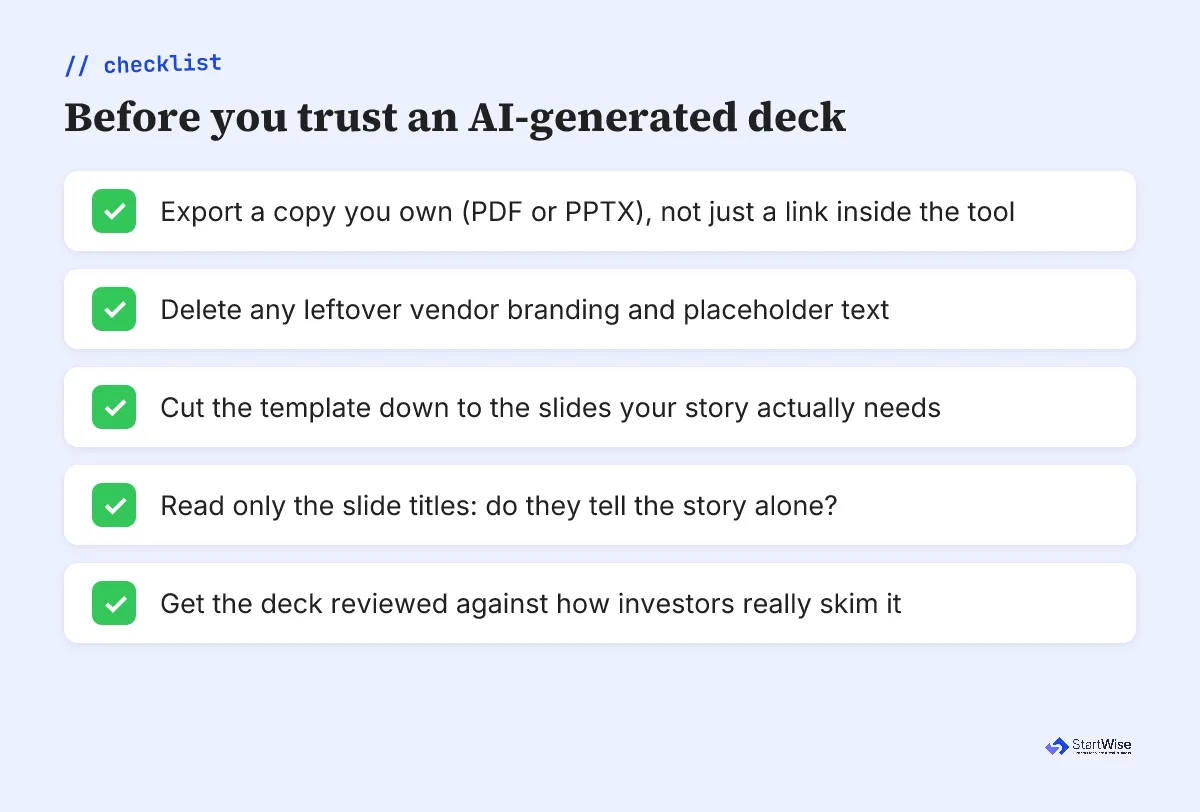
- Export a copy you own as PDF or PPTX, and strip any leftover PitchBob or vendor branding.
- Cut the deck to the slides your story needs, then read only the titles. If they tell the story alone, you’ve passed the slide-count test.
- Get it reviewed against the investor skim before you send it, not after the rejections come in.
If you’re leaving a tool that shut down rather than one that’s just uneven, our Tome alternatives guide covers that case. Either way, the tool was never the thing standing between you and the meeting. The deck was.