
 By
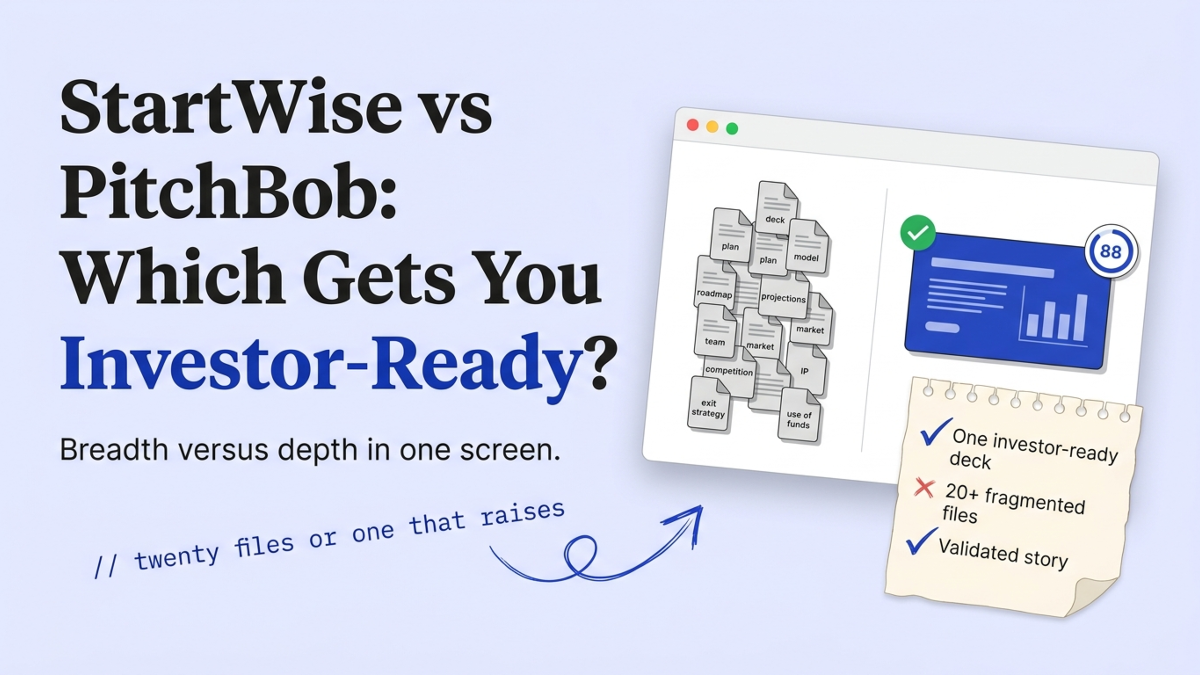
StartWise and PitchBob are both AI co-pilots that promise to take a founder from a rough idea to fundraising-ready. PitchBob does it by generating documents: a deck, a plan, a financial model, and roughly twenty other artifacts from one questionnaire. StartWise does it by building fewer things and then checking the ones investors read. We review founder decks every week, and the ones a generator produced almost always share the same tell. The slides got filled. Nobody asked whether they’d survive the read.
StartWise vs PitchBob: what’s the real difference?
The real difference between StartWise and PitchBob is what each one chooses to optimize for. PitchBob optimizes for coverage, one questionnaire turned into every document a startup might need. StartWise optimizes for the two documents an investor actually opens, the deck and the model, and for what happens after you send them.
| Tool | Optimizes for | Fundraising fit | Price |
|---|---|---|---|
| StartWise | The deck and model being investor-ready | Reviews your deck slide-by-slide, builds the model, matches investors. Check your deck free → | Free deck check |
| PitchBob | Generating every document fast | Drafts 20-plus documents in 14 languages; 2.6/5 on Product Hunt for quality | One-time from $29.90 |
When founders ask us which to pick, that split is what we point to. One tool hands you the most files. The other makes the two that matter good enough to send.
What does PitchBob do well?
PitchBob does breadth better than almost anyone. From a single chat-style questionnaire it generates a pitch deck, a business plan, financial models, a lean canvas, a 100-step roadmap, investor letters, even startup-visa applications for eight countries, in 14 languages (PitchBob, 2026). For a founder staring at a blank page, that’s real value. It runs a chat interface, including WhatsApp, so you shape your story in plain conversation instead of wrestling a slide editor.
The reach matters most for founders who don’t work in English. A native Turkish or Vietnamese founder who needs a first draft in their own language has few honest options, and PitchBob is one of them. 60,183 people have run it (PitchBob, 2026), and it bundles AI investor matching against a 150,000-plus database, returning a “Top 50” list per submission.
My honest take: for a same-day rough draft in a language most tools ignore, PitchBob earns its $29.90. A tool that gets a first-time, non-English founder from zero to a shareable draft in an afternoon is doing a job the slick English-only builders skip.
Where does PitchBob fall short for a fundraise?
PitchBob falls short exactly where a raise gets decided: the quality of the one deck you send. It holds a 2.6 out of 5 rating across 7 reviews on Product Hunt in 2026, and the reviews read like a QA log:
- Slides “badly structured, misaligned, with spelling mistakes”
- A checkout where “refunds are impossible” and “no customer support”
- A questionnaire that keeps “resetting as I go through the questions”
Those aren’t cherry-picked. They’re the reviews founders left on the product’s own page.
The pattern underneath is breadth. When one questionnaire feeds twenty documents, each one gets the same shallow pass. A person writing a deck makes dozens of small cuts per slide about what to leave out. A questionnaire-to-deck pipeline makes none of them, so you get a clean, generic 12-slide deck that reads fine at your desk and says nothing sharp. We see it constantly. The deck looks finished, so nobody edits it hard enough to make it land.
Built your deck in PitchBob or any generator? See what an investor sees before you send it, slide by slide.
How is StartWise different from PitchBob?
StartWise is different because it doesn’t try to generate everything. It builds the pieces that carry a raise: a business plan, a pitch deck, a financial model, and an MVP. Then it does the part PitchBob skips. It reviews the deck the way an investor reads it, slide by slide, and tells you what to fix. Once the deck is ready, it matches you to investors for your stage and industry and helps you run the outreach. StartWise recently raised $2.5M and works from Miami’s Brickell district on that idea-to-investment path (StartWise, 2025).
A review catches what a template can’t. A generator fills a market slide with a $1T number because the template has a market slide. A review asks whether that survives a napkin check, and at pre-seed a bottoms-up count of reachable customers in year one says far more than any top-down total. That’s a judgment call, not a fill-in-the-blank, and it’s the kind of call we make on every deck we read.
Here’s the thing generators miss. An investor doesn’t read your folder. Papermark analyzed 3,000 decks across 2024 and found they spend about 3.2 minutes on a deck, 23 seconds on the first slide, and roughly 15 seconds on each one after. They open the deck, maybe the model, and nothing else. Twenty auto-filled documents don’t touch that read. The two they open do.
StartWise's position
Generating twenty documents from one questionnaire spreads the same shallow answers across all of them. Investors open one deck and maybe the model. Depth on those two beats a folder of files nobody grades, so the count of documents a tool can produce is the wrong thing to compare.
A generator is measured by how many documents it fills. An investor measures you by the one you send.
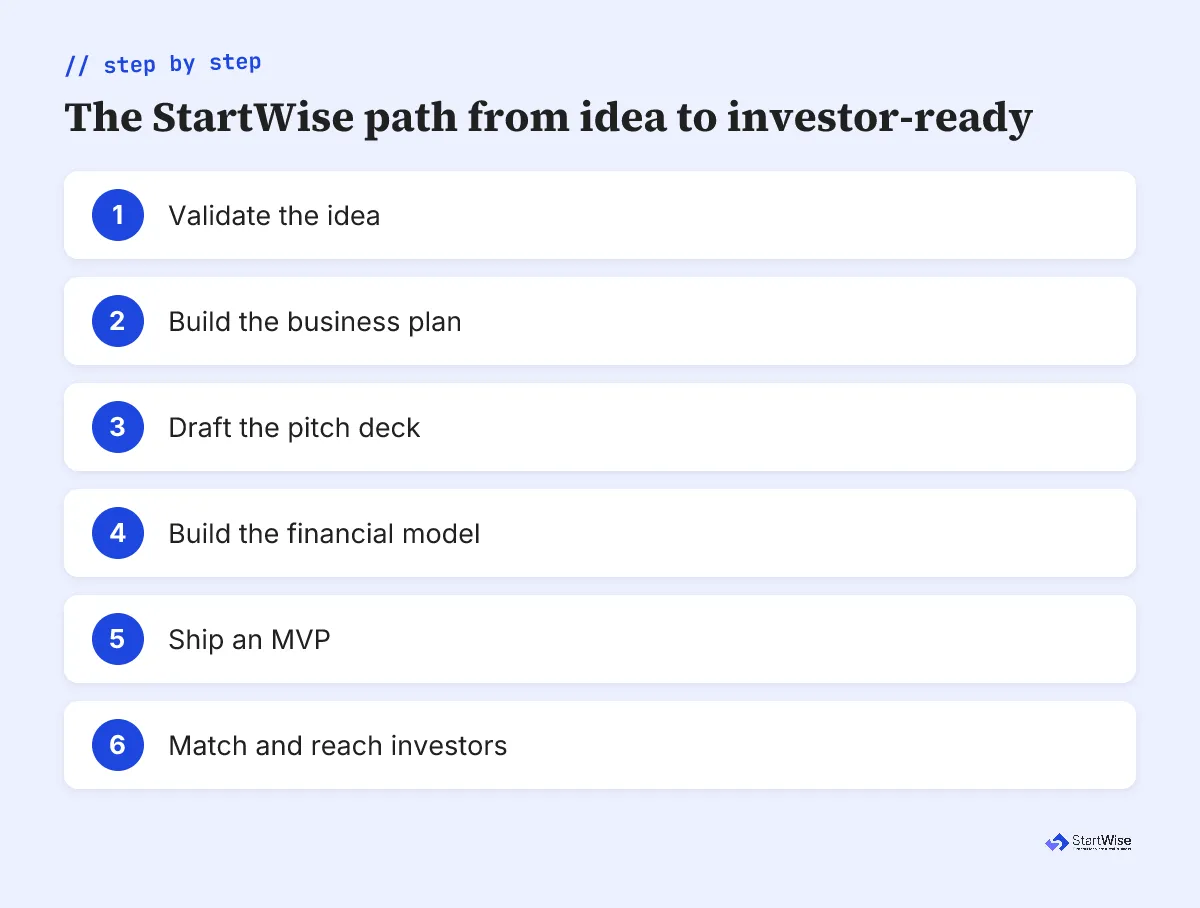
So the choice between them was never really about which tool checks more feature boxes. It’s whether you want the one that hands you the most files, or the one that makes the two that decide your round good enough to send. In the decks we read, the second is what earns the meeting.
PitchBob vs StartWise on price
On price, the two aren’t really in the same market. PitchBob sells one-time plans at $29.90, $49.90, and $99.90, plus a co-pilot subscription from $19.90 a month (PitchBob, 2026). You pay once and own a stack of drafts. StartWise’s deck check is free, and the wider platform is priced as an ongoing tool for the whole raise rather than a one-off export.
That gap tells you what each is for. PitchBob is cheap because it’s a draft engine. Pay, generate, done. StartWise costs more over time because the work doesn’t stop at a generated file. It stops when the deck is ready and the outreach is running. If all you need is a first draft to react to, PitchBob is the cheaper buy, and I’d say so to any founder. Need the draft to become a fundable deck? Then price stops being the number that decides it.
Which one should you choose?
Choose PitchBob if your bottleneck is the blank page and your budget is tight, especially if you need a draft in a language most tools ignore. It gets you from nothing to a first version fast. $29.90 once is fair for a rough starting point you’ll rewrite anyway. Just export a copy you own, strip the leftover branding some reviewers flagged, and treat every output as a draft.
Choose StartWise if the draft already exists. From PitchBob, Gamma, Canva, anywhere, the real question becomes whether it lands, and that’s when a slide-by-slide review and a real financial model investors interrogate matter more than another generator. Founders we work with draft with a builder and check with StartWise. It’s the honest way to run it.
PitchBob wins the draft. StartWise wins the send. Pick based on which one you’re closer to.
What to do this week
Stop shopping for a better generator and fix the deck you already have. Here’s the order we give founders:
- Pick one generator for your real bottleneck and stop shopping. A second one won’t fix a weak story.
- Export a copy you own as PDF or PPTX, and delete any leftover vendor branding or placeholder text.
- Cut the deck to the slides your story needs, then read only the titles. If they tell the story alone, you’ve passed the slide-count test.
- Get it reviewed against the investor skim before you send it, not after the rejections come in.
If you’re weighing other whole-stack options, our PitchBob alternatives roundup, StartWise vs Slidebean, and StartWise vs Storydoc cover the rest. The tool was never the thing between you and the meeting. The deck was.