
 By
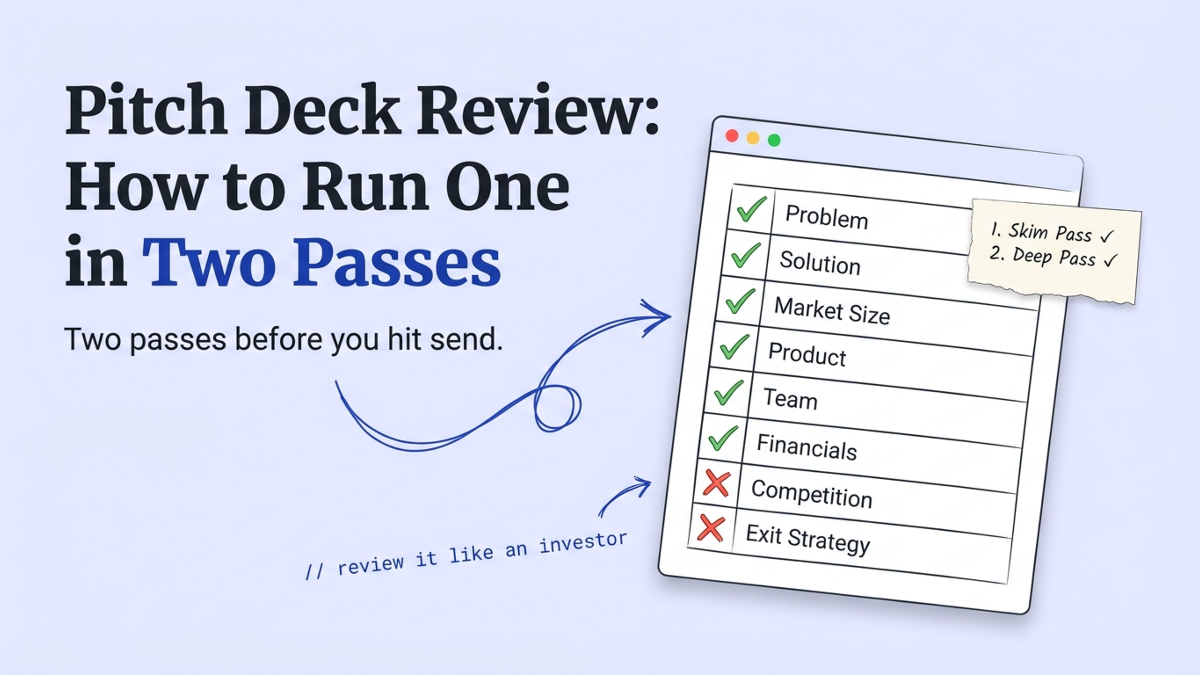
A pitch deck review is a structured read of your deck that judges one thing: whether it earns the next investor meeting. It copies how an investor actually reads, which is fast, skeptical, and title-first. We run these reviews every day at StartWise, and most founders skip the step that decides the outcome, which is reviewing in the right order. Investors give a first-time deck about 2 minutes 30 seconds (DocSend, 2024). Here’s how to review a deck under that constraint, in two passes.
What does a pitch deck review actually check?
A pitch deck review checks whether the story survives a fast, skeptical read, not whether the slides are pretty. Design still matters, and it matters last. The review is really asking a chain of questions: does the problem land, does the solution follow, is there proof, and does the ask make sense? If any link breaks, the deck stalls there and the reader leaves.
That’s the part founders get backwards, and we see it in reviews constantly. They obsess over polish, because polish is the part of a deck you can actually see, while story flow stays invisible until someone reads it cold. But the numbers say story wins the read. When Ben Yoskovitz reviewed 50 startup decks in 2025, 93% had design working against the founder and 75% were missing a why-now slide. The missing slide is the story gap. The design is the symptom.
A useful review separates the two and fixes them in order.
There’s a second thing a review checks that founders almost never test: whether a stranger can follow the deck without you narrating it. Your deck gets read alone, in an inbox, with no voiceover. If it only makes sense when you’re in the room, it fails the read that actually happens. A review is where you catch that before an investor does. Want the slide-by-slide scoring version of this? We built a separate pitch deck grader for the numeric side.
Review a deck in two passes
The method is two passes, run in order: a fast skim, then a slow deep read. Most founders do neither. They open slide one, tweak a font, jump to slide six, rewrite a headline, and call it a review. That’s editing, and it never catches the structural problem that’s actually sinking the deck.
The two passes exist because they catch different things. The skim mimics the investor who has 30 seconds and low patience. The deep pass mimics the associate who got interested and is now checking whether your numbers hold. You need both, because a deck can pass one and fail the other.
| Aspect | Skim pass (60 seconds) | Deep pass (slide by slide) |
|---|---|---|
| Mimics | The investor deciding whether to keep reading | The associate checking whether it holds up |
| Time budget | 60 seconds, titles and visuals only | 3 to 5 minutes per slide, no rush |
| Catches | Broken story arc, dead titles, missing slides | Weak evidence, vague numbers, a shy ask |
| Misses | Anything below the headline | The 30-second first impression |
| Run it | First, every time | Only after the skim passes |
Run the skim first. If the story doesn’t survive 60 seconds, the deep pass is a waste of an hour on a deck that needs restructuring, not editing. I’ve watched founders polish a deck for a week that a 60-second skim would have told them to rebuild.
What does the 60-second skim pass catch?
The skim pass catches whether your deck tells its story from the titles and visuals alone. Here’s how you run it: read only the slide titles, top to bottom, in under a minute. Ignore the body copy. If those titles carry the arc from problem to solution to traction to ask, you pass. If they read like labels (“Market,” “Team,” “Product”), the story is hiding in text no investor will read.
This isn’t a nice-to-have.
It’s the read investors actually do first.
23 seconds
is all an investor gives your first slide before deciding whether to keep reading. Papermark, Pitch Deck Metrics Report 2024-2025
Papermark’s 2024-2025 report, built on 3,000 decks and over 8 million data points, found the average deck gets 3.2 minutes total, with 23 seconds on the first slide and roughly 15 seconds on each one after. Read that against the skim test. An investor giving you 15 seconds a slide is reading your titles, not your paragraphs. In our review room, a title-only skim is the single most accurate way we’ve found to predict how a deck performs cold.
The skim also catches missing slides, which is where most decks lose points. That why-now slide 75% of founders skip? A skim finds it in seconds, because the arc has a visible hole where the timing argument should be.
Fix everything the skim flags before you touch the deep pass. A gorgeous slide twelve can’t rescue a story that fell apart on slide two.
What does the slide-by-slide deep pass check?
The deep pass checks each slide against the one question it exists to answer. The skim reads speed. The deep pass reads evidence. You slow down to 3 to 5 minutes a slide and ask, for each one, whether it would survive a skeptical associate with a spreadsheet open.
Every slide has exactly one job. The problem slide has to prove the pain is real, frequent, and expensive. The market slide has to show a bottom-up count of reachable customers, not a $1T number borrowed from an analyst report. The traction slide has to show a slope, because investors read direction and speed, not a vanity total. We go deep on that specific trap in our traction slide guide.
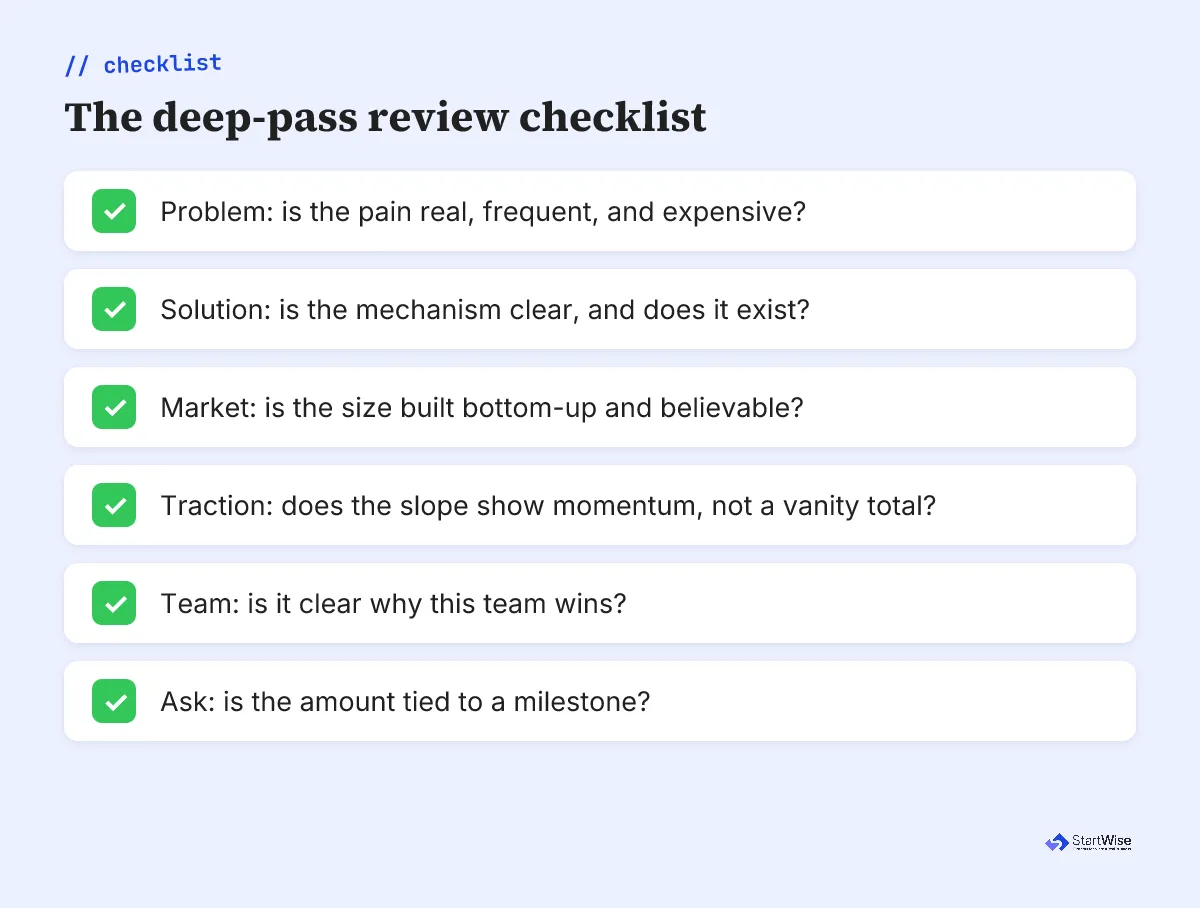
Alejandro Cremades lays out the same review order investors use: problem first, then team, market, model, and traction, then the risks. Your deep pass should walk that exact path, because it’s the path the reader walks. Reviewing slides in deck order instead of reader-priority order is how founders miss that their strongest proof is buried on slide nine.
Weak evidence is the quiet killer in the deep pass. In Yoskovitz’s 50-deck read, 40% had weak or missing go-to-market, the kind of gap a skim glides over but a deep pass has to catch.
The ask slide is where I see the most fixable damage.
StartWise's position
The single most common fixable flaw we flag in reviews is a shy ask. Founders write "$500K to accelerate growth," which is wallpaper. An ask is a number tied to a milestone that de-risks the next round: "$500K for 18 months of runway to reach $50K MRR." One is a request an investor can evaluate. The other is noise.
Run the deep pass with a notepad, not a mouse. Write down every flag and fix nothing until the pass is done, or you’ll rabbit-hole on slide three and never finish. The AI review our tool runs uses this same slide-by-slide rubric, if you’d rather have a machine make the first pass.
Running the deep pass by hand is slow. Get a free, slide-by-slide review with a concrete fix list, in minutes.
How do you review your own deck without fooling yourself?
Reviewing your own deck is hard because you know what every slide means, so you read what you intended instead of what’s there. The fix is to force distance. Three tricks work, and they cost nothing.
First, wait a day. A deck you rewrote at midnight reads completely differently after sleep, because you’ve stopped hearing your own narration.
Second, read the titles aloud. Reading forces the skim you’d otherwise fake in your head. If you stumble or the arc jumps, the reader will too.
Third, run the stranger test. Hand the deck to a sharp friend outside your space, give them 60 seconds, and ask them to tell you the story back. Where they get it wrong is exactly where a cold investor gets it wrong, and they won’t email you to ask.
A review that only fixes typos is a proofread. A real review asks whether the deck earns the next meeting.
The honest problem with self-review is that you’ll always grade your own baby generously. So set a rule before you start: any slide you have to explain out loud gets flagged, no exceptions. That single rule catches more than any checklist, because the slides you defend are the ones that aren’t carrying their weight. We keep seeing founders talk past a broken slide in a live review, then go quiet when we ask them to point to where the deck says what they just said.
When should you get an outside review?
An outside review earns its cost once your deck is already clean. Self-review catches the mechanical debt for free. A second reader, or a paid one, is worth it for the judgment calls you can’t make about your own company: whether the market is real, whether the wedge is defensible, whether the team reads as the one to win.
Sequence it.
Run your own two passes, fix what you find, then bring in help on a version that no longer has obvious holes. Paying a person to catch your typos is the most common way founders waste a review budget.
The options run from free to a few thousand dollars. A free AI pass handles structure and clarity. A founder friend or an accelerator mentor brings pattern-matching from the decks they’ve already watched succeed and fail. A paid reviewer or agency brings deep judgment and a network. We broke down what each tier catches and what it costs in our pitch deck review service guide, so you don’t overpay for a proofread.
What to do this week
You can review your deck properly in one focused hour. Here’s the order that works:
- Run the 60-second skim today. Read only your titles. If the story doesn’t survive, stop and restructure before anything else, because polish on a broken arc is wasted time.
- Run the deep pass with a notepad. Give each slide 3 to 5 minutes, write down every flag, and fix nothing until you’re done. Check the slide count while you’re there.
- Fix in priority order. Close missing-slide flags and story gaps first, then evidence and numbers, then design and typos last.
- Get one outside read. Once it’s clean, hand it to a stranger or run a free review for the calls you can’t make yourself. Every number here comes from a source we fetched the day this was written; our rules are on the About page and the byline is accountable at the author profile.
The goal was never a prettier deck. It’s a deck that survives a 2 minute 30 second skim from someone who’s already decided to say no, and a real review is how you get there before you hit send.