 By
An AI business plan generator turns a short questionnaire into a full plan, financials and all, in minutes. By 2026 there are dozens, and the roundups ranking them mostly skip the one question a founder raising money should ask first: who reads the thing you’re making? We read fundraising materials before they go out, and the long written plan is almost never what gets someone funded. Papermark’s 2026 report found 16% of investors quit a deck inside 10 seconds. Pick your generator for the artifact they actually open.
What are the best AI business plan generators in 2026?
The best AI business plan generators in 2026 are Upmetrics, Venturekit, PrometAI, Bizplanr, and LivePlan, but the honest answer depends on who reads your output. A bank or a visa officer wants a long written document. A seed investor wants a deck and a model. Here’s how the main tools compare for a founder raising equity, with StartWise included and our bias disclosed up front.
| Tool | Built for | What it makes for a raise | Free? |
|---|---|---|---|
| StartWise | First-time founders raising equity | Plan, deck, model, then investor outreach; the free deck review is the entry. Check your deck free → | Free deck check |
| Venturekit | Founders who want one all-in-one artifact | 28-page plan, financials, and a pitch deck from 12 themes | Free tier |
| PrometAI | A fast first draft | Plan, SWOT and PESTEL frameworks, basic projections | Free tier |
| Upmetrics | SMB, loans, visa, accelerators | Plan, 3-year forecast, deck, plan-vs-actuals tracking | 15-day guarantee |
| LivePlan | SBA and lender plans | 3-statement financials in SBA-style format | Trial only |
| Bizplanr | A free first draft | Plan and financial statements, pay once for lifetime | Free |
None of them is wrong. They’re built for different readers, and that’s the split the other roundups blur.
Why your reader decides which generator to use
Your reader decides the tool. The two jobs a business plan does barely overlap: one is the long written document a bank, an accelerator, or a visa officer requires, and the other is the short case a seed investor skims before taking a call. Same facts, completely different artifact. Grab the wrong one and you’ve spent a weekend formatting for an audience you’ll never pitch.
The loan-and-compliance tools say so in their own marketing. Venturekit leads with users being “3x more likely to get a loan.” Upmetrics lists accelerators and E2 visa sponsorship among its audiences and syncs plan-vs-actuals with QuickBooks and Xero, which is bookkeeping, not fundraising. LivePlan formats to an SBA-style three-statement plan, per Venngage’s May 2026 test, which scored LivePlan 5 out of 5 for lender-readiness but only 3.5 for investors.
If you’re raising equity, that gap is the whole point. A plan optimized for a loan officer is tuned for the wrong reader. My honest take: grab a loan-shaped tool only if a loan or a visa is actually on your list.
Does a business plan even matter for a venture raise?
For a venture raise, the written plan barely matters, and the data is blunt about it. Papermark tracked 24,541 decks and 358,672 investor views across 2024 to 2026. Investors spend about 4.0 minutes on an average view, and only 44% ever reach the last slide. The deck and the model carry the read. The 30-page document sits in a folder.
The business plan is the one document in a venture raise that nobody actually opens.
That’s why we point founders at the deck first. We made the full case in what an investor-ready business plan actually is, and the short version holds here: a deck does the first read, a one-page summary travels in a cold email, and a light model backs the numbers. A generator that only spits out a long plan has built you the artifact with the smallest audience. Read more on how long investors actually spend on a deck if the 4.0-minute figure sounds low.
Which generator fits your kind of founder?
The generator that fits you depends on the output you’re short on, not the brand. Sort by the artifact your reader opens, and the finalists split cleanly.
- Venturekit, if you want one tool for everything. It outputs a 28-page plan, financials down to a profit-and-loss and balance sheet, and a pitch deck from 12 themes. The closest all-in-one for a founder who wants a single place to raise from.
- PrometAI, if you need a draft today. It promises idea to investor-ready in two minutes with SWOT and PESTEL frameworks and basic projections, and it has a free tier to try first.
- Upmetrics, if a loan, a visa, or an accelerator is in play. Strong forecasts, Lean Canvas, and live plan-vs-actuals, built for the long document those readers expect.
- Bizplanr, if free is the constraint. A full draft with financial statements for nothing, then one payment for lifetime access, aimed squarely at first-time founders.
- ChatGPT, if you just want to think out loud. It drafts and rewrites text well, with no native financials, so it’s a writing partner rather than a plan engine.
A second tier covers narrower jobs. monday.com’s 2026 roundup also ranks IdeaBuddy for early-stage idea validation, 15MinutePlan.AI for a plan at a one-time price, and Canva for a design-first document with no real financials. Each does one slice well. None changes the core split between a document for a lender and an artifact for an investor, so don’t let a longer list distract you from that one decision.
So the choice is less “which is best” and more “which hole am I filling.” Pick the tool that produces the artifact you’re missing, then stop paying for the parts you won’t use.
Generated the plan? The deck is what an investor opens. See where yours loses the room, slide by slide, free.
Can you trust the “funded” stats these tools advertise?
You can’t take the funding stats at face value, because they’re self-reported sales copy. Upmetrics advertises that “90% of Upmetrics plans get funded” and says 1M+ entrepreneurs have used it since 2019. Venturekit says its users have “raised $350 million” and are “3x more likely to get a loan.” Both numbers may be real. Neither comes with a methodology, a sample, or a definition of “funded.”
90%
Upmetrics advertises that 90% of its plans get funded, with no published sample or method. treat vendor funding rates as marketing, not evidence (Upmetrics, 2026)
Think about what “funded” could even mean here. A founder who raised a $5,000 friends-and-family round counts the same as a seed round. A plan written and never sent still had the tool. I’d ignore every funding percentage on these sites and judge the output on one thing: does it hand you a deck and a model you could defend in a meeting?
What actually makes a plan investor-ready?
An investor-ready plan is one whose assumptions survive scrutiny, and that’s exactly the part a generator can’t fake for you. These tools are fluent. They’ll produce a confident market section and a tidy hockey-stick forecast in seconds. Fluent and true are different things, and an investor pokes at the second one.
StartWise's position
Most AI market-size and financial sections are theater. A bottoms-up count of the customers you can actually reach in year one tells an investor more than any billion-dollar total addressable market. If your numbers can't survive a napkin check, they're hurting your raise.
This is where the testing roundups quietly agree with us. Venngage weighted financial accuracy at 25% of its scoring rubric, the single largest factor, precisely because that’s where generated plans crack. Here’s the napkin check we run on a generated market section. Take the “reachable customers” the tool claims for year one, multiply by a price you could actually charge, and see if the revenue line still matches the plan’s forecast. It almost never does. So treat the tool’s output as a first draft to argue with. Make every number traceable to an assumption you can say out loud, and see what financial model investors actually want by stage before you ship the forecast a generator hands you.
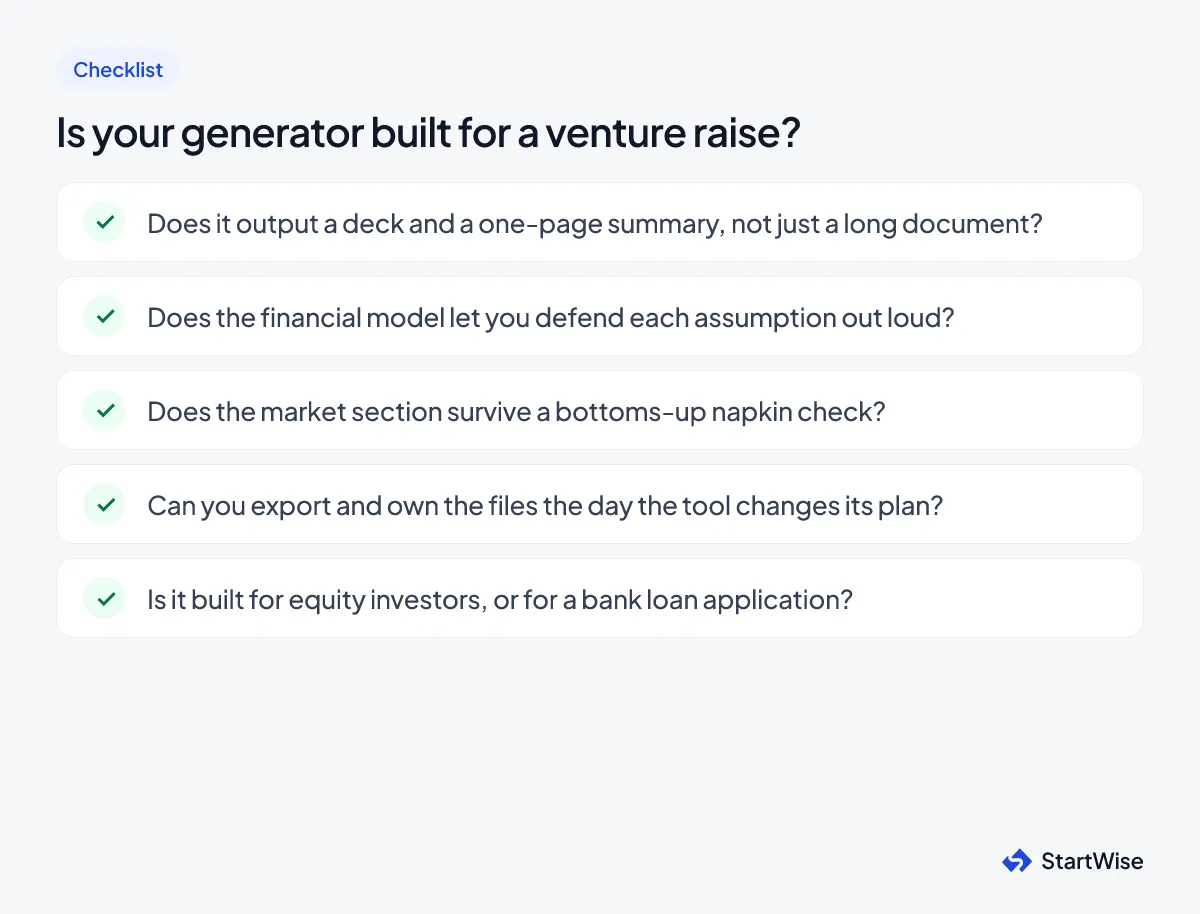
Here’s my committed take. Most founders raising equity should not generate a 30-page business plan at all. Generate the deck and the model, write the long document only if a bank, an accelerator, or a visa officer asks, and spend the saved hours making your market math honest.
What to do this week
Start from your reader, then pick the tool, in that order.
- Name your reader. Raising equity points you at the deck and model; a loan or visa points you at the long written plan.
- Pick one generator from the table for the artifact you’re missing, and use the free tier before you pay.
- Rewrite the market section as a bottoms-up count of reachable year-one customers, so it clears a napkin check.
- Export and save the files you own, so a pricing change can’t lock up your plan.
- Put the deck first. If you want a tool that drafts one fast, see our best AI pitch deck generator roundup, then get it reviewed before you send it.
The plan is the document nobody opens. Build the one they do.
