 By
Your first board meeting is the first formal sit-down with the directors who now share legal oversight of your company, usually your lead investor and you. It lands right after a priced round, and most first-time founders over-prepare the wrong half. At StartWise we review the decks and updates founders bring to investors, and the board deck is where the nerves show. Carta’s State of Seed 2025 data puts the median seed at $4.0M, and the fund that wrote part of that check now expects a seat at your table. Here’s how to run the room.
Do you even need a board meeting yet?
Probably not, if you haven’t raised a priced round. A board of directors forms when you sell equity and hand an investor a seat, and at pre-seed on a SAFE that usually hasn’t happened. Carta’s State of Seed 2025 data shows founders sell about 20% of the company in a priced seed, and that lead typically takes the single outside board seat.
So a SAFE-funded pre-seed founder scheduling formal quarterly board meetings is performing governance, not doing it. You don’t have a board. You have a few people rooting for you, and a monthly update email serves them better than a staged meeting.
The real board shows up as your seed closes. For most first-timers that’s three people: you, maybe a co-founder, and the partner from your lead fund. The way those seats get set is decided in the term sheet, so read it with the board in mind before you sign and the round closes. We walk through that moment in how to close a funding round.
My honest take: the founders who struggle at the first meeting are the ones who treated it as a milestone to clear rather than a tool they now own. It’s yours. Use it.
Keep your first board to three people
Keep your first board small, ideally three seats: you, a co-founder if you have one, and the partner from your lead fund. At seed you don’t need an independent director yet, and adding chairs you can’t fill with real value only slows every decision down. The lead earns the outside seat by writing the check, since Carta’s State of Seed 2025 data has founders selling about 20% in a priced round, and that ownership is what a board seat tracks. After the round the founding team still holds a median 56.2% (Carta, 2025), so at seed the room stays small and founder-controlled, which is exactly how you want it.
Your other seed investors usually get information rights, not a vote. That means they see the deck and the updates, but they don’t sit on the board. Keep that line clear in your head, because inviting every small check to the table turns a working session into a performance for an audience.
A five-person board at seed is a governance cargo cult. Independent directors matter later, often around Series B, when the board starts balancing founders against investors and needs a neutral voice. I’ve seen first-timers rush to recruit a famous name for the seat and regret handing a vote to someone who shows up unprepared. Wait until the seat buys you judgment you actually lack.
What goes on a first board meeting agenda?
A first board meeting agenda splits into four blocks across 60 to 90 minutes: opening and admin, the CEO and financial update, strategic decisions, then a closed session. I’mBoard’s startup agenda template puts the rough split at 5 to 10 minutes for admin, 15 to 20 for the update, 45 to 60 on strategy, and 10 to 15 to close.
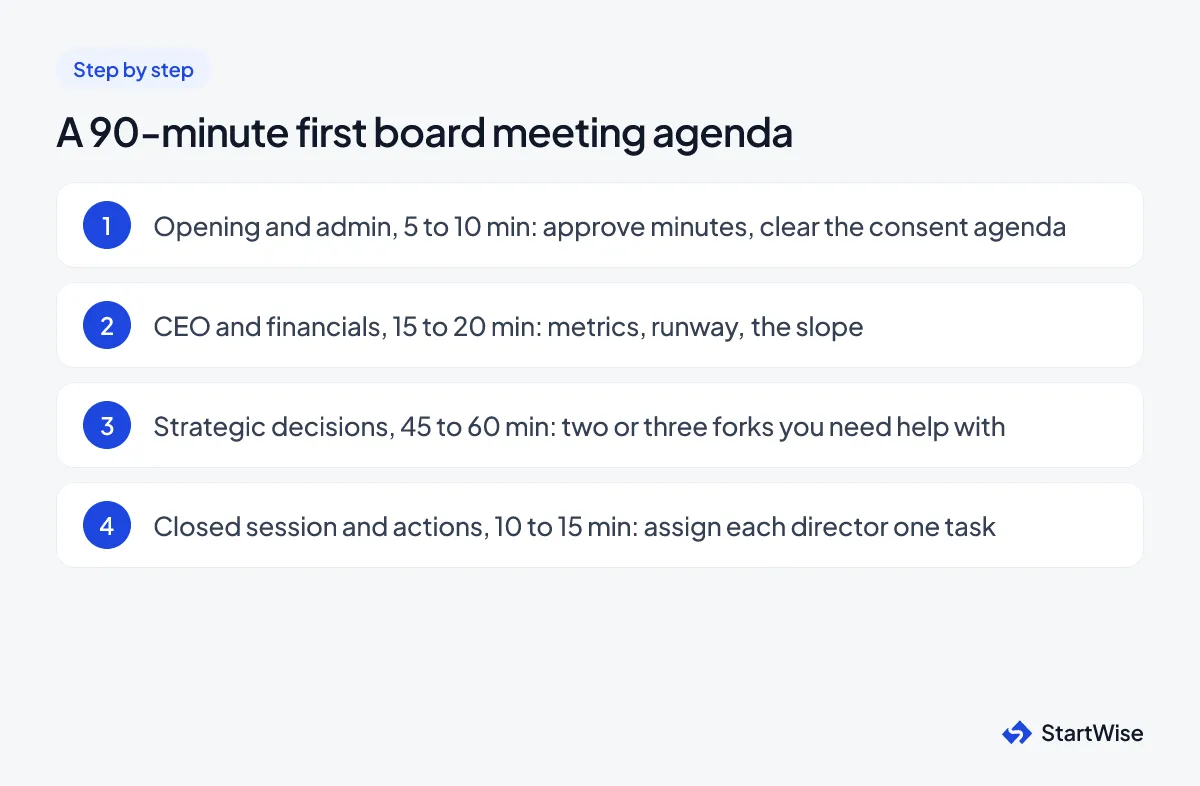
Notice where the time goes. The update is the small block. The decisions are the big one. NFX frames the ideal as spending 30% of the meeting on updates and 70% on the forks where you want help, and that ratio is the whole game. Founders who invert it burn an hour narrating slides their board already read, then run out of time for the one question that mattered.
The first meeting also carries a bit of setup the later ones won’t: confirming board composition, agreeing on a meeting cadence, and approving the basic resolutions your counsel flags. Get that housekeeping done fast. Then move to the part that earns the room.
How is a board deck different from your pitch deck?
A board deck and a pitch deck are both slides you show investors, but they have opposite jobs. The pitch deck sells a stranger on a maybe. The board deck briefs people who already said yes and now want the unvarnished truth, quickly.
| What changes | Pitch deck | Board deck |
|---|---|---|
| Reader | A stranger deciding whether to meet | Directors who already invested |
| Core job | Earn a 20-minute call | Get help on real decisions |
| Lead with | Your sharpest proof point | The problem you need solved |
| Bad news | Softened or left out | Stated plainly, up front |
| Length | 10 to 12 slides | A short update plus an appendix |
We review both kinds every week, and the tell is tone. A board deck that reads like a sales doc, all wins and no asks, quietly trains your directors to stop believing you. The strongest ones read like a status memo a sharp operator wrote: here’s the number, here’s what moved it, here’s where I’m stuck. For the metrics themselves, the same discipline we cover in the traction slide guide applies, just pointed at people who are now inside the company.
A workable first board deck runs short on the main thread and long in the appendix. The front of it is a one-page scorecard, the metrics that matter with their trend, cash and runway, and a plain line on whether you’re ahead or behind plan. Then one slide per decision you want help on, framed as a question with your recommendation attached. Everything else, the full financials, the hiring plan, the product roadmap, moves to an appendix the board can read if they want the detail. Keep the live deck to what you’ll actually talk about, and let the appendix carry the reference.
A board deck that only shows wins trains your board to stop believing you.
What should your metrics actually show?
Your metrics section should show movement, not a trophy. A board reads the slope, not the absolute number, because direction and speed predict next quarter and a lifetime total never will. Lead with the two or three numbers that track your core loop, each shown over time, and flag the one that worries you before anyone asks.
StartWise's position
After reviewing founder updates daily, our blunt take: traction is a slope, not a number. A board reads week-over-week direction and a believable reason behind it, and that beats any vanity total. The lead who took roughly 20% of your company at a $20.0M median post-money (Carta, 2025) is really tracking one thing, whether that stake is compounding, and only a slope answers it.
This is also why your worst metric belongs on the screen, not buried in the appendix. A board that learns about a problem three months late can’t help, and it remembers being surprised. Put the dip up front with your read on the cause, and the room shifts from judging you to solving it with you.
How do you run the room without freezing?
You run the room by flipping it: ask the board to work, don’t perform for them. NFX calls this flipping the board meeting, and the move is simple. Open with the hardest question you need answered, hand the board the context, then shut up and let the people you recruited actually earn their seats.
A few things that help a first-timer settle:
- Sit at the table, not at the front. You’re a peer convening help, not a candidate presenting to a panel.
- Bring your worst number first. It buys more credibility than any win.
- Close every topic by naming who does what. A board meeting that produces homework beats one that produces applause.
- Keep the cadence tight. NFX recommends seed boards meet every 6 to 12 weeks, so no single meeting carries a season of surprises.
End the meeting with a short closed session, the few minutes where management steps out and the directors talk alone, or where you talk without your team in the room. It sounds formal for a three-person board, but it sets a healthy habit: the board needs space to be candid, and you need a channel for the thing you can’t say in front of your whole company. Name it on the agenda from meeting one so it never feels like an ambush later.
I’ve watched founders walk out of these meetings deflated because the board picked at a weak spot. That’s the board doing its job. The meeting isn’t a review of you. It’s a working session on the company, and the sooner you stop hearing feedback as a grade, the more you’ll get out of the people in the room. The questions they press on are the same ones your next investor will, which is why we keep a running list of the questions investors ask.
Just added investors to your corner? Map who you already know and your clearest next moves with Atlas, free, in about 15 seconds.
What to do the week before your first board meeting
Prep the week before comes down to five moves, and sending the deck early is the one that changes the meeting most. Directors who read ahead arrive ready to debate; directors reading live just nod along, and you waste your scarce strategy time.
- Send the board deck 48 hours ahead, with the decisions you want flagged on the first page.
- Pre-call your lead. Walk them through the hard topics so the meeting has no ambush and you have one ally already briefed.
- Pick the two or three decisions worth the room. Everything else is an update line, not a discussion.
- Write your worst number into the update yourself, with your read on why.
- Book the follow-up slot now, and keep a shared action tracker from day one.
After the meeting, send a written summary within 48 hours: decisions made, each action item with an owner and a date, open questions still live. That summary is the difference between a board that compounds and one that drifts, and it’s the same muscle as a strong investor update email. Run your first one as a working review, assign the homework, and your second board meeting will already feel like a tool instead of a test.
