 By
A pitch deck and a business plan are two different fundraising documents. The deck is a 10 to 20 slide visual story built to win a meeting. The business plan is a 20 to 40 page written document that proves the whole company out, written for a reader who already decided to dig in. For an equity raise, you need the deck. We review founder decks every week, and the ones who stall usually haven’t finished one, because they spent three weeks polishing a plan no investor asked for. A deck gets about 3.2 minutes of attention before an investor decides to lean in or pass (Papermark, 2024-2025). A 40-page plan gets closer to none.
What is the difference between a pitch deck and a business plan?
The difference comes down to job and length. A pitch deck sells the meeting in minutes. A business plan documents the strategy in depth for a reader who already decided to engage, which at the earliest stages is almost nobody. One is your opening line. The other is the appendix that waits until diligence, if anyone opens it at all.
| Dimension | Pitch deck | Business plan |
|---|---|---|
| Length | 10 to 20 slides | 20 to 40 pages |
| Job | Win the meeting | Prove viability in depth |
| Audience | VCs, angels, accelerators | Lenders, grant bodies, your team |
| Read time | About 3.2 minutes (Papermark) | Rarely read cover to cover |
We see founders treat these as two versions of the same thing, a short one and a long one. They aren’t. A deck is a sales tool for a skeptical reader with seconds to spare. The plan is a reference document for someone who already said yes and now wants the detail behind the decision. Build one for the wrong audience and it won’t land.
Do you need a business plan to raise money?
For an equity round, you almost never need a traditional business plan. In 2026, 93% of pre-priced pre-seed rounds closed on SAFEs (Carta, via Finro), and 95% of the capital flowed through them. A SAFE round runs on a deck, a conversation, and a cap. There isn’t a bound document in that loop.
The business plan is a habit left over from the bank-loan era, when a lender needed pages of narrative before writing a check. Equity works the other way. An investor meets you off the deck, gets interested, then asks for the numbers. We’ve watched this play out on hundreds of raises, and the order holds every time.
Investors ask for your deck, then the numbers behind it. In the review room, a 40-page business plan is the one document nobody requests.
StartWise's position
Build for the skim, not the bound read. An investor decides in a few minutes whether to take the call, and they decide off your deck, never off a plan they will not open. Spend the weeks on a sharper deck and a model that survives hard questions, not on prose chapters that sit unread in an inbox.
So here’s the committed version, the one you can quote back at me: for an equity raise, writing a 40-page business plan is procrastination dressed as diligence. It feels like progress. It won’t move the round.
What investors read instead of a business plan
Investors read your deck first, then the two artifacts that carry the real depth: a financial model and a data room. The business plan’s actual content, the market math and the projections, belongs in the model. The operating detail belongs in the room, released only when someone leans in. Neither needs to be prose.
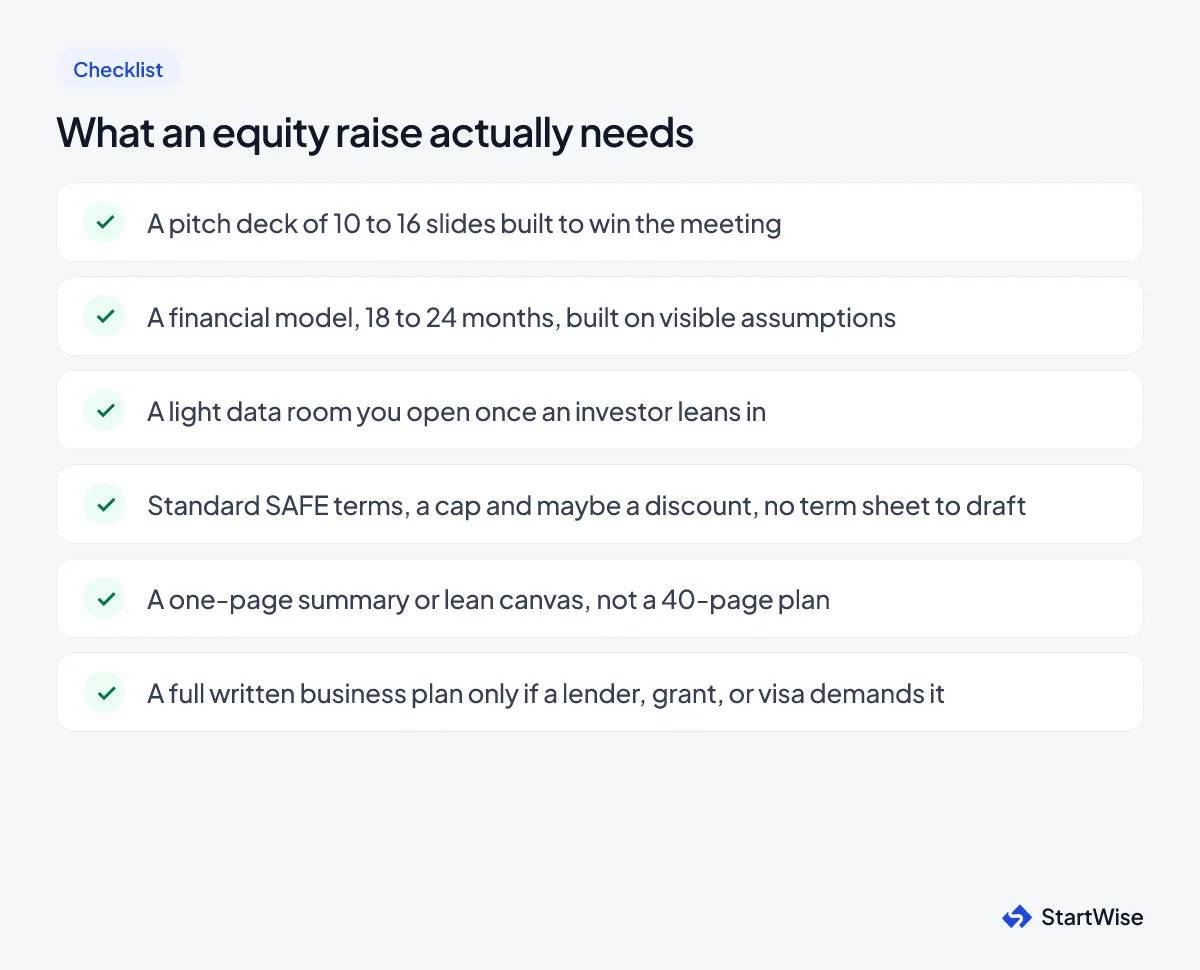
That split matters because it tells you where to spend your time. The deck earns the meeting. The financial model answers the first hard questions on a call. The data room handles diligence once an investor is serious. A pre-seed data room is 8 to 12 documents, not the 60-document stack built for a Series A.
- The deck: your story, told to win 20 minutes of attention.
- The model: 18 to 24 months on visible assumptions, so an investor can change a number and watch it move.
- The data room: incorporation docs, the cap table, your SAFE terms, and a short metrics summary.
This is the part the generic guides miss. They’re stuck framing it as deck versus plan, short versus long. The honest frame is deck to open, model and room to close. We built two of our products around exactly that split because the “plan” founders think they need is really a model and a room wearing a trench coat.
The model is where a plan’s financials section actually belongs. Instead of three paragraphs narrating your revenue, you hand an investor a sheet they can poke, so they change the conversion rate and watch the runway move. That interactivity is the whole point, and no PDF of prose can match it. We’d rather read a rough model a founder can defend live than a polished plan they’re reciting from memory.
When do you actually need a business plan?
You need a full business plan when the money is debt or non-dilutive, not equity. An SBA lender treats it as a core requirement. US Bank calls a comprehensive business plan essential for an SBA loan application, because a lender has to see how you’ll repay. Grants and founder visas ask for the same.
So the plan isn’t dead. It’s just aimed at a different funder. Here’s who still requires one:
- Debt financing: SBA loans and most bank loans want a full plan with projections.
- Grants: SBIR, state programs, and foundations usually mandate a written plan.
- Founder visas: E-2, EB-5, and some O-1 petitions need a detailed business plan.
- Some accelerators and incubators: a few still ask for a plan in the application.
- Co-founder alignment: a shared written plan can be worth it internally, even at one page.
3 to 4 weeks
The time founders sink into a business plan their equity investors will not read. A deck takes days to two weeks. Spend the difference on the deck and the model instead. business plan build time, Waveup, 2026
The mistake we flag most often: a first-time founder spends a month on a 40-page plan for a pre-seed equity raise, then has no deck to send. The plan was built for the wrong funder. You raised the question “deck or plan,” and the answer turned on who signs the check.
About to send your deck instead of a plan? See what a reviewer would flag slide-by-slide before an investor does, free and in minutes.
Is a one-page business plan or lean canvas enough?
A one-page plan or lean canvas is enough for an equity raise, and it’s often better than a 40-page version. It forces you to answer the same questions a deck does, in a format you’ll actually keep current as the company changes. The long document goes stale the week after you print it.
We tell founders the useful “plan” is a page, not a binder. Keep an investor one-pager that states the problem, the solution, the market, the team, and the ask, then let the deck tell the story and the model carry the math. If a lender or grant later demands the long form, you expand the one-pager into it. You don’t start there.
A lean canvas does a slightly different job than the one-pager. It maps your problem, solution, channels, and cost structure onto a single grid you can revise in an afternoon, while the one-pager is the outward-facing summary you send ahead of a deck. Either one beats a 40-page plan, because you’ll actually keep it current when the business shifts. A founder who updates one page every month reads as someone running a company, not describing one.
Which comes first, the pitch deck or the business plan?
The deck comes first, every time you’re raising equity. It gets the meeting. The model answers the first round of questions. The data room opens once an investor is leaning in. The written plan, if you need one at all, comes last and lives inside that room.
Treat it as a sequence, not a choice. We watch founders burn their best weeks on the wrong artifact, and it’s almost always the plan, drafted before they’ve sent a single deck. Flip it. Build the thing that earns the call, then build the depth that survives the follow-up.
Build the thing that earns the call first. The depth can wait for the people who actually lean in.
The pre-seed raise itself runs on that order, and the deck sets the pace for everything after it.
In practice it looks like this. The deck goes out in a cold email or a warm intro, a 20-minute call happens, the investor asks for the model, and only once they’re moving toward a check does the data room open. The written plan, if a bank or a grant ever needs one, gets built last from everything you already assembled along the way.
What to do this week
You don’t need a 40-page plan to start raising. You need a deck that earns a meeting and enough depth to survive the second conversation. The founders we see raise fastest are the ones who’ve built in that order.
- Draft or sharpen the deck first, 10 to 16 slides, built to win 20 minutes.
- Put the depth in a financial model, 18 to 24 months on visible assumptions, not in prose.
- Assemble a light data room, 8 to 12 documents, that you share once an investor is interested.
- Keep the “plan” to one page, and write the full version only if a lender or grant asks for it.
Then send the deck, not the plan. If the second question breaks your story, fix the deck and the model, because that’s where investors were always going to look.
