 By
The roadmap slide in a pitch deck shows where your startup is headed and the milestones you’ll hit to get there. Most founders build it as a timeline of features stretched across three to five years. That’s the first thing we flag at StartWise, where we review founder decks before they raise.
Investors read this slide in about 15 seconds, per Papermark’s 2024 analysis of 3,000 decks, and in those seconds they’re not reading your feature list. They’re asking one thing: can this money get you to your next round?
What is the roadmap slide in a pitch deck?
The roadmap slide maps your plan from today to a short set of future milestones: product launches, revenue marks, key hires, the next raise. Some decks call it the milestones slide, some the timeline slide. Same job, and in the decks we review it sits near the back, usually after traction and before the ask.
Here’s the distinction that matters. The traction slide looks backward at what you’ve already done. The roadmap looks forward at what you’ll prove next.
Traction earns belief. The roadmap spends it, by showing you know which proof points come next and roughly when.
Get that split right and the slide does real work. Get it wrong and it reads as filler, the kind of slide the investor scrolls past on the way to your ask without registering a single milestone.
Product roadmap vs investor roadmap: what’s the difference?
A product roadmap and an investor roadmap answer different questions, and plenty of founders paste the wrong one onto the slide without noticing they’re built for two completely different readers. Your internal product roadmap lists features and sprints. The investor roadmap lists the milestones that remove risk and earn the next check.
The decks we review most often show the first by accident, copied straight from Notion.
| Dimension | Product roadmap | Investor roadmap |
|---|---|---|
| Who reads it | Your team | Your next investor |
| Unit of work | Features and sprints | De-risking milestones |
| Horizon | The next few quarters of build | The gap to your next round |
| What counts as a win | Shipped on time | Proof that earns the raise |
The feature list belongs in your data room and your product docs. On the slide, every line has to earn its place by removing a doubt an investor would otherwise raise.
“Ship dark mode” is a feature. “Reach $30K MRR” is a milestone. One moves your product; the other moves your valuation.
How many years should a startup roadmap cover?
A pre-seed roadmap should cover the next 12 to 18 months, not three to five years. The longer horizon feels ambitious, but it reads as a founder who doesn’t yet know which milestone actually matters.
Investors fund the gap to your next round, not your path to an exit, so the slide should end where that next raise begins.
The math backs the short horizon. A pre-seed round raises a median of $1M on a $4M to $6M post-money cap in 2026, diluting founders 15% to 20% (Carta State of Private Markets, via Value Add VC). That money buys roughly 18 months of runway.
Your roadmap’s whole job is to show the milestones that money reaches, and that those milestones clear the bar for a seed round, which carried a $4.1M median last year on a record $24M post-money (Carta, via Value Add VC).
StartWise's position
After reviewing decks daily, our take is blunt: a pre-seed roadmap that spans five years is a tell. Investors fund the 12 to 18 months to your next round, so show the three or four milestones that de-risk the seed and stop there. A longer timeline doesn't read as vision. It reads as a founder guessing.
So anchor the slide on the next round: name it, name its bar, and show the path that gets you there. Longer isn’t more credible, just vaguer.
What should the roadmap slide include?
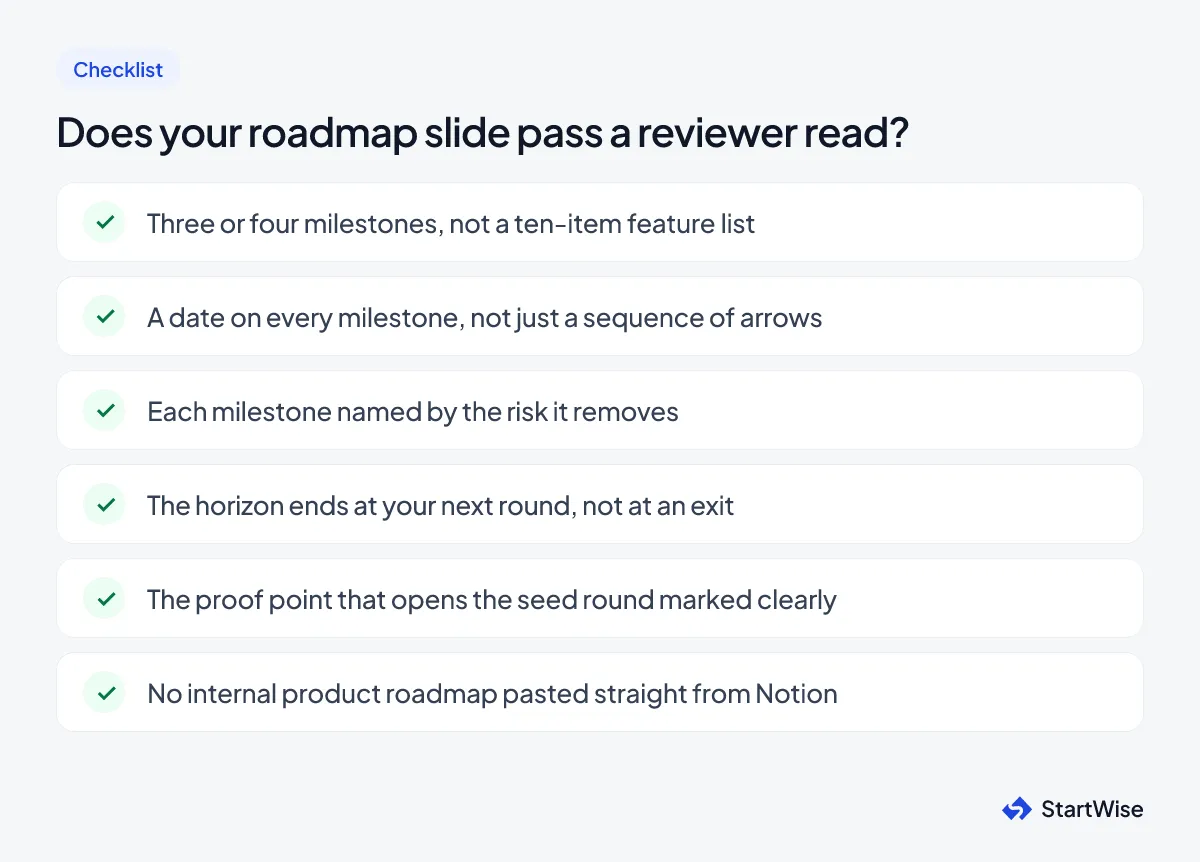
A strong roadmap slide includes three or four milestones, each with a date and the risk it removes. That’s the whole slide. Push past four and it turns into the Gantt chart investors skim past.
What makes a milestone count is that clearing it removes a reason to say no:
- A revenue or usage mark that proves demand, like “$30K MRR by Q3”
- A product milestone that proves you can build, like “v2 live with three enterprise pilots”
- A key hire that removes an execution gap, like “technical lead signed”
- The explicit next-round trigger, the metric that opens seed conversations
A milestone that doesn’t remove a risk is just a to-do list with a date on it.
In the decks we review, the line founders forget is the last one. They show product and growth goals, then leave out the proof point that actually starts the next raise.
That proof point is the reason the slide exists, and it ties your roadmap to the ask slide, where the same milestones justify how much you’re raising and what it buys.
How long do investors spend on the roadmap slide?
Investors spend about 15 seconds on the roadmap slide, the same budget they give any slide after the first, per Papermark’s report on 3,000 decks and more than 8 million data points. A whole deck gets 3.2 minutes on a first read.
The opening slide takes 23 seconds. Everything after it, roughly 15. Nearly half of decks, 49%, run 9 to 16 slides, so your roadmap competes for attention near the thin end of a fast skim.
Fifteen seconds reads three dated milestones. It does not decode a twelve-bar Gantt with color-coded workstreams and a legend.
If your roadmap needs a careful read it won’t get one, and your plan reaches the investor as a blur, so design it to land in a glance: a short line, a few markers, a date on each.
Not sure your roadmap reads as de-risking milestones or a feature wishlist? Get a slide-by-slide read.
Four ways the roadmap slide goes wrong
The roadmap slide goes wrong in four predictable ways, and we flag them most weeks. The biggest is the horizon.
Qubit Capital and Vestbee both still advise a three to five year timeline running toward profitability or an exit.
For a pre-seed deck, that’s exactly backward.
5 years
the horizon most roadmap guides still recommend, which at pre-seed signals you don't know which milestone opens your next round (Qubit Capital and Vestbee both advise a 3 to 5 year timeline, 2026)
The second failure is the pasted product roadmap: a wall of features with no dollar or usage outcome attached. The third is milestones with no dates, so a reader can’t tell what happens in six months versus two years.
The fourth is the quiet one: the roadmap shows big goals but never names the next round or its bar, so the investor can’t connect your plan to the check in front of them.
Fix the horizon first. The rest usually falls into place once the slide ends at your next raise.
What to do this week
Rebuild your roadmap slide around your next round in four steps, in one sitting.
- Write down your next round and the bar that funds it: the revenue, usage, or product proof a seed investor will want.
- List the three or four milestones between today and that raise, and nothing past it.
- Put a date on each one, plus the single risk clearing it removes.
- Delete every line that’s a feature instead of a proof point.
Do that and your roadmap stops being the Gantt chart we skim past and forget. It becomes the slide that answers the only question an investor brings to it: can this money get you to the next round?
Give them that in 15 seconds, and the slide has done its job.
