
 By
By 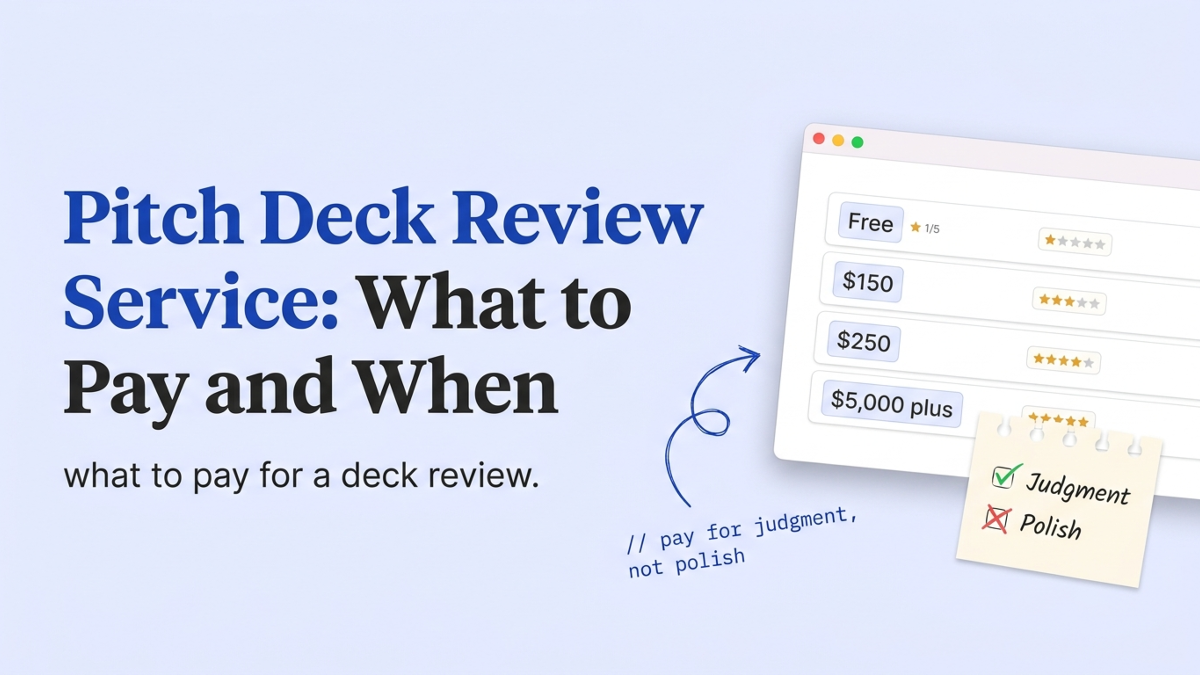
A pitch deck review service is anyone you pay to critique your deck before investors see it, from a free AI tool to a $50,000 agency retainer. The trouble is that the search results blur two very different purchases: paying for feedback on the deck you have, and paying someone to build you a new one. We review decks every week at StartWise, and most founders who ask “what should I pay for a review” are about to overspend on the wrong thing. Here’s what each tier costs, what it catches, and when paying is worth it.
What does a pitch deck review service cost?
A pitch deck review service costs anywhere from nothing to over $5,000, and the price maps cleanly to four tiers. The cheap end is automated and instant. The expensive end is a human rebuilding your deck and coaching your pitch. Most founders need something from the bottom half of this table, not the top, and the bottom half is where we point nearly everyone who asks us in the review room. Run your own two-pass review before you pay, so you’re buying judgment and not a proofread.
| Tier | Cost and turnaround | What you get | Best for |
|---|---|---|---|
| Free AI review (Pitch Deck Doctor) | Free, minutes | Slide-by-slide flags and a concrete fix list. Check your deck free → | Every founder, as the first pass |
| Async written review | $150 to $300, 1 to 3 days | A written feedback document on your existing deck | A clean outside second opinion |
| Live consultant session | $250 to $2,000, about a week | A video call or slide-by-slide report, with judgment | A human read before a real meeting |
| Boutique agency or retainer | $5,000 to $50,000+ | Strategy, full redesign, pitch coaching | Funded teams raising later rounds |
Those ranges track Spectup’s 2026 pricing breakdown: a freelance redesign runs $1,000 to $5,000, and an agency rebuild $3,000 to $50,000 or more. Written reviews sit far below that. In the review room we see them cluster around $150 to $300 for a feedback document on the deck you already have, and $250 to $2,000 once a live consultant call is attached. The gap between a $200 critique and a $50,000 rebuild is the whole story of this category.
The free tier is worth naming, because in 2026 “free” stopped meaning weak. Slidebean’s reviewer scores a deck in minutes for nothing, off the method it says has raised more than $350 million. Evalyze hands back a 1,000-point investor-readiness score with the missing slides flagged, also free. Both are loss leaders for a paid upsell, so read the notes as a sales pitch with useful feedback attached. The mechanical read, though, is genuinely good now.
The spread is enormous for one reason: the word “review” is doing too much work.
Are you buying a review or a redesign?
A review and a redesign are different purchases, and confusing them is how founders blow a budget. A review critiques the deck you already have. A redesign throws it out and builds a new one. The $150 written service and the $50,000 agency aren’t two points on one scale. They’re two different products that happen to share a name. The same line separates a deck builder from a deck review, which is why we put Slidebean and StartWise side by side instead of calling one an alternative to the other.
Spectup’s data makes the split visible. A freelance redesign runs $1,000 to $5,000, and an agency rebuild $3,000 to $50,000 or more, with hidden costs that “typically double the initial budget” once revisions and investor-specific versions stack up. A review, by contrast, tops out around $300 for written feedback. Same word, a 100x price gap.
Here’s the test we give founders deciding which they need:
- If your deck communicates the business and you want it sharper, buy a review.
- If a stranger can’t tell what you do after reading it, you might need a redesign.
- If you’re pre-revenue and pre-seed, you almost certainly need the review, not the rebuild.
Most early decks are fixable, not broken. Paying agency prices to rebuild a deck that needed three slides rewritten is the most expensive mistake in this whole category.
What does each review tier actually catch?
Each tier catches a different layer of the deck, and the jump that matters is from mechanics to judgment. A free AI pass and a $150 written review both work the mechanical layer: missing slides, buried numbers, slide titles that carry no meaning, a problem slide that hides the pain. That layer is real, and it’s most of what loses early meetings. It’s also cheap to fix once you can see it.
The difference in 2026 is that the free layer got good. A tool that scores your deck on a 1,000-point scale and lists the slides you’re missing does the mechanical audit as well as a paid $150 write-up did two years ago. So the mechanical tier is close to a solved problem, and paying for it is close to waste.
What you pay a human for is the judgment layer. Whether the market is actually there. Whether this team is the one to win it. Whether your “why now” holds up. No tool scores those, and a generic design agency mostly doesn’t either, because it’s optimizing pixels, not the thesis. We mapped exactly where the machine stops and a person starts in our breakdown of AI versus human review.
Picture the two reviews side by side. The free pass says: your traction slide buries the growth number on line four, your market slide cites a trillion-dollar figure with no path to it, slide nine has no title. All true, all fixable in an evening. The human says: the market’s real but your wedge is too broad, and you’re raising six months too early. One report saves you a weekend. The other can save you a quarter. They’re not competing, and you shouldn’t make them. You’re meant to buy them in sequence.
A free tool tells you the deck is legible. A good human tells you whether you’re right.
So read the tiers as a sequence, not a menu. The free pass clears mechanical debt. The paid human, if you buy one, spends their attention on the calls a rubric can’t make. Buy them in that order and you stop paying senior rates to catch typos.
Before you pay anyone, clear the mechanical flags free. Get a slide-by-slide review with a concrete fix list, in minutes.
Is a paid pitch deck review worth it?
A paid review is worth it when it buys judgment you can’t get for free, and not worth it when it buys polish you could. The honest case for paying is strong on paper. Qubit Capital reports that 89% of VCs expect a polished deck, while only 1% of startup presentations secure funding, and that investors spend about 2 minutes 42 seconds reading one. In a field that thin, every advantage counts.
But read the vendor claims with a cold eye. Spectup says professional decks lift “investor meeting rates by 40 to 50%” and close probability “15 to 25%.” Those are real numbers from people selling the service, measured on founders who could already afford a $5,000 deck. Correlation, mostly. A fundable company with money to spend on design raises. The design didn’t make it fundable.
There’s a quieter cost too. A paid review takes days, and a deck you’re sending cold doesn’t always have days. If a warm intro lands and you want your deck in front of a partner this week, a free pass you act on tonight beats a written critique that arrives Thursday. The best review is the one that fits inside your actual timeline, not the most expensive one you can book.
2x
How much a professional pitch deck budget typically grows once revisions, financial-model integration, and investor-specific versions are added, per Spectup's 2026 breakdown (Spectup, 2026)
My honest take after reviewing decks every week: a paid review earns its fee when you’ve run out of things a free pass can find. Until then, you’re buying feedback on problems you could have closed yourself.
How much should you spend at your stage?
How much you should spend on a review depends almost entirely on your stage, and most founders spend as if they’re one round ahead. A pre-seed founder doing cold outreach doesn’t need a $5,000 agency. They need a free pass, maybe one $150 written review, and the discipline to act on both. A seed or Series A team walking into partner meetings has a different math: a few thousand dollars on a human read is cheap insurance on a multi-million-dollar raise. The mistake runs in one direction. Almost nobody underspends here; they overspend, early, on the wrong tier.
The trap is paying for polish on a deck built for the wrong meeting entirely.
StartWise's position
The 10-slide ceiling is wrong for pre-seed. Most "perfect deck" advice, and most paid redesigns, optimize for a partner meeting. But a cold-outreach deck has one job: earn a 20-minute call. That usually means fewer slides and a sharper problem slide than a template or an agency suggests. Paying to polish a 20-slide deck for cold email is paying to perfect the wrong artifact.
This is why we push founders to settle the slide count and the ask before they pay for anything. A reviewer who sharpens a too-long deck still leaves you with a too-long deck. Get the shape right first, then buy feedback on the right thing. The fundraising context for all of it sits in our pre-seed raising guide.
How to get the most from a pitch deck review
Getting the most from a review means coming to it with mechanical debt already cleared. The founders who waste a paid review hand over a first draft and ask “is this good?” The ones who get their money’s worth hand over a clean deck and ask one sharp question. Reviewers, free or paid, give better feedback when you aim them.
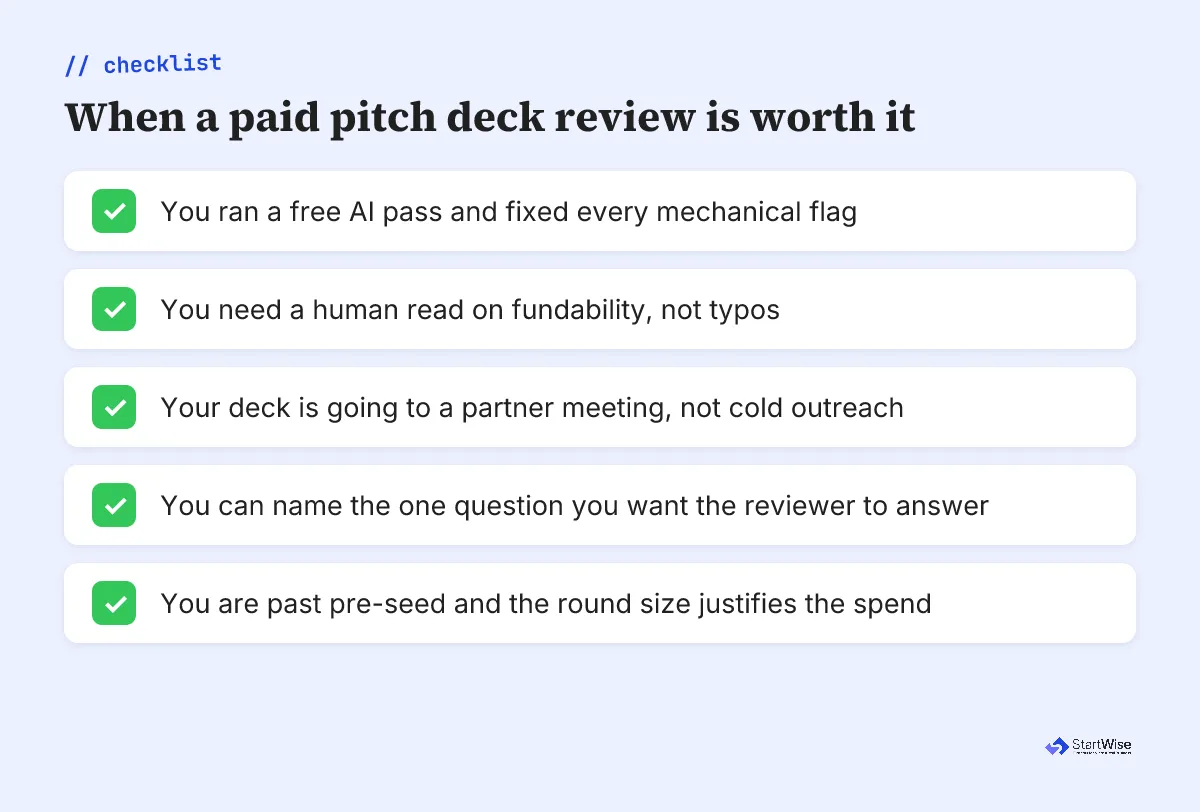
Run this order:
- Run a free AI review and fix every mechanical flag it returns. This is the part you never pay for.
- Read your slide titles alone, in order. If they don’t tell the story, no reviewer can fix that for you cheaply.
- Write down the one question you want a human to answer. “Is my market framing credible?” beats “thoughts?”
- Only now book a paid review, and match the tier to your stage and your timeline.
A grader-style score, free or paid, is a readiness signal, not a verdict, and we explain how that scoring works if you want the rubric underneath it. The review is a tool, not an oracle.
What to do this week
Get your deck reviewed for free before you pay anyone a cent. Run a free AI pass today, fix the top three flags it surfaces, and read your titles cold to see if the story survives. If it does and you still want a human read before a real meeting, buy one review that matches your stage, a $150 to $300 written critique at pre-seed, and bring it your one sharpest question. Skip the agency rebuild unless a funded round justifies it. The rules we publish under are on the About page, and the byline is accountable at the author profile. Polish is the floor every deck has to clear. It was never the thing that gets you funded.