 By
Sharing a pitch deck means getting it in front of an investor in a way you can see and control. Most founders do it the way they’d send a resume: attach a PDF, hit send, hope. That throws away the signal it’s supposed to buy you. The median raised deck reaches just 11 unique investors (Papermark, 2026), so every send is a scarce shot. We read founders’ outreach every week. How you share changes what you learn more than the slides do.
How should you share your pitch deck with investors?
Share your deck as one tracked link per investor, pasted into the body of a short email, with the method matched to the channel. A tracked link is a web page version of your deck that records who opened it and how long they stayed. It replaces the attachment, so you keep control of the file and learn something every time it gets viewed.
The payoff is real engagement data. Investors spend about 4.0 minutes on a deck they actually open, and roughly 18 minutes of total attention across return visits, according to Papermark’s 2026 report of 24,541 decks. But 16% quit in under 10 seconds. A PDF attachment won’t tell you any of that. A tracked link tells you all of it, so you’ll know who to chase.
Tools like DocSend, Papermark, OpenVC, and Visible all do this, most with a free tier. Pick one and stop attaching files. For how to read the numbers once views start landing, we wrote a full guide on what deck view time actually tells you.
Match how you share to how warm the intro is
The right delivery method depends on how you reached the investor, not on a blanket rule. Every other guide says the same thing: always a link, never a PDF. That advice is wrong at one specific moment. It’s the most valuable moment you’ve got. A warm double opt-in intro should carry the attached file the forwarder expects.
Here’s my honest take after watching hundreds of outreach threads. For a warm intro, attach the PDF and put the tracked link underneath it. The investor got your deck from someone they trust, they’ll open the attachment in one tap on their phone, and a bare link can read as friction or a privacy wall at the exact wrong time. For a cold email, flip it: send the link only, so you’ll get the open signal and can fix a weak slide mid-raise.
StartWise's position
How you share is a decision about the relationship, not the file. Blasting every investor the same cold tracked link is how warm-intro founders leak their best meetings. The median deck reaches just 11 investors and holds about 4.0 minutes of attention per view (Papermark, 2026), so the warmest few are worth bending the rule for. Treat the intro as the context, and let it pick the method.
| Channel | What to send | Why |
|---|---|---|
| Warm intro (double opt-in) | The attached PDF plus a tracked link below it | The forwarder and investor expect a file they can open in one tap; the link still logs the view |
| Cold outreach | A tracked link only, one per investor | You get the open signal and can update the deck later; a raw attachment strips both |
| After a first meeting | A data room link, same kind of destination | Real interest has earned the detailed deck, model, and cap table in one controlled place |
| Forwarded internally | A non-confidential version by default | Your deck will reach people you never emailed, so treat every slide as public |
A quick definition, since the terms blur. A warm intro is when a mutual contact connects you to the investor, usually a double opt-in where both sides agree first. We cover the mechanics in how to get warm intros to investors.
Which version of your deck should you send?
Send one non-confidential outreach deck, and keep the detailed version for later. It’s a sample, not your full file. It has to earn a meeting, and it has to be safe to lose, because you’ll lose control of it the moment you hit send. Most early-stage investors won’t sign an NDA to read a first deck, so anything you wouldn’t want public shouldn’t be on those slides.
We keep seeing this in the review room, because the deck doesn’t stay with the people you sent it to. Fully 67% of deck views come from outside the United States, across 184 countries, in Papermark’s 2026 data. Your 11 investors forward it to partners, analysts, and friends in other time zones. The file keeps working without you in the room.
Your deck travels without you. Share the version you’d be fine seeing on a stranger’s screen in another country.
So build the outreach deck for the forward. Clear titles that carry the story alone, no live financials you wouldn’t publish, no customer names you haven’t cleared. Keep the deep numbers, the detailed model, and the cap table for the data room you open once someone asks. One clean public deck, one private detailed set. That split is the whole system.
Know who you want to reach but not how to run the send? StartWise matches you to investors for your stage and helps you share your deck and track the outreach from one place.
What should you send with the deck?
Send the deck with a three-line email and one clear ask, never a bare link on its own. The link is the delivery; the note is the reason they click. A deck with no context reads as spam, and a tracked link with no note won’t get opened at all.
Keep the note to three lines:
- Who you are and the one traction fact that matters
- The raise, the stage, and why now
- A specific ask, usually a 20-minute call
Paste the labeled link in the body. Attach the PDF too only if this is a warm intro. We have five tested versions of this email in our cold email templates for investors.
One rule holds across every send. Generate a separate link for each investor and label it with their name. SeedLegals reports more than 3 billion pounds raised through single shareable pitch links, and Peony’s 2026 guide makes the same point: a per-investor link is what turns an open into a named signal. Reuse one link for everyone and you blind yourself. Before any of this, you need the list itself, which starts with how to find investors for your startup.
When should you share a data room instead of a deck?
Share a data room after a first meeting or clear interest, not in the first email. A data room is a single link holding your detailed deck, financial model, cap table, and key documents, access-controlled so you choose who sees what. It’s the graduation from the public deck, and it only makes sense once an investor has earned the deeper look.
The timing follows the raise, which runs longer than one email. Papermark’s 2026 data puts the average reading window at 59 days from an investor’s first view to their last, and about six months from first view to a round announcement. So the deck link is a campaign, not a moment. When a cold prospect turns into real interest, open the data room behind the same kind of tracked link and keep the thread in one place. For what goes inside it, we built a lean pre-seed data room checklist.
What to do this week
Set up the sharing system before you email a single investor, so the first send already learns something back. The founders we review who’ve done this first are the ones who can act on a view. The whole thing takes an afternoon.
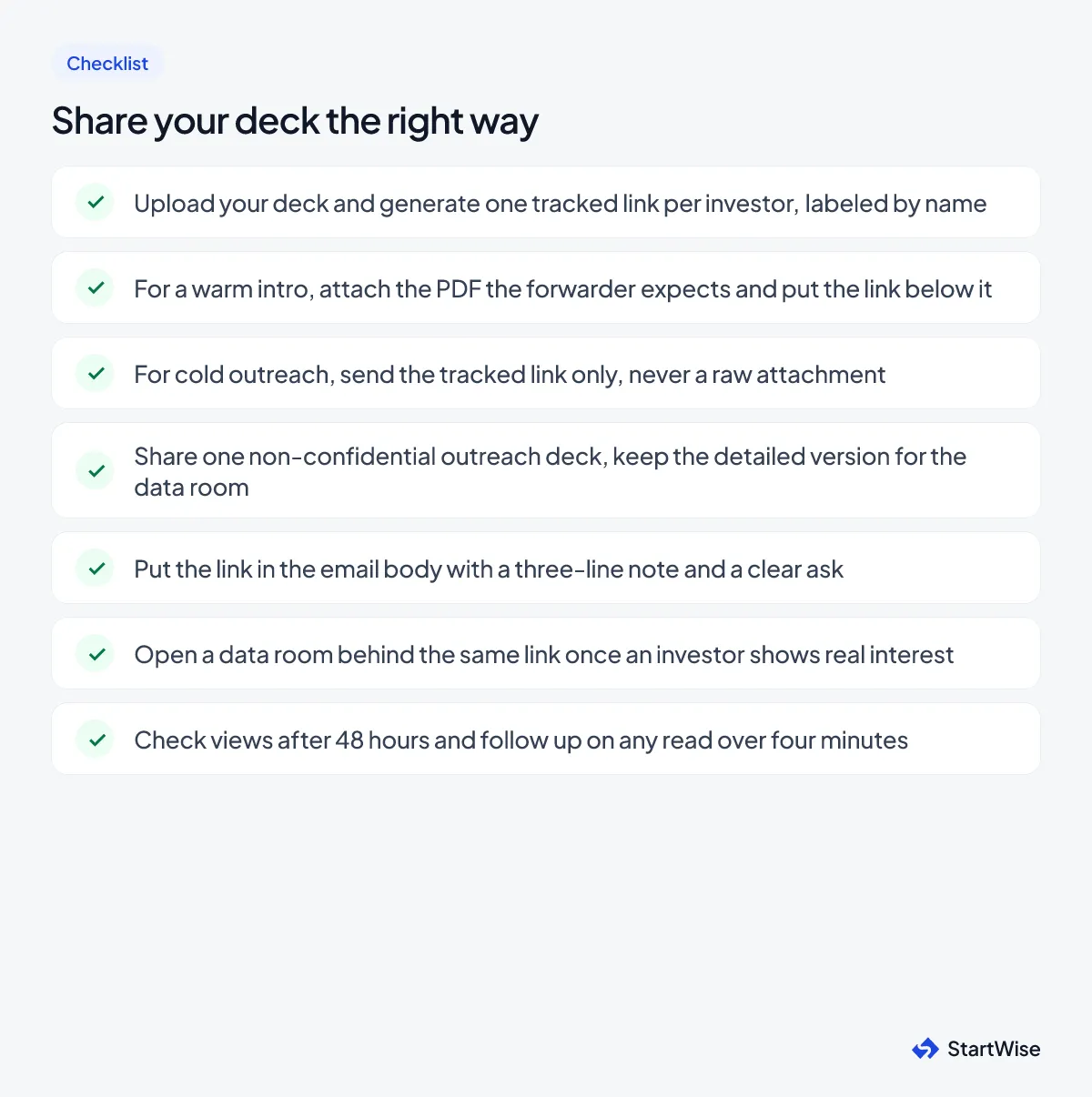
- Upload your deck to a tracking tool and generate one labeled link per investor on your list.
- Save two versions: a non-confidential outreach deck for email, a detailed set for the data room.
- Write the three-line note with a specific ask, and decide per investor whether a warm intro also gets the attached PDF.
- Send in small waves, then check views after 48 hours and follow up same-day on any read over four minutes.
Do that and your deck stops being a file you lose track of. It becomes a signal you can read. One link, one named investor, one thing you learn every time it travels without you.
