 By
A term sheet is the short, mostly non-binding document an investor sends to propose the price and terms of your round, usually one to three pages that arrive before the long legal contracts. Getting one means an investor finally said yes. Papermark’s 2026 report shows the median raised deck reaches just 11 investors before that happens, so the offer sitting in your inbox is rarer than it feels. At StartWise we read the term sheets founders forward us, and the same reflex shows up every time. They fixate on the valuation and skim the rest.
What is a term sheet, and is it binding?
A term sheet is the offer letter for your round, and almost none of it binds you yet. It runs one to three pages, proposes the price and the handful of terms that matter, and precedes the real legal documents: the stock purchase agreement, the investor rights agreement, the charter. Two clauses are the exception. The no-shop (or exclusivity) clause and the confidentiality clause usually do bind the moment you sign, as Hustle Fund spells out in its founder term sheet guide.
So signing a term sheet is a handshake, not a finish line. The round still closes weeks later, once lawyers turn those few pages into forty. For most founders that gap runs four to six weeks of diligence and drafting, and we walk through the full stretch in how to close a funding round.
That’s exactly why the term sheet matters more than its length suggests. The definitive documents don’t reopen the deal, they encode it. You’re negotiating these few pages precisely because nobody reopens settled terms later. Read the sheet as if every line survives to the final contract, because the ones you wave through here almost always do.
Which four terms actually move your outcome?
Of the fifteen-odd clauses on a seed term sheet, four decide how you come out the other side: valuation, the option pool, liquidation preference, and board composition. Hustle Fund sorts every term sheet into three buckets, economics, control, and deal structure, and your real negotiating room is in the first two. The rest is mostly machinery.
Here’s the triage I’d run on any seed sheet before calling a lawyer:
| Term | What it decides | 2026 market standard | Your move |
|---|---|---|---|
| Valuation + option pool | Your effective price | Seed near $24M post-money (Carta) | Negotiate the two as one number |
| Liquidation preference | Who gets paid first at exit | 1x non-participating, 95.8% of deals (Cooley) | Accept 1x, flag anything above it |
| Board composition | Who controls company decisions | Founder-majority at seed | Keep the majority |
| Anti-dilution | What happens in a down round | Broad-based weighted average | Accept standard, refuse full ratchet |
Notice what’s not on that list. Dividends, registration rights, pro-rata, drag-along: all real, all mostly standardized, none worth spending your goodwill on at seed. Put your negotiating capital where the table is, and sign the rest fast.
StartWise's position
After reading the term sheets founders bring us, our blunt take: the valuation number is the least important line on the page. Cooley's Q2 2026 data shows 96.4% of deals already use non-participating preferred, so the economics are mostly settled market terms. The fight worth having is over the option pool and who controls the board, because those compound at every round after this one.
Why the option pool is the term founders miss
The option pool is where founders quietly lose the most equity, because a pre-money pool comes out of your ownership and not the investor’s. Here’s the move. An investor offers, say, $3M on a $12M pre-money valuation, then asks for a 15% option pool sized into that pre-money number. That pool isn’t free equity conjured from nowhere. It gets carved out before the investor’s money lands, so it dilutes you alone, and your effective pre-money is really closer to $10M.
Carta’s mid-2026 data puts median seed dilution around 18%, and an oversized pool is how founders push past that line without noticing.
18%
Median equity a founder sells at seed in 2026. A pre-money option pool is carved from your share of that, not the investor's, so an oversized pool is a silent raise on your own dilution. from Carta State of Private Markets, mid-2026, via Value Add VC
Two fixes work. First, size the pool to a real hiring plan for the next 12 to 18 months, not a round-number 15% an investor floats because it’s convenient. If you’ll make four hires before the next raise, price four hires, not a theoretical org chart. You won’t get the pool to zero, and you shouldn’t try. The goal is to right-size it, not to fight it. Second, push for the pool to count as part of total dilution rather than a separate haircut on you alone. Both are standard asks, and the guides from Gunderson Dettmer and Hustle Fund treat them as normal negotiation, not aggression. We see the same unexamined 10 to 15% pool on sheet after sheet. If your cap table already worries you, startup cap table mistakes covers the rest.
The option pool is the cheapest equity most founders never think to defend.
Who controls the board after a seed round?
At seed, you should still control your board, usually with a two-to-one founder majority. The structure most first-timers see is three seats: you, a co-founder or second founder seat, and one seat for your lead investor. Carta’s data has the lead buying roughly 18% of the company at a priced seed, and that check buys the single outside seat, not the room. We cover the mechanics in your first board meeting. Keep it that way.
Here’s why it compounds. Board control decides who can fire you, approve the next round, or force a sale, and every future round negotiates from the structure you set now. Hand a lead board control for a seed check and you’ll spend Series A trying to win it back from a position of weakness. Investors also get protective provisions, a short list of decisions that need their sign-off, like selling the company or raising debt above a threshold. Those are normal and worth granting. A board majority isn’t. We see founders give away the first and guard the second, when it should be the other way around.
What’s standard in 2026, and safe to sign fast?
Most of a modern seed term sheet is boilerplate the whole market has already converged on, and knowing what’s standard is what lets you sign it fast. Cooley’s Q2 2026 financing data shows 95.8% of deals carried a 1x liquidation preference and 96.4% were non-participating, so a plain 1x non-participating preference isn’t a concession. It’s just the market. The same report found 83.6% of rounds were up rounds and only 12.1% were down. Investors aren’t writing unusually harsh terms right now.
So here’s my committed opinion, the one a sharper lawyer might argue with: at seed, the valuation number is the least important line on the page. A founder who trades board control for a fatter valuation made a bad deal, because the valuation resets next round and the board seat doesn’t.
Terms you can usually accept without a fight, assuming they read as standard:
- A 1x non-participating liquidation preference
- Broad-based weighted-average anti-dilution
- Pro-rata rights for major investors only
- A standard drag-along needing a majority of preferred and common
- Information rights and a 30-day no-shop
When they’re boilerplate, you’re not conceding anything by signing quickly. If a term sheet reaches past these, that’s your signal to slow down and ask why. Off-market terms, as the Gunderson Dettmer guide puts it, often say more about the investor than the deal.
Negotiating your first term sheet? Map who you already know and your next fundraising moves with Atlas, free, in about 15 seconds.
How do SAFEs change the term sheet?
At pre-seed, your first term sheet usually isn’t a term sheet at all. It’s a SAFE, short for Simple Agreement for Future Equity, and it has three numbers that matter: the valuation cap, the discount, and whether it’s post-money. A SAFE carries no liquidation preference, no board seat, and no anti-dilution clause to argue over, so pouring thousands of dollars of legal review into a $250K SAFE is effort spent in the wrong place.
The catch is the post-money cap. Y Combinator’s post-money SAFE, now the default, locks in the investor’s ownership percentage and pushes the dilution math onto you, especially once you stack several SAFEs before a priced round. Each new SAFE at a higher cap looks generous, but they’re stacking dilution you’ll only feel at conversion. We see founders treat SAFEs as free money, then meet the full number when the priced round finally prices. How that conversion plays out is worth understanding before you sign, which is why we wrote how a SAFE converts and SAFE vs convertible note.
My honest take: match your scrutiny to the instrument. A SAFE needs you to get three numbers right. A priced term sheet needs the full four-term triage above, where real money rides on the liquidation preference and the board seat. Treating them the same wastes money on one and attention on the other.
What to do this week
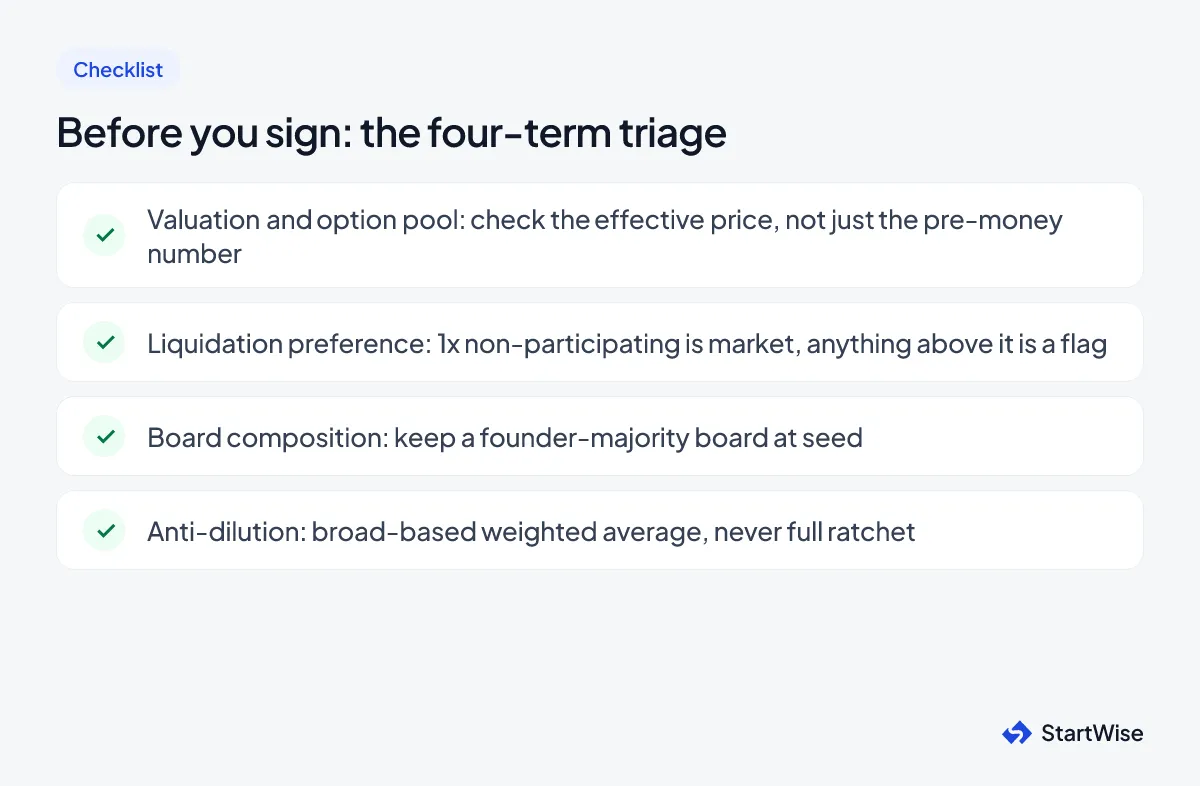
Before you sign anything, run the four-term triage and tune out the rest of the noise. The checklist below is the version I’d hand a first-time founder staring at their first sheet.
Then work the offer in this order:
- Model the effective price. Put the valuation and the option pool in one view, because a $14M pre-money with a 20% pool can be worse than a $12M with a 10% one.
- Check the liquidation preference reads 1x non-participating. If it doesn’t, ask why before anything else.
- Count the board seats. At seed you want a founder majority, full stop.
- Scan the standard terms against the list above, and flag only what’s off-market.
- Bring a startup lawyer in for the pass that matters, armed with your three or four real questions instead of a blank-page read.
A term sheet is the one document in your raise where an hour of attention is worth more than a month of pitching. You’re past the hard part: you got the yes. Spend the negotiation where it compounds, keep the board and the pool honest, and let the boilerplate be boilerplate.
