 By
A pre-seed valuation is the price tag on your company before you have revenue to justify one. For most founders it isn’t even a price. It’s a cap on a SAFE, a ceiling that quietly decides how much of the company your first check buys. The median priced pre-seed pre-money valuation sat at $7.7M in late 2025, down from $8.0M a quarter earlier, per PitchBook-NVCA data. At StartWise we read the fundraising materials founders send us, and the same reflex repeats. They treat the number as a score to maximize.
What is a good pre-seed valuation in 2026?
A good pre-seed valuation in 2026 is whatever lets you raise enough to reach your next milestone while selling 10% to 20% of the company. Priced rounds cluster around that $7.7M pre-money median, but most pre-seed rounds never get priced at all. Carta’s data puts the typical pre-seed round near $500K, done on a SAFE with a $10M to $15M valuation cap and roughly 19% to 20% dilution. Seed is the next rung up.
| Stage | Typical round | Valuation benchmark | Dilution |
|---|---|---|---|
| Pre-seed (SAFE) | ~$500K | $10M-$15M cap | 19-20% |
| Pre-seed (priced) | up to ~$1M | ~$7.7M pre-money | 15-20% |
| Seed | ~$3.2M | ~$16M pre-money | ~20% |
| Series A | $5M-$15M | much higher | 15-25% |
Pre-seed and seed figures come from Carta and PitchBook-NVCA, 2025 to 2026. Notice what those numbers aren’t: a formula. They’re a market reading, and a soft one. We see founders quote the top of that range back to us and assume it’s the baseline for everyone. It rarely is. The spread between a $5M cap and a $15M cap on the same tiny company is enormous, and nothing in a spreadsheet tells you where you land inside it.
Why you don’t calculate a pre-seed valuation
You don’t calculate a pre-seed valuation because there’s almost nothing concrete to calculate it from. With little revenue and no profit, the textbook tools (discounted cash flow, revenue multiples) have nothing to chew on. The methods built for this stage are educated guesses dressed up as math. The Berkus method assigns up to $500K each to five things like the team and the prototype, capping out around $2.5M. The Scorecard method, from angel investor Bill Payne, compares you to recently funded startups in your region and industry, then nudges that average up or down based on your team, your product, and the size of the opportunity.
Investors reach for these to sanity-check a number, not to discover one. We’ve never seen a founder win a negotiation by waving a Berkus spreadsheet. The number gets set the way prices usually do: by what comparable startups raised recently, and by how many investors want in.
Why isn’t a valuation cap the same as your valuation?
A valuation cap is not a valuation, and blurring the two is the most expensive mistake we flag on SAFEs. A cap is a ceiling. It sets the highest price at which your investor’s money converts to equity later, usually at your priced seed or Series A. If your next round prices above the cap, the SAFE investor converts at the cap and gets a better deal than the new money. If it prices below, they convert at that lower price. Here is how a SAFE actually converts, step by step.
Common mistake
Treating a high cap as a high valuation. A cap is the most your first investors will ever pay per share, not proof of what the company is worth. A cap you can't clear at the next round comes back as dilution you never priced in.
So a $12M cap doesn’t mean your company is worth $12M today. Not even close. It means you’ve promised your first backers they’ll never pay more than a $12M price when the SAFE settles up. That’s why 92% of pre-priced rounds now use SAFEs, per Carta’s pre-seed data. Nobody has to agree on today’s value, only on a ceiling, which is exactly why the instrument spread so fast once founders realized it let them skip the hardest argument in the raise. The cap does the work your valuation would have. If you’re weighing a SAFE against a note, we broke down SAFE vs convertible note separately.
Pre-money or post-money: which cap are you agreeing to?
Pre-money is what your company is worth before the new money lands. Post-money adds the raise on top of that, and this one distinction quietly decides how much of your company the check actually buys. Your dilution is calculated on the post-money number, and most modern SAFEs use a post-money cap. On a $4M post-money cap with a $750K SAFE, that first check owns $750K divided by $4M, about 18.75%, and the figure locks the day you sign. A pre-money cap of the same $4M would leave the investor with a smaller slice, because the raise sits on top of it.
That one-word swing moves your ownership by a few points, and those points compound through every future round. We watch founders agree to a headline number without asking which convention it uses, then act surprised at their cap table a year later. When an investor says “$8M cap,” your first question is simple. Pre or post?
The 2018 shift to post-money SAFEs, pushed by Y Combinator, made the math cleaner for investors and a touch worse for founders. A post-money cap locks the investor’s percentage no matter how much more you stack on the same SAFE, so stacking several post-money SAFEs can dilute you more than you expect.
How to reverse-engineer your number from the raise
Reverse-engineering your number means starting from two decisions and solving for the cap, instead of guessing a valuation and backing into a raise. Decision one: how much do you need? Not what you’d love to have, but what buys you to the milestone that makes your next round easy. Decision two: how much are you willing to sell? At pre-seed, 15% to 20% is the normal band, per Carta.
The math is one line: your post-money cap equals the raise divided by the slice you sell. Raising $750K and selling 15%? That’s a $5M cap. Sell a fifth of the company instead and the same raise implies a post-money cap near $3.75M, a number most angels find reasonable at this stage. Push for a $10M cap on that same $750K and you’re only selling 7.5%, which most pre-seed investors reject because it leaves too little on the table for them to care.
StartWise's position
Your valuation cap is a byproduct of your ask, not a target. The only number that matters at pre-seed is how much you need to reach the milestone that de-risks your next round. Your raise and your dilution target set the cap. Chasing a bigger cap for its own sake just means selling less than investors expect, or raising less than your milestone needs.
This is why we tell founders to write the ask slide before the cap. The ask slide forces the milestone-and-money question that actually sets your number. Decide the raise, pick the dilution, and the cap falls out. The order isn’t cosmetic. Do it the other way around and you’ll either raise too little to hit the milestone or sell more than you meant to. Both show up a year later as pain on your cap table.
Can your pre-seed valuation be too high?
Yes, and a cap set too high is more dangerous than one set too low. Founders chase the biggest number an angel will float, treating it as a win. It isn’t one. We watch the bill come due a round later. Put a $20M cap on your SAFE, then go raise your priced seed, and you now have to clear a valuation above $20M just to avoid a down round. If your traction doesn’t support that, you face an ugly choice: a flat or down round that signals weakness to Series A investors, or a painful renegotiation with the people who backed you first.
Worse, anti-dilution terms in that later priced round can quietly re-price your earlier shares when the valuation disappoints. The founders who raise cleanly set a cap they’re confident they’ll beat in 12 to 18 months.
A cap you can’t grow into isn’t a trophy. It’s a bill your next round pays.
Your valuation cap is a claim. Your deck is the evidence investors actually weigh.
What actually moves your pre-seed number?
Two things move your pre-seed number: evidence and demand. Investors anchor the cap on a handful of signals, then let competition do the rest. Here’s what we see actually shift the number in the materials founders send us:
- A team that has shipped or sold in this exact space before
- Behavioral traction: people who paid, came back, or fought to use an early version
- A market big enough that one fund can picture returning their whole fund
- A contested round: two interested investors move your cap more than any slide
Seed dollars are flowing, which helps the weather. Crunchbase counted $9.9B in seed funding in Q4 2025, up 12% year over year. But capital availability sets the climate, not your number. Your cap comes from the story your deck tells about those four things. If the deck doesn’t make the team, the traction, and the market obvious in the first 90 seconds, the number drifts down to whatever an investor can defend to their partners. 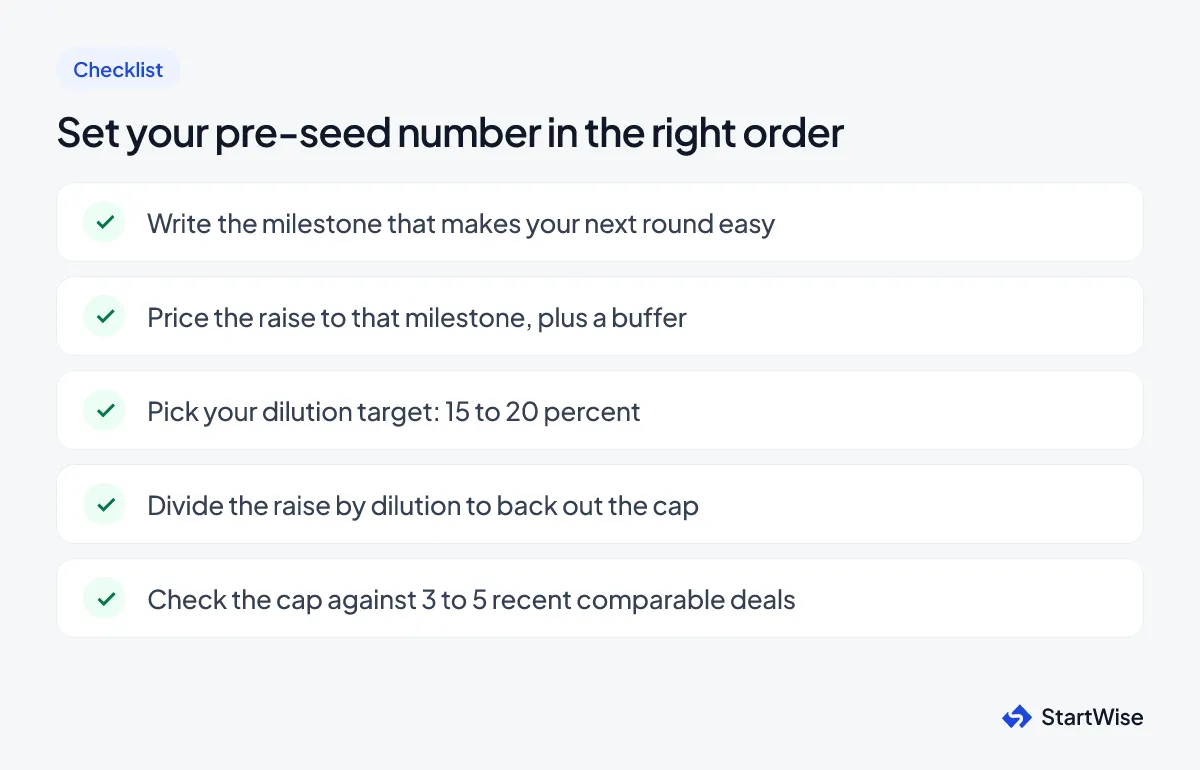
What to do this week
Set your number in order, starting from the milestone and ending at the cap. This is the sequence we walk founders through before they ever name a figure:
- Write your milestone first: the one proof point that makes your next round easy, like “$30K MRR” or “a signed pilot with a logo investors recognize.”
- Price the raise to that milestone, plus a buffer. That’s the amount you’re raising.
- Pick your dilution target. At pre-seed, 15% to 20% is the band to stay inside.
- Divide the raise by the dilution to back out your cap, then sanity-check it against 3 to 5 recent deals in your space and stage.
- Make sure your deck earns that number. The cap is a claim; the deck is the evidence.
Set the number in that order and it holds up when an investor pushes on it. Set it backwards, starting from a cap you liked the sound of, and you’ll spend the whole raise defending a figure you picked out of thin air. For the full sequence around this, see how to raise a pre-seed round.
