 By
A demo day pitch deck is the deck you present at an accelerator’s demo day, where you pitch to a room of investors in a slot that often lasts a single minute. Most guides hand you one six-slide template and call it done. That’s the mistake we flag most with founders prepping to pitch.
Because it isn’t one deck. It’s two. Y Combinator’s F26 demo day on December 2, 2026 drew about 1,500 investors and media, and almost none of them wrote a check that day. The money comes later, from the deck you’ll send after.
What is a demo day pitch deck?
A demo day pitch deck is two artifacts doing two different jobs. The first is the stage deck: six slides or fewer, built to survive a one-minute live pitch. The second is the send deck, the longer file you email to every investor who raises a hand afterward.
In the decks we review, founders build one deck and try to make it do both. It can’t.
The stage deck exists to earn a follow-up. The send deck exists to close one. They have different lengths, different depth, and different readers, so treating them as a single file is why so many strong companies pitch well and still struggle to convert the room into meetings.
If you’re deciding whether an accelerator is even worth the equity, start with whether the program fits your stage. This guide assumes you’re in and demo day is coming.
Stage deck vs send deck: what’s the difference?
The stage deck and the send deck differ on length, job, and reader. The stage deck is a backdrop for your voice. The send deck has to stand alone on an investor’s screen, where you’re not there to narrate it.
Here’s the split we coach founders through.
| Dimension | Stage deck | Send deck |
|---|---|---|
| Length | 6 slides or fewer | 9 to 16 slides |
| Job | Earn a meeting | Close the round |
| Read time | About one minute, live | About 3 minutes, alone |
| Reader | A skimming room | One investor, later |
| Design | One idea per slide, huge type | Readable detail, standalone |
The stage deck carries almost no text because you’re the voice-over. The send deck carries the detail the room never heard: the model, the market math, the team, the full ask.
Build the stage deck to open a door. Build the send deck to walk through it.
How long is a demo day pitch, and how many slides?
A demo day pitch usually runs one to three minutes, and the on-stage deck runs six slides or fewer. Y Combinator now caps live pitches at about one minute per company, down from an older format of a 2.5-minute slot with a 5 to 7 slide deck (Articuler). Many other accelerators give founders two to four minutes.
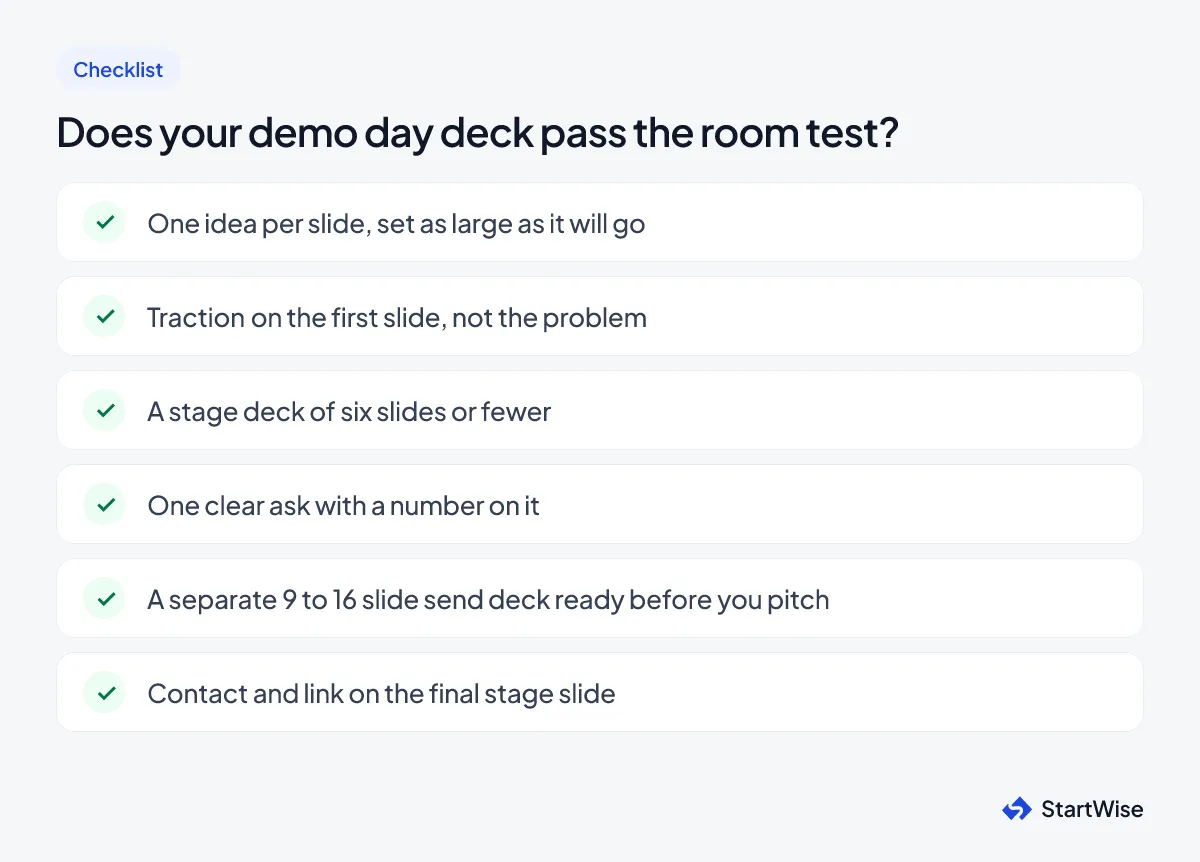
That slot is brutal math. We keep seeing founders bring a dense send deck to the stage, and the back row glazes over by slide two. One idea per slide, set as large as it goes, is the only format that reads from the back of a room.
~1 minute
how long YC now gives each company to pitch live on stage, in front of roughly 1,500 investors and media at its December 2026 demo day (Articuler, 2026)
When demo day moved online in March 2020, YC pushed the constraint even further: a single-slide summary, 200 companies pitching to 500-plus investors who browsed a gallery and skimmed (SketchDeck). One slide. That tells you how little room you have to make an impression.
The send deck is where length returns. It runs 9 to 16 slides, the range that covers 49% of all decks in Papermark’s 2024 analysis of 3,000 decks. For the full reasoning on that range, see how many slides a pitch deck should have.
What goes on the six stage slides?
The six stage slides are a tight sequence built to land one point at a time. Each slide holds a single idea, because a room skimming at speed can’t track two. SlideGMM’s template guide lands on the same six-slide, traction-first shape, and it’s the structure we’ve seen work.
- Traction: your clearest growth number, set huge. Lead here, not on the problem.
- What you do: one sentence on what you build and for whom, no feature list.
- Why now: the shift that makes this the moment, in a line.
- Market and model: how big the reachable market is and how you make money, compressed.
- Team: why this team, named by the scars that fit the problem, not by titles.
- The ask: how much you’re raising and what it buys, with a number on it.
That’s it. The elevator pitch you deliver over these slides is its own craft, and a sharp 30-second version is what carries the room when the slides are this bare.
Everything you want to add, the competitive detail, the full financials, the roadmap, goes in the send deck. On stage, it would just blur the one point each slide is there to make.
Why your stage deck should lead with traction
Your stage deck should open on traction because growth is the one signal an investor can judge while skimming 200 companies in a morning. A problem slide asks them to agree with your worldview. A traction slide hands them evidence. In a fast room, evidence wins.
This is the heart of it, so here’s our blunt take.
StartWise's position
After reviewing founder decks daily, our position is that a deck dies in the first 90 seconds of a skim, and a demo day deck is the purest version of that. You have one minute and a half-distracted room. Build for the skim first and the deep read second. If your opening slide needs a paragraph to make sense, it has already lost the row of investors checking their phones.
The data backs the instinct. Investors spend about 3.2 minutes on a full deck and 23 seconds on the first page (Papermark). On stage, the budget is tighter still.
If reading only your first slide doesn’t make an investor lean in, no slide behind it will.
So put your best number where their eyes land first. A traction slide that shows a steep, believable slope does more in two seconds than a problem statement does in twenty.
Not sure your deck survives a one-minute skim or buries the ask on slide five? Get a slide-by-slide read.
Where demo day decks go wrong
Demo day decks go wrong in a few repeatable ways we see every batch season, and the biggest is building only the stage deck. Founders pour a week into six perfect slides, nail the pitch, then they’ve got nothing polished to send when the follow-up requests land that night.
The second mistake is opening on the problem. It feels like storytelling. In a skimming room it reads as a delay before the number they actually want.
The third is cramming. Teams try to fit the market math, the model, and the roadmap onto six slides, and every slide turns into a wall nobody at the back can read. That detail isn’t cut, it’s just moved to the send deck where they’ll actually read it.
The fourth is a soft ask. “We’re raising to grow” wastes your last slide. Name the amount and the milestone it buys, the same way a strong ask slide ties the money to a bar that opens your next round.
Fix the first one and the rest get easier. Build both decks before you walk on stage.
What to do this week
Build both decks before demo day. Here’s the order we’d work in, so the follow-up never catches you empty.
- Draft the send deck first: 9 to 16 slides, standalone, the full story an investor reads alone.
- Cut it down to the six stage slides, one idea each, traction on slide one.
- Write the ask as a number tied to a milestone, not a vibe.
- Line up your follow-up plan now, because how fast you follow up decides how much of the room converts.
Demo day doesn’t close your round. It starts the sprint that does. Walk off stage with the send deck already in your outbox, and you turn a one-minute pitch into the meetings that actually fund you.
