 By
A hardware pitch deck is the deck a founder building a physical product uses to raise money, and it shares most of its slides with a software deck. The difference sits in three of them. Failory’s gallery of 21 hardware decks, with Ring, Peloton, and Dandelion Energy on the shelf, is a useful set of examples. It also stops at the shelf. None of these galleries explain what a hardware deck has to prove that a SaaS deck never does, and that gap is what we fix most often with the hardware founders whose decks we review.
What makes a hardware pitch deck different from a software deck?
A hardware pitch deck differs from a software deck on three slides, not the whole structure. Your problem and solution slides look much like any other pitch deck examples you’ve studied, and so do market and team. The raise moves on unit economics, manufacturing, and how you prove traction before a single unit ships.
Here’s the slide-by-slide difference we look for when a hardware deck lands in review.
| Slide | Software deck | Hardware startup deck |
|---|---|---|
| Unit economics | CAC, LTV, payback | Bill of materials, COGS, gross margin at scale |
| Traction | Users, revenue, retention | Pre-orders, LOIs, pilot runs, waitlist growth |
| Use of funds | Hiring and growth | Inventory, tooling, manufacturing partners |
| Risk | Churn and competition | Supply chain and manufacturing execution |
| Timeline | Ship weekly | 18-month roadmap to production |
The decks that stall reuse a SaaS template and leave those three slides generic. An investor reading hundreds of decks a quarter spots it fast. Papermark’s analysis of 3,000 shared decks found investors spend about 3.2 minutes on an average deck and only 23 seconds on the first page (Papermark, 2024-2025), so the hardware-specific case has to land quickly or not at all.
Which hardware startups have public pitch decks worth studying?
Several funded hardware startups have published the decks they raised on, and a handful reward a close read. The point isn’t to copy them. It’s to see how each one handled the three slides that matter.
- Ring raised a $4M Series A in 2014 for a connected doorbell, years before Amazon acquired it.
- Peloton closed a $400K seed in 2012 on connected fitness hardware paired with a content subscription, the model that carried the business.
- Dandelion Energy raised a $70M Series B in 2022 for home geothermal, a capital-heavy install business.
- Minut published its full $14M Series B deck in 2022 for a privacy-first home sensor.
You can read most of these in Failory’s hardware deck gallery, and Minut’s deck sits in full on TechCrunch. One caution we give every founder studying later-stage decks: copy the structure, not the stage. A Series B deck carries metrics a pre-seed deck can’t, so lift the slide logic and leave the numbers. If you’re earlier, our annotated pre-seed pitch deck examples show what belongs on the deck when you have less to point at.
How do you show unit economics and margin on a hardware deck?
Unit economics on a hardware deck means one thing to investors: a bill of materials and a credible path to gross margin at scale. A bill of materials, or BOM, lists every component, its supplier, and its cost at volume breaks like 1,000 and 10,000 units. It’s the slide software founders never build, and the one hardware founders most often bury.
Pitch Protocol puts it plainly: show bill-of-materials cost and gross margin at scale, not just at prototype stage, with an itemized path from today’s costs to target unit economics at real production volume. Your prototype margin is almost always ugly. That’s fine. What an investor funds is the slope from ugly to healthy, and the specific cost reductions that get you there as volume climbs.
Common mistake
Budgeting hardware like software. Analogy Design recommends adding roughly a 30% contingency to every line of your development budget, because tooling, certification, and manufacturing runs almost always come in over plan (Analogy Design, 2026).
This is also where your financials slide earns its place. Tie the BOM to the model so the margin story and the money story agree. When they don’t, we see investors stop reading.
What counts as traction before you can ship?
Traction before shipping is the slide hardware founders get most wrong, because there’s no revenue to point at yet. So they reach for the biggest number they have. A pre-order total. A waitlist count. A Kickstarter figure. On its own, none of it moves an investor.
A pre-order count is a photo. Investors want the film: how fast it’s growing, and why.
StartWise's position
Traction before shipping is a slope, not a number. A pre-order or waitlist total tells an investor almost nothing on its own. The growth rate, plus a believable reason it keeps climbing, is the signal they fund. We keep seeing founders lead with "12,000 signups" when "reservations doubling month over month at a $40 cost per sign-up" is the far stronger slide.
The good news is that soft signals count when you show the mechanism behind them. In the decks we review, the pre-launch traction slides that land pair every soft signal with the reason it’s growing. Analogy Design’s funding guide treats a landing page converting at 10% or higher as a warm market, and points to 30 to 50 in-depth customer interviews as proof the pain is real (Analogy Design, 2026). Pair those with a short pilot and you have a traction slide that works pre-launch. For the structure of the slide itself, our traction slide guide applies directly, hardware or not.
Not sure your margin and traction slides make the hardware case or read like a SaaS deck? Get a slide-by-slide read.
How much should a hardware startup raise, and how do you show use of funds?
Hardware startups raise more than software startups at the same stage, and the deck has to justify every extra dollar. Hardware seed rounds typically run $3-5M, with Series A around $12-20M, because the money funds inventory, tooling, and manufacturing partners before real revenue (Ellty, 2026). San Francisco hardware companies alone raised $8.3B across 240+ deals in 2025.
That capital is also concentrating. In Q3 2026, 80 semiconductor and deep-tech startups raised $8.5B, but nearly $7.5B of it went to just 22 companies raising $100M or more (Semiconductor Engineering, 2026). The money at the top is huge. For everyone below it, capital efficiency is the whole pitch, which is why your use-of-funds slide can’t read like a software deck’s “hiring and growth” line.
Make it a milestone map instead. The use-of-funds slides we send back most carry a dollar figure with no milestone attached. Analogy Design describes an 18-month roadmap moving through design freeze to a pilot run of 50 to 200 units by month six, then toward commercial launch. Map each tranche of the raise to one of those de-risking events:
- One tranche to a design freeze and a working engineering prototype
- One to tooling and a pilot run of 50 to 200 units
- One to a signed manufacturing partner and the first production batch
“This round gets us to a tooled pilot and a signed manufacturing partner” is an ask. A round of capital against a vague growth plan is wallpaper.
What do investors scrutinize most in a hardware deck?
Investors scrutinize manufacturing and supply-chain risk hardest, because those are failure modes software never has. Pitch Protocol notes that they look for your specific supply-chain dependencies and single points of failure, a clear line between what’s proven at pilot scale versus what’s still assumed, and whether anyone on the team has genuine manufacturing and operations experience.
That last point does quiet work. A hardware deck with a software-only team reads as risk, no matter how good the industrial design looks. I’d put a named manufacturing lead or a credible advisor on the team slide before polishing any other part of the deck.
Length still matters here too. Keep the whole thing in the 9 to 16 slide band that investors expect; the hardware-specific depth belongs in an appendix, not the main flow.
What to do this week
Start by auditing your deck against the three slides that carry a hardware raise, then fix them in the order we’d tackle them in a review, worst damage first.
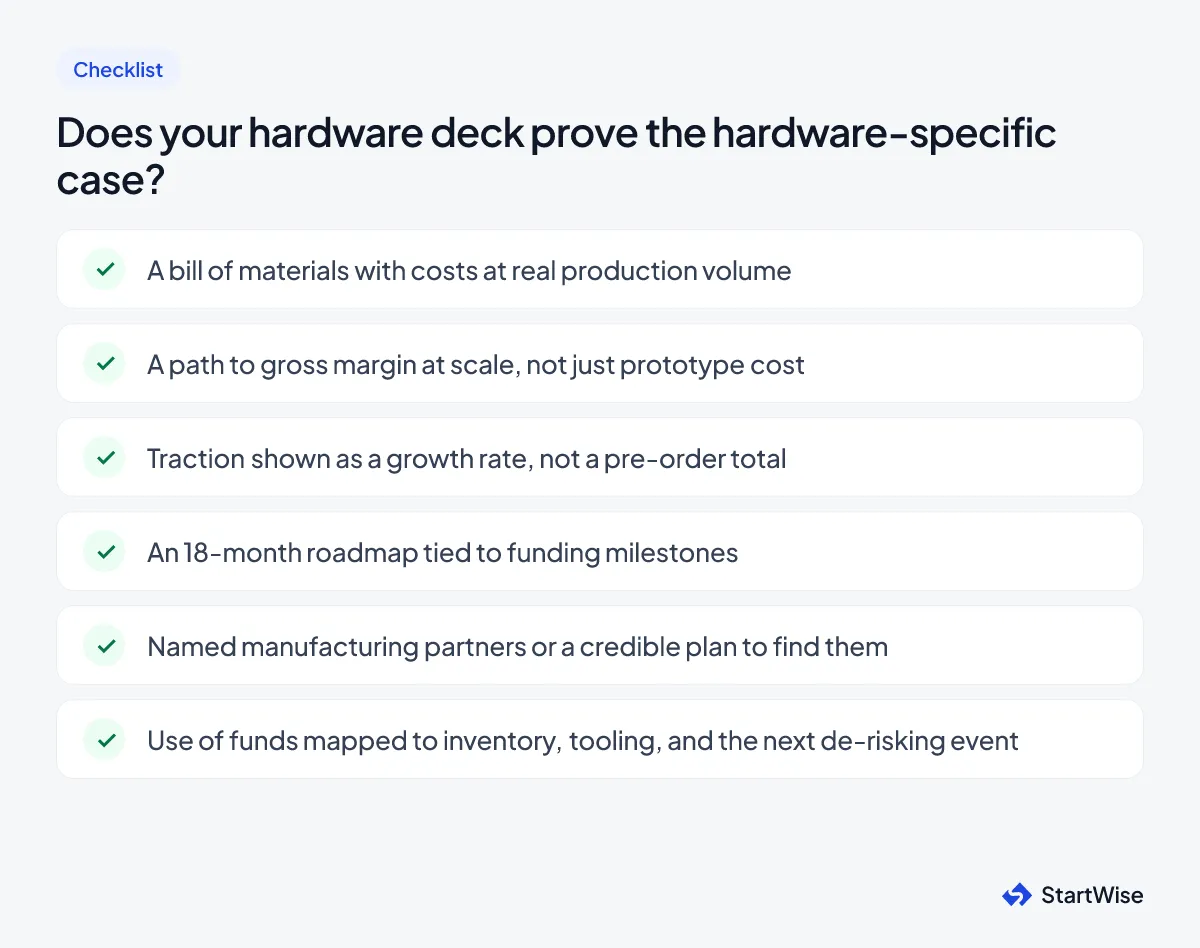
- Build the real BOM. One row per component, with costs at 1,000 and 10,000 units, and the margin that falls out at each volume.
- Rewrite the traction slide as a rate. Replace every total with a growth number and the mechanism driving it.
- Turn use of funds into a milestone map, with each tranche tied to a pilot, a tooling step, or a signed partner.
- Put manufacturing experience on the team slide, or name the advisor who brings it.
Do those four and your deck stops reading like a SaaS template with a gadget inside. Want a second read before you send it? That’s exactly what the check below does.
