 By
A pitch deck outline is the running order of slides that carries an investor from your problem to your ask. Most decks lean on the same twelve: cover, problem, solution, why now, market, product, traction, business model, competition, go-to-market, team, and the ask. We review founder decks before they go out, and the order trips people up more than the words on any single slide. DocSend’s viewer data shows investors now spend under three minutes on a deck. So the sequence has to do the work your voice can’t.
What goes in a pitch deck outline, slide by slide?
A pitch deck outline, slide by slide, is twelve slides in a deliberate order, each one answering the question the slide before it raised. Think of it as four short arguments stacked up: the problem is worth solving, you can win it, the model pays, and the money buys a specific next step. Sandy Kory of Horizon Partners recommends ten to fifteen slides, and Guy Kawasaki’s old 10/20/30 rule put the live ceiling near ten. Most pre-seed decks land at ten to twelve. Here’s the running order, and the one job each slide has to do.
| # | Slide | The one job | What we flag in review |
|---|---|---|---|
| 1 | Cover | Name, one line on what you do, the round | A tagline nobody can decode |
| 2 | Problem | The pain, who feels it, how often | A problem the investor must be taught to care about |
| 3 | Solution | Your answer and why it works | Features listed before the outcome |
| 4 | Why now | The shift that makes this buildable today | No reason this couldn’t exist in 2019 |
| 5 | Market | A bottom-up count of reachable customers | A trillion-dollar TAM with no path to it |
| 6 | Product | What it does, shown not told | A wall of text where a screenshot belongs |
| 7 | Traction | Direction and speed, with dates | A vanity total with no slope |
| 8 | Business model | How one customer makes you money | Pricing that appears for the first time here |
| 9 | Competition | Honest alternatives and your wedge | An empty quadrant claiming no rivals |
| 10 | Go-to-market | The channel you’ve actually tested | Five channels, none proven |
| 11 | Team | Why this team, not a credential list | A logo parade with no relevant scars |
| 12 | The ask | An amount tied to a milestone | A number with no use of funds |
That order isn’t sacred, and the back half especially moves around. But it’s the default that reads fastest, and each slide here has its own deep guide if you want slide-level detail. Start with how many slides a deck needs if you’re still fighting the length question.
Why does the order of your pitch deck slides matter?
The order of your pitch deck slides matters because investors skim before they read, and a skim follows the titles from top to bottom. If your titles don’t tell the story on their own, the deck fails on the first pass, no matter how sharp slide seven is. DocSend’s data backs this hard: successful decks skip the table-of-contents slide entirely and move product and why-now earlier, jumping straight into the narrative. A typical deck runs about 50 words a slide across roughly 20 pages, so there isn’t room to bury the point and hope it surfaces later.
StartWise's position
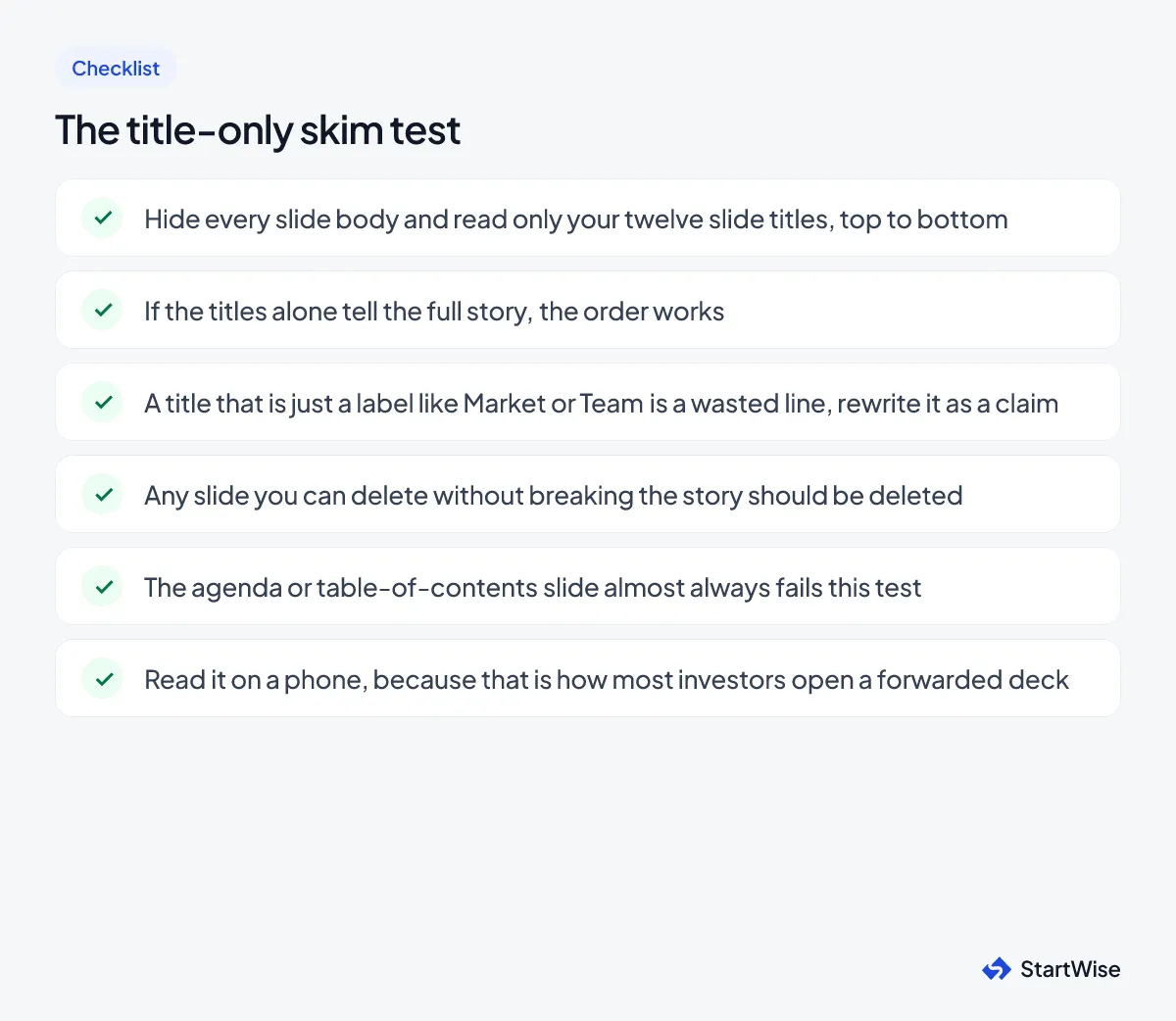
Decks die in the first ninety seconds of a skim. Build for the skim first and the deep read second: if reading only your slide titles, in order, tells the whole story, the deck passes. Most founders write the bodies first and the titles last, which is backwards. The title is the slide.
We run this test on every deck we review. Lay the twelve titles out with the bodies hidden, and read down the list.
An investor reads your titles in order. They almost never read your body copy. Write the outline for that reader first.
When the titles read like a sentence, you’ve got an outline. When they read like a filing cabinet, you’ve got slides in a pile.
The first four slides: cover, problem, solution, why now
The first four slides set up the whole pitch and earn you the rest of the time. Get them wrong and nothing after slide four gets read, because this is exactly where DocSend’s successful decks spend their attention. Your cover slide is a name, a one-line description, and the round you’re raising, nothing more. The problem slide names a pain the investor already believes in. If you have to teach them to care, you’ve started two slides too early.
Then the solution slide answers that exact problem and resists the urge to list every feature you’ve shipped. The why-now slide is the one most pre-seed founders skip, and it’s the one I’d fight to keep. It answers why this is buildable today and wasn’t in 2019: a new model, a rule change, a behavior that flipped.
Without it, you’re a good idea with no clock on it.
The middle four slides: market, product, traction, model
The middle four slides prove the opportunity is real and winnable: market, product, traction, and business model. This is where founders either show evidence or start bluffing, and an investor spots the difference fast. Your market slide should be a bottom-up count, reachable customers times what they’ll pay, not a trillion-dollar TAM lifted from a research report. The product slide shows the thing working, a screenshot or a short flow, because a described product and a real one look identical in text.
Traction is the slide that moves the most. Show the slope, not the total: week-over-week or month-over-month direction, with dates on it. Then the business model slide says how one customer makes you money, with pricing that didn’t appear out of nowhere.
We flag it constantly: the price shows up here for the first time and quietly contradicts the market math three slides back.
The last four slides: competition, go-to-market, team, ask
The last four slides close the argument: competition, go-to-market, team, and the ask. By now the investor is deciding, so these have to resolve doubt instead of raising it. The competition slide names real alternatives, including “they do nothing today,” and draws your wedge honestly. An empty quadrant where you sit alone reads as naivety, not dominance. Your go-to-market slide names the one channel you’ve actually tested, not five you hope might work.
Then the team slide answers why you specifically, which we’ll come back to in a second. The ask is a number tied to a milestone. “$500K for eighteen months of runway to reach $50K MRR” is an ask; “$500K to accelerate growth” is wallpaper. If you carry financials, they sit here near the ask, and a roadmap slide is optional appendix material, not one of the core twelve. Keep the count honest: seed decks average 14 slides and Series A decks 18 (Waveup, 2026), and the 2026 seed median round was about $4.5M (Carta), so a pre-seed deck pushing twenty slides is padding.
Not sure your outline tells the story in order? See what a reviewer flags on each slide before an investor does, free and in minutes.
Where should the team slide go in the order?
The team slide usually sits eleventh, and it’s still the most argued-over slide in the whole outline. One VC guide places the team slide eighth while calling it the slide that decides the round (Value Add VC). Other coaches push it to slide two or three so investors meet the founders first.
Both can be right, and the deciding factor is simple.
Move the team slide early only when the team is the story. If you’re repeat founders who sold the last company, or you’ve spent ten years inside the exact problem, lead with it, because that’s your strongest card. If your team’s edge is “we’re sharp and we care,” which describes every founder alive, keep it in its default late slot where it supports the case rather than overpromising on slide two. My honest take: most first-time founders should leave it at eleven and spend the saved energy sharpening the problem slide.
How is a cold-email outline different from a live pitch?
A cold-email outline and a live-pitch outline are not the same deck, and treating them as one is a quiet, common mistake. The emailed deck travels without you, so it has to stand on its own. No voiceover fills the gaps, and every title has to land cold. The live deck can lean on what you say out loud, so it runs leaner and more visual. We review far more emailed decks than live ones, and the emailed ones fail more often on exactly this.
For the cold deck, three moves matter, and they all trace back to the skim:
- Cut the agenda slide. DocSend found successful decks skip the table of contents and open on the problem, because a reader who gave you three minutes doesn’t want slide two to be a menu.
- Lead harder on problem and traction, the two slides most likely to survive a forward to a partner’s inbox.
- Make the title-only story legible on a phone, since that’s where most decks actually get opened.
If you’re weighing how the deck reaches people, the storytelling and sequencing choices matter more than the design does.
0
The number of table-of-contents slides on a winning emailed deck. DocSend found successful decks skip the agenda and open on the problem, because a menu slide spends attention you don't have. DocSend pitch deck research, Dropbox
What to do this week
You can fix an outline in an afternoon, and it’s the highest-return hour you’ll spend on the deck. The founders we see get meetings fastest aren’t the ones with the prettiest slides. They’re the ones whose titles, read alone, already make the case.
- Lay out all twelve slides as titles only, in the default order above, with the bodies hidden.
- Read the titles top to bottom. If they don’t tell the story, rewrite each title into a claim, not a label.
- Delete any slide you can remove without breaking the story, starting with the agenda slide.
- Move the team slide early only if your team is genuinely the reason to invest.
- Make two versions: a lean live deck, and a stand-alone emailed one that opens on the problem.
Then send the emailed version to one honest friend and ask them to tell you the story back from the titles alone. If they can’t, your reader won’t either. Want a reference point first? Study a few annotated pre-seed deck examples and watch how the order carries each one.
