 By
Turning an idea into a startup is a sequence of cheap tests, run in order, where each step earns the money and time the next one costs. The order matters more than the steps. Most first-time founders already know the pieces: validate, plan, build, pitch, raise. They just run them in the wrong sequence, usually building or raising before they have proof anyone wants the thing. Of 431 startups that shut down since 2023, poor product-market fit showed up in 43% of the failures (CB Insights, 2026). Start with the test that kills that risk.
What does turning an idea into a startup actually involve?
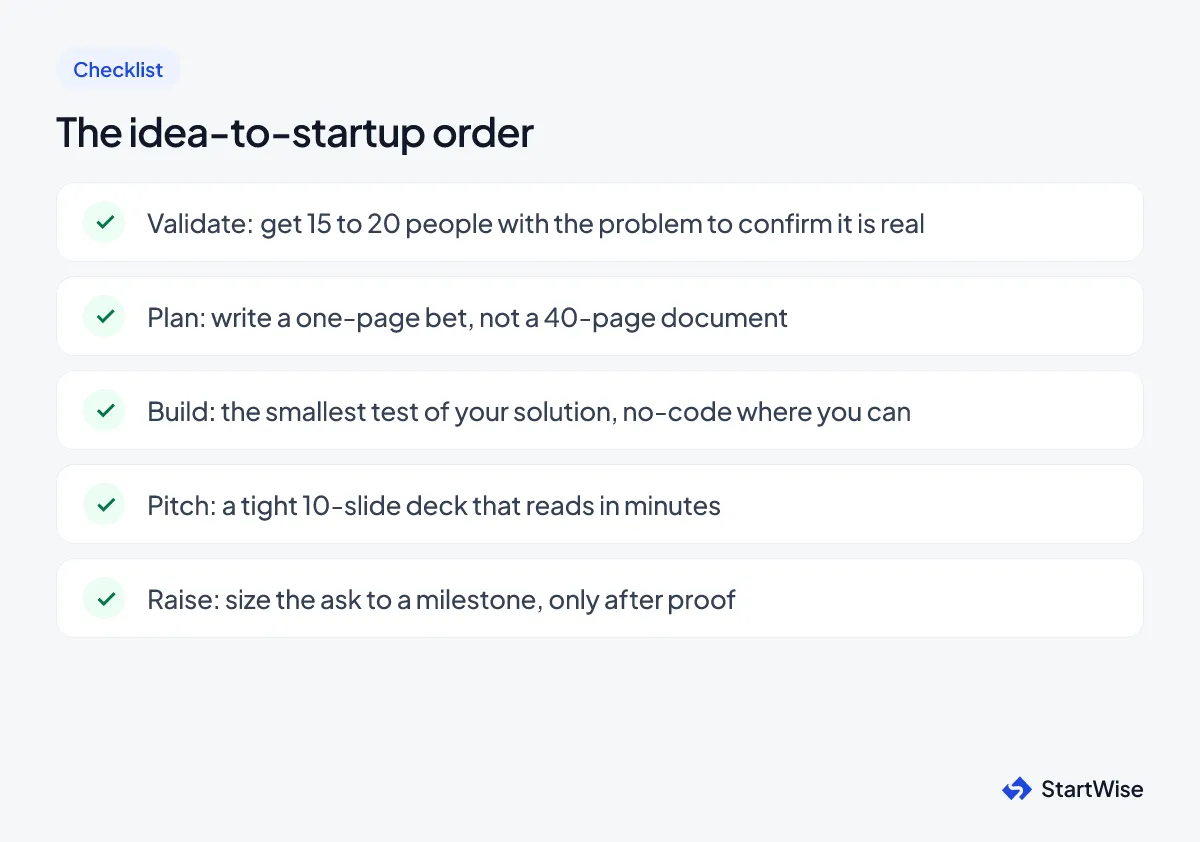
Turning an idea into a startup involves five moves in a fixed order: validate the problem, size a market you can reach, build the smallest thing that tests your bet, package it as a deck, then raise. Skip a stage and the later ones cost more, because you end up paying to learn what an earlier test would have told you for free. The order is the product, not the list of steps.
| Stage | The question it answers | Cheapest evidence | What to skip |
|---|---|---|---|
| Validate | Does anyone actually need this? | 20 problem interviews, a waitlist | A build, a 40-page plan |
| Market | Can you reach enough of them? | A bottoms-up year-one customer count | Trillion-dollar TAM slides |
| Build | Does the solution work for them? | A manual or no-code MVP | Full engineering, early hires |
| Pitch | Can you tell it in minutes? | A tight 10-slide deck | Polish, animations |
| Raise | Will this hit a fundable milestone? | A milestone-sized ask | Raising before proof |
Build before you validate and you’ve just bought an expensive way to learn you were wrong.
We review decks every week, and the weak ones almost always trace back to a skipped stage. A beautiful product, zero evidence anyone wanted it.
The order isn’t arbitrary. Each stage produces the evidence the next one needs to be worth doing. Validation gives you the problem a deck can open with, and a reachable market gives the ask a number. Skip a step and you’re guessing where you should be proving.
Validate the problem before you build anything
Validation means getting evidence that a real group of people has the problem you think they have, before you spend a line of code or a dollar on solving it. The cheapest version is conversation. Twenty honest problem interviews with people in your target group will teach you more than six months of building alone in a room, because you hear the problem in their words instead of yours.
Poor product-market fit sank 43% of the failed startups CB Insights studied in 2026, and bad timing another 29%. You can’t fix either from inside a codebase. There are concrete ways to validate a startup idea without building anything:
- Problem interviews: 15 to 20 people who have the pain, no pitching
- A fake-door or waitlist page to measure real sign-up intent
- A letter of intent or a pre-order from one or two buyers
Here’s my honest take. If you can’t find 20 people who will give you 15 minutes about the problem, that’s your answer. The problem isn’t painful enough to build a company on. The pattern we keep seeing in the review room is simple: founders who talked to customers first write sharper problem slides, because the language is the customer’s.
One more thing we keep seeing. Founders treat validation as a box to tick, then never go back to it. Keep talking to users as the idea shifts, because the problem you start with is rarely the one you end up solving.
Do you need a business plan at the idea stage?
You don’t need a formal business plan at the idea stage, and writing a 40-page one is usually wasted motion. Investors at pre-seed read a deck in about 3.2 minutes (Papermark, 2024-2025), not a bound document. What you want instead is a one-page bet you can defend to a stranger in a minute:
- The problem and who has it, one sentence each
- Your solution, and why now
- The market you can realistically reach in year one
- How you make money
- What the next 12 months of work buys
If a funder or an accelerator asks for a longer document, a business plan built for a tech startup stays lean and venture-shaped rather than SBA-shaped. Keep it to one page on purpose. A longer document mostly hides the weak parts, and the weak parts are exactly what you need to see early. My honest take, after reading hundreds of fundraising documents: a one-pager a stranger gets in 60 seconds beats a thick plan every time.
Common mistake
Founders still burn weeks on a 40-page plan no investor finishes. The median deck gets 3.2 minutes of attention (Papermark, 2024-2025). Write for the skim, not the shelf.
When should you build an MVP?
Build an MVP once validation says the problem is real and you know roughly who pays, not before. The point of a minimum viable product is to test whether your solution actually solves the problem for real users, so building it before you’ve confirmed the problem tests nothing. Plenty of ideas never need custom code to make the point.
The smallest test is often you, doing the thing by hand. A concierge MVP means you deliver the service manually for the first ten customers before you automate a single step. It feels slow. It’s also the fastest way to learn what to build, because you watch the problem up close instead of guessing at features from a backlog.
A spreadsheet, a Figma click-through, or a no-code build often answers the question in a weekend instead of a quarter. Running out of capital ended 70% of the startups in that CB Insights sample, and the fastest way to run out is to build big before you’ve proven small. We’ve written about what an MVP actually costs once you strip it to the test.
We see this in decks constantly. A polished product slide, and nothing behind it to show the thing on it was ever wanted.
Not sure the idea survives contact with an investor? Score it free before you build.
How big does your market really need to be?
Your market needs to be big enough that a reachable slice of it, in year one, can support a real business, and that’s a smaller and harder number than the billion-dollar total everyone drops on a slide. A huge total addressable market doesn’t save you from a market that won’t actually buy. Poor product-market fit, again, sank 43% of the failures CB Insights tracked in 2026.
StartWise's position
Most market-size slides are theater. A bottoms-up count of the customers you can actually reach in year one tells an investor more than any trillion-dollar TAM. If your SAM math can't survive a napkin check, it's hurting you. That's our view after reviewing decks daily.
The TAM, SAM, SOM breakdown only helps if your SOM is a count you can defend on a napkin. A bottoms-up count is boring arithmetic, and that’s exactly why it works. Start from the buyers you can name or reach through one channel, multiply by what they would realistically pay, and stop there. If that first-year number is too small to matter, a trillion-dollar headline won’t save it. If it’s big enough, you don’t need the headline at all.
Count, don’t dream. We flag inflated market slides all the time, and a bottoms-up number earns trust far faster than a top-down trillion ever does.
What investors expect before they fund an idea
Investors at pre-seed expect enough evidence to believe the next 18 months will reach a milestone worth more money, delivered in a deck they can skim fast. They give the first slide about 23 seconds and the whole deck around 3.2 minutes (Papermark, 2024-2025). Your slide titles have to carry the story on their own, because that skim is the real read. We go through these the same way they do, fast and skeptical, and the decks that survive are the ones built for the skim.
Investors don’t fund ideas. They fund evidence that an idea is becoming a business.
Pre-seed rounds now run a median near $500K on a SAFE with a $10M to $15M valuation cap, for roughly 19% to 20% dilution (Carta, Q1 2026, via Value Add VC). A SAFE is a simple agreement that converts to equity later, so your cap is a ceiling, not a price. Size the ask to a milestone, not a round number.
A fundable milestone is a specific number that de-risks the next round, whether that’s early revenue, a waitlist that converts, or a usage curve that bends up. Raising $500K to reach $25K in monthly revenue is an ask. Raising $500K to grow is wallpaper. The sharper the milestone, the easier the money is to justify, because the investor can picture exactly what their check buys.
Before any of it, decide whether you should raise at all. Plenty of good businesses shouldn’t take venture money. If the answer is yes, the pre-seed raise itself runs on its own playbook. Most decks land in the 9 to 16 slide range for a reason: that’s the length that gets read.
Turn your idea into a startup this week
This week, don’t build. Pick the one stage you’ve skipped and close it with the cheapest test you have:
- List 15 people who have the problem and book three calls. Ask about the problem, never your solution.
- Write the one-page bet: problem, who has it, your reachable year-one market, and how you make money.
- If the problem is real, scope the smallest test of your solution, a no-code build or a click-through, not a hire.
- Only then draft a 10-slide deck, and size any ask to a milestone.
The founders we review who move in this order waste far less money, because every stage is paid for by the one before it. The order is the product. Earn each step, and the next one gets cheaper to reach.
